Ginger Baker: “Philly” Joe Jones said, “Man, You Tell a Story”

SKF NOTE: A snippet from Jim Clash’s four-part interview with Ginger Baker for Forbes magazine.

JUN 16, 2015 @ 9:52 PM
Cream Drummer Ginger Baker’s Early Influences, How He Kicked Heroin Habit
Jim Clash CONTRIBUTOR

Ginger Baker

Ginger Baker

Jim Clash: You are a jazz drummer at heart. Name some of the greats who you have met and/or played with.

Ginger Baker: I’ve played with Art Blakey, a totally unrehearsed thing in Munich in 1972. I’ve played with Elvin Jones. One of the nicest compliments I’ve ever had was from “Philly” Joe Jones when he heard me play. He said, “Man, you tell a story.” There was also playing in Nigeria and getting the whole audience on their feet!

JC: I know people here in America who consider you the best of all time.

GB: I wouldn’t quite say that. I think I’m one of them, for sure. I had my own thing, which Phil Seamen had, which Art Blakey had. When you hear them playing, you know who it is. Max Roach, “Philly” Joe Jones, Elvin Jones. It goes back to “Papa” Jo Jones and [Warren] Baby Dodds. All of these guys had a huge influence on me, but I didn’t copy them. Probably the biggest influence was Phil Seamen. He was God. He heard me play one night and said afterward, “Sit down, I want to talk to you. You’re the only drummer I know who’s got it.”

Full Story

Posted in Drum/Music News | Tagged , , , , , | Leave a comment

John Von Ohlen: Some Best Moments in Drumming Have Been the Simplest

SKF NOTE: Indianapolis music teacher Bob Phillips, who John Von Ohlen mentions in this post, is, John says, “the guy who really taught me music.” Mr. Phillips and the back story to this 1985 Modern Drummer interview are explained here. Learn more about Mr. Von Ohlen’s current drumming on The Blue Wisp Big Band web site.

Scott K Fish: I’ve heard many favorable comments about the Stan Kenton Clinics. What were you expected to do there? How did you feel about doing them?

John Von Ohlen

John Von Ohlen

John Von Ohlen: Well, they were wonderful experiences. There was only one thing that might have been a detiment: Teaching should be done by someone who knows. Well, hell! We were going into all these clinics, and alot of guys in the band were just learning themselves. But we were put into teaching positions. The kids looked up to us because we were with a nationwide touring band.

So you’re spouting out all this crap that is probably erroneous. I was guilty of that sometimes, but there were guys in the band who were in alot worse shape than I was and they were giving dissertations that were wrong. They were into brawn: How to play loud and nothing else.

What the hell kind of clinic is that?

I always stressed that drummers shouldn’t take it too seriously and should relax. Keep your physical body as relaxed as possible while you’re playing. Right away you get a better sound, and your time will probably be better because you are relaxed and free in your mind.

Everytime you get a bunch of drummers together they’re so serious. They’re thinking about all of this crap they’ve got to do because of all these heavy drummers around the country.

Man, some of the best moments in drumming have been the simplest little things.

Don’t worry about trying to be complicated. Bob Phillips use to tell me, “John, if you never remember anything else I ever say, don’t be afraid to play simple. Don’t be ashamed to play simple.”

I like to play as complicated as the next guy, but you don’t have to do that. Your base should be a simple perspective.

Harvey Mason can play complicated, but he lays down some pretty simple things. But it’s got that feel on it – so, what the hell! You don’t need to do much when you’ve got the feel. Why blow the feel for some brainy idea?

end

SKF NOTE: A DrumForum.org user asked about John’s severe snare drum angle in the photo accompanying this post. Here is my reply:

I spoke yesterday afternoon (6/22/15) by phone with John Von Ohlen. He told me he uses the severe snare angle for playing Bebop and small group gigs. It enables him to get certain left hand rim hits and shots he can’t get when his snare is at a flatter angle. That is, when John is playing in a situation where he most often is using his left hand only on his snare drum – he likes the severe angle. The snare drum, he said, “looks like it’s going to slide off the snare stand!”

But, John said, “That’s not the way to play.”

In situations where a drummer will be using his or her right hand on the snare — use a less severe angle.

And thank you, Joe Gaudio, for reconnecting me with John Von Ohlen.

Best, skf

Posted in SKF Blog | Tagged , , , , | 3 Comments

Gary Chester’s Drum Setup

SKF NOTE: On May 22, 2015 I posted two pages of photos of Gary Chester at a studio recording session from a book Gary co-wrote with Charles “Charley” Perry called, “The Popular Rock Drummer.”

These two pages from the same book are of historical interest. Example, Gary tunes his bass drum, in part, by filling inside the drum halfway with “rolled balls of newspaper.”

Click on the pics for full size versions.

152005_garychester_buddy_0001

152005_garychester_buddy_0002

Posted in SKF Blog | Tagged , , , , | Leave a comment

Freddie Gruber: In the Final Analysis, You Are the Instrument

SKF NOTE: I post this, with hesitation, because it is a glimpse at Freddie Gruber as drum teacher. As such, it probably belongs in the public square. But it doesn’t show my drumming skill in the best light. Oh well.

I spent part of several days with Freddie Gruber in New York City. A fascinating, non-stop talker, I enjoyed our time together. But our prime goal was to have me interview Freddie for Modern Drummer. Much easier said than done. The back story is here

In brief, on our last day together I was able to persuade Freddie to let me tape our conversation, which became the basis for his MD article. At one point I asked Freddie, “Let’s say I come to you for a drum lesson. I walk in your door and introduce myself. Where does it go from there?”

After talking for a few minutes about how he’d approach our first drum lesson, I asked Freddie to show me. And he did.

We were sitting across from each other at a formica top kitchen table in Buddy Rich’s New York City apartment. Was I nervous? You bet. I played a double-stroke roll on a magazine placed on the kitchen table. Then, at Freddie’s request, I played a double-stroke roll on the formica table top.

I wish I could say Freddie’s reaction was, “Wow!” It wasn’t. Here is exactly what Freddie Gruber said during my “first drum lesson.” He instructed me to relax and not think about what I was doing.

glry28-093Freddie Gruber: Okay. You responded differently to this harder surface with another sound than you were playing on the magazine.

You’re the instrument. In the final analysis you are the instrument. The instrument you are sitting behind is just an extension of you and what you hear and feel.

Something changed when you played on another surface.

Let’s do it again.

[SKF NOTE: I again play a double-stroke roll on the table top.]

Freddie Gruber: Okay. You can hear that the strokes are not as even as they were on the magazine. You’ve backed off a little because the sound of the table is harder. In other words, it discloses more of what you’re doing. It hides less.

So you’ve backed off a little, which only means that you got mildly apprehensive. So we dismiss that. It doesn’t really count. We’ll try to get relaxed and we’ll do it again.

[SKF NOTE: Again I play a double-stroke roll on the table top.]

Freddie Gruber: Okay. On the left hand, the first stroke of the double-stroke was much louder, and the second one came down as a rebound.

The right hand was following the left hand. It was just hanging there limp and just playing a little rebound. Whereas, the left hand was actually playing the more aggressive lead.

So in technical terms it means, simply, that it’s uneven. One hand is different than the other. And if we’re talking technically, one hand should be able to do what the other can do.

Freddie-Gruber3We’re not talking about sitting down and playing music now. We’re not talking about swinging. We’re not talking about phrasing.

Technically speaking, that means that one of your hands is not matched to the other. And there’s a slim possibility that, sometime in your playing life, you might want to express something you’re hearing that might not come out because of the technical deficiency. And you find yourself saying, “I can’t get it out!”

Now this may or may not be relevant, because we’re sitting together for the first time, and you might not be doing what you can actually do. But I’m getting an opportunity to view what you’re doing at that moment, which gives me the opportunity to estimate where you’re at.

[SKF NOTE: I didn’t play again. Freddie finished up by explaining what his next step would be if I were actually a student sitting with him for the first time.]

Freddie Gruber: Then I’d try to instill some confidence and have him [play] again. I’d try to point out some bad habits, if they were in existence, where I could show you, very quickly, that you are not utilizing some fundamentally correct natural principles.

I’d make you aware that you could do what you’re doing, possibly better, and certainly alot easier. So when people ask you, “How’d you do that?” the best answer is “Easily.”

end

Posted in SKF Blog | Tagged , , , | Comments Off on Freddie Gruber: In the Final Analysis, You Are the Instrument

Tony Williams’s Drumset and the Nub of Great Drummers

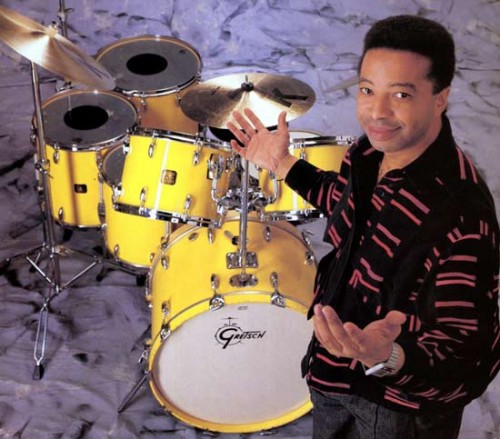
Driving Maine roads, listening for the first time to Tony Williams’s “Civilization” album. I think of a recent email concerning Tony’s yellow Gretsch drumset. The email includes a photo of Tony’s drumset assembled in a home basement.

Tony Williams

Tony Williams

The photo haunts me as if I’m seeing a close friend, an inspiration, dead in an open coffin. I think of my lifelong conflict with drummers putting so much emphasis on drum equipment. As if the nub of great drumming and drummers is made of wood, brass, or chrome.

I like drum equipment. Especially well-made, beautifully designed, great sounding drum equipment. And I confess to buying my Gretsch drumset because I liked how Gretsch drums sounded when my drum heroes played them.

But back when I was interviewing drummers for a living, I stopped asking equipment questions unless a drummer’s set included something unique. Bill Bruford‘s Simmons drums, for example. I was, and am, more interested in what makes drummers tick.

As Pamodhi Kuruppu said: “[O]ne drummer‘s style cannot be followed by another. It’s always different. Above everything when the drummer dies, the drum dies too.”

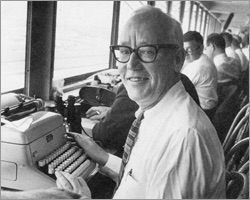
Red Smith

Red Smith

That is true of every tool used by great communicators of all types. No one will ever sit at Red Smith’s typewriter and write sports columns as Red Smith.

Tony Williams’s yellow Gretsch drumset is a tool through which Tony communicated to world. What’s gone is the spark, that life force that went from Tony, through his drumset and cymbals, to the world.

No one will ever again play this drumset and be Tony Williams.

end

Posted in SKF Blog | Tagged , , , , | Leave a comment