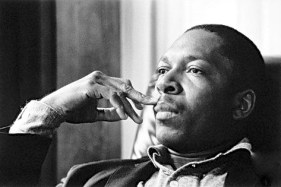
SKF NOTE: Somewhere — among my magazines, I think — there is a John Coltrane interview in which Coltrane’s how-to-listen-to-albums idea helps my ear training and gives me great joy. Maybe it will do the same for you.
John Coltrane told his interviewer if you really want to hear an album, listen to it once for each musician on the album so “you can hear what each man is doing.”
The one Milestones cut that is must listening for drummers is Billy Boy. The track is a trio date: Garland, Chambers, Jones. No horns. For as long as I can remember, this version of Billy Boy has been a model for trio drumming, for brush playing, and for creative drum soloing.
And not that Tony Williams’s opinion on what is at the apex of hard bop albums needs my agreement, but Milestones is a killer.
Now, I was reminded by two photos recently posted on The Great Drummer’s Group Facebook page of something that amazed me when I first studied the same photos, years ago, in the Milestones CD booklet.
These photos were taken during the Milestones recording session. They show Philly Joe on a three-piece drumset with just one ride cymbal and a hi-hat. A music stand is positioned where his small tom and crash cymbal would be.
Did Philly Joe really record the apex of hard bop albums with that three-piece drumset and one ride cymbal? I think so. I’ve re-listened to the album and come to that conclusion. Maybe an audio expert can prove otherwise.
But, I think what listeners hear on Milestones is the drumset shown in these photos. Take a listen to Billy Boy and see what I mean.
SKF NOTE: This is my original transcript which, in September 1983, was edited and published in Mix magazine. I was more disappointed in the editing of this transcript than anything else I had published. Re-reading the Mix version — which I’ve included at the end of the original transcript — it’s not as bad as I remember. I think I disliked the way the editor put words in my mouth.
This interview was done at Jimmy Webb’s home in upstate New York. As with other of my interviews between 1980-1983, this would not have happened without Jim Keltner.
Mama went to heaven in ’64 / I was alone in ’65 / A-layin’ in a cheap California hotel just trying to stay alive. / Trying to stay alive. / And the years went by and the money rolled in / And it came so easily / I almost forgot the original thought / My mama gave to me / God, my mama gave to me. / You gotta work for a dollar / To earn a dime, Jimmy / You gotta work for a dollar / To earn a dime / They’ll take it from you everytime.
These words from Work For A Dollar on Jimmy Webb‘s Angel Heart album are really a short autobiography. I spoke with Jimmy in February and we spoke about why he became a songwriter, they heyday of the early Webb classics, what he’s been doing recently and where he sees himself going.
The “key thing” that Jimmy Webb says pushed him “over the edge” of becoming a pro songwriter was an encounter with his music professor, Russell C. Baldwin. Webb was studying for a career in music education at San Bernardino Valley College when he was called into Baldwin’s office at the end of a semester.
Mr. Baldwin showed him his final exam grade on an original choral composition. It was an A-plus. But, Jimmy’s final semester grade was a D.
“You spend too much time in the practice rooms writing songs and you don’t do your homework,” Mr. Baldwin told him. “I think you’d be better suited for this dream you have of being a songwriter than you are for college. Why don’t you make the commitment and do it?”
With a loan of $1,000 and a used VW, Jimmy Webb moved to Hollywood. His first success came when Motown used his song, My Christmas Tree, on the Supremes Christmas album.
“And I use to do odds and ends for Motown,” Webb said. “I’d do lead sheets, write a song for Billy Eckstine, worked with Brenda Holloway, and while I was there I got my first chance to arrange.”
This was for a group of girls he’d gone to college with called The Contessas, at Bob Ross Music Service. “We did two songs with them and two songs with a guy named Don Ray Sampson. All the instruments were in concert because I did not trust my transposing ability. It was the first time I’d heard a playback with an arrangement I’d done and it really sound okay! That was one of the most incredible moments of my life.”
The Contessas
Later, while working with Johnny Rivers, Jimmy Webb became a rehearsal pianist for The Fifth Dimension when they were called The Versatiles. “Rivers left me with this group and said, ‘When I get back we really want to do this album.’
“I brought in this song called Up, Up and Away. They all liked it. Rivers said, ‘Well, that’s got to be the album title.’ One thing led to another. I just suddenly found myself in the studio. I was fortunate because people never tried to keep me out of the studio. I was just a studio kid.
At this time, Jimmy Webb was 19 years old. “I felt like a real greenhorn and didn’t feel all the time that I knew what I was doing. But, I knew what I wanted to hear. A lot has happened since then. I was just in a very formative stage. I wasn’t a street kid. I’d basically been either always on a farm or in a very small town; in the church or with my father or mother doing some religious music or something.
“Then school and then Hollywood. I should’ve taken my career a little more seriously and thought before I made some of the decisions I made. That’s easy to do when you’re 35 years old. It’s not easy when you’re 17.
“One of the biggest mistakes I made was I assumed I had a magic formula and anytime I wrote a song it was going to be a hit. Once the first three or four things I’d written were so successful, I thought, ‘Well, this is it. It’s the Second Coming and I’m it.’
“To simplify it, I would’ve just worked harder.”
In the early ’70s, Jimmy decided to grow from songwriter to singer/songwriter. He saw the music business “basically split into two parts. There was a socially responsive and politically sensitive part of the music business that dealt with the issues.
“The other side — the side that I saw myself basically associated with — was of a more purely entertaining form of music. As a songwriter for The Fifth Dimension, Glen Campbell, or Richard Harris, my horizon was limited. I didn’t want to be thought of as someone who wrote popcorn music, no matter how successful I was, no matter how much money I made. I made a conscious decision to stop it. I turned my back on a lot of money.
“I made the Words & Music album, got together a four-piece band and did bus tours, trying to chop out a niche as a serious artist, singer/songwriter.
“I didn’t gain a lot of acceptance. The people I played for, I always got a good reaction from. I improved as I went on, but seemingly I could never get past that initial change up from being pop songwriter to performer. I think it caused a backlash when people heard profanity in my lyrics or some outrageous social statement. They’d say, ‘What’s he trying to do? Who does he think he is? Why doesn’t he just go out and write a beautiful song?’
“It still isn’t easy. Angel Heart is the best album I’ve ever made. As my potentiality, chops, and concept of what I wanted to do improved — and as it became clearer to me who I was — the possibilities for success were declining because of tightening playlists and the general malaise of the recording industry.
“Even though my albums got better, the chances of getting a hit worsened.
“To stick around as a songwriter you have to put the idea of writing hit songs out of your mind. You have to write good songs. Then you have to match those songs with artists who have the capability of making them come alive, making them breathe, and giving life to them. If that turns out to be an album cut — fine. If the album turns out to be a hit — you make money and stay in the business.
“In any other business, if you couldn’t count on doing your thing at least once a year, how could you ever hope to be successful at it? Yet, I don’t think you could count on having a hit song once a year as a songwriter. You have to take up the slack somewhere else.
“In the years subsequent to my attempt to become an artist, I worked closely with artists to get album cuts. I wrote a weekly TV series called Seven Brides for Seven Brothers, essentially writing a song a week. I wrote a song about chili, a baby, politics, a mountain lion — off-the-wall projects, each one totally different and very challenging.
“This last year I had an animated feature out called The Last Unicorn. I wrote five songs for that and the underscore.
“I was very, very happy this last year because I accomplished a goal of being in three mediums at the same time: record, television, and theaters. That’s really the epitome of my philosophy of what it actually takes to be a songwriter and composer.
“I just do what I do. I don’t ever sit down to write a song that’s more complicated than someone elses. It has to be interesting and fun for me or I’d be doing something else. I like interesting chord changes. Even though I’m not always successful, I like to do something with a lyric that’s a little different.
“I always set a goal of originality to not write the same things I’ve or other people have written before. If I feel that happening I’ll start altering it to a degree that I’m happy with its originality.
“I could never be happy if I thought I was shamelessly copying somebody else, thinking, ‘I don’t care. This is going to be a hit.’
“Sometimes I think that hurts me. It drives me out of some of the more obvious simple approaches to the listener. Sometimes I actually hurt my chances of commercial success because I don’t let the thing progress in an obvious and expected way. It’s easier to walk down a road than it is to hike through the woods. But I don’t care. That’s the only way I have fun doing it, and that’s the way I always will do it. I’m not a songwriter just to make money. I put a lot more time into my songs than I use to. On the average, a couple of days.
“I’ve always liked key changes. I liked Burt Bacharach‘s music when I was first starting because it was interesting to listen to. I emulated him in certain ways. I always wanted interesting chords in my songs. Sometimes I’d just say, ‘Well, I know I can’t get out of this key, so I’m just going to go to this key.’
“Then the record would come out, like, The Worst That Could Happen, and some guy would say, ‘Man, that’s a wild change. How did you ever do that?’ Not realizing that it was just the pragmatics of ignorance.
“I’ve always been a great fan of Ralph Vaughn Williams and chordal composers in general. I love chord surprises. I’m probably more inclined in my soul toward folk tunes, Irish tunes, and country tunes, than anything else. That’s where I’m really comfortable. The Moon’s A Harsh Mistress is a folk tune. I probably wrote that song in a half hour because it’s the kind of thing that comes real natural to me.”
On his first albums, and also on Richard Harris’s, A Tramp Shining, Jimmy Webb is listed as writer, arranger and composer. On each successive album he’s gotten less involved with the production.
“We did MacArthur Park in one take,” Jimm said, referring to the Richard Harris recording. We did the basic rhythm track straight through. When my own albums didn’t get to be real big, smash platinum its, the demand for me as a producer began to decline.
“I still like to produce and still think I can. But I have to stick to the basics. The bread and butter for me is writing songs and getting them recorded.
“I was involved with choosing the musicians on Angel Heart. All those guys are friends. I wouldn’t choose anyone else anyway. I love the way Jeff Porcaro plays. David Paich and I go a long way back. They’ve done tremendous work for me. The energy they’ve put into it is like they’re working on their own record. That you can’t buy. There’s no price on that kind of involvement, commitment and loyalty.”
Webb’s albums have gotten consistently better. His singing has improved 100-percent. Couple his amazing songwriting with the truism that no one can deliver a song as convincing as the composer; add to that his beautiful singing, and you’ve got a monster package.
It’s dumbfounding that Jimmy Webb has had challenges with record promotion and concert bookings. I asked him if he’d consider touring on his own without record company support.
“The next time for me as an artist I will probably go out by myself with a piano and maybe Fred Tackett on acoustic guitar. If you have something interesting that you want to do onstage that involves anything more than sitting down at the piano, playing by yourself, it’s going to cost a lot of money. Then, if you make that investment on your own to subsidize your own career, then you go into a town and check out a record store — and your records aren’t there.
“It’s kind of heartbreaking after you’ve spent two years on album and $125,000, and you go into a record store and you can’t find a Jimmy Webb album. Or, under ‘Miscellaneous Male Vocalist’ you find two copies of El Mirage — which was produced by George Martin, which Rolling Stone said was one of the year’s 10 best albums.
“So, it doesn’t make you want to go out and spend your royalties that you’ve amassed by working hard with other artists, being very conservative about what you do, and blow them on a tour.
“The only response I’ve ever wanted to my albums anyway, was to be able to play small halls, clubs, 3000 seat auditoriums, and fill them up. I wanted a following there. I wanted to sell a quarter million or 300,000 albums and just have a chance to expose my music to the public.
“The most frustrating thing about my series of albums is that I actually don’t get a chance to communicate my music to people. Then I have someone say to me, ‘I saw you on such-and-such a show sing this. I really enjoyed that. Why don’t you ever make an album?’ And I feel like my stomach is suddenly full of battery acid.
“I feel so much frustration over this idea that there may be people out there who really would appreciate seeing me and would like to see me. I’m not looking for Rod Stewart‘s audience. But, I would like to be able to reach the people that want to hearr me. And I have a feeling that they are out there.”
SKF NOTE: One of my all-time favorite jazz tracks. The communication among these musicians on this track is S-U-P-E-R-B. Roy Haynes burns throughout. But my favorite listening is the rapport between Herbie Hancock and Jackie McLean. The whole It’s Time album is great, but this track, IMO, is the best of the best.
SKF NOTE: As long as I’m on a Bonham roll (no pun intended), here’s John Bonham‘s Profile from Paiste‘s 1975 Profiles of International Drummers, Percussionists, Musicians #2.

 SKF NOTE: Somewhere — among my magazines, I think — there is a John Coltrane interview in which Coltrane’s how-to-listen-to-albums idea helps my ear training and gives me great joy. Maybe it will do the same for you.
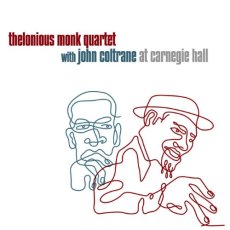 For example, the Thelonious Monk Quartet with John Coltrane at Carnegie Hall album. Listen to it once focusing on Thelonious Monk, even when he’s comping behind a soloist, even when he’s laying out. Focus on when Monk is playing, when he is not playing, and on what he’s playing.






You must be logged in to post a comment.