
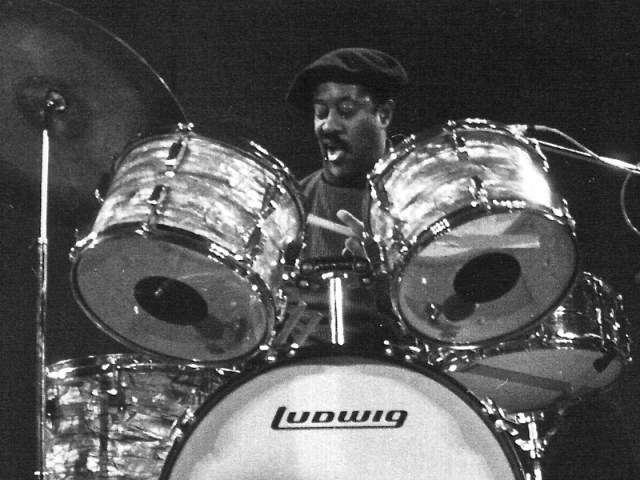
SKF NOTE: This interview with Fred Below took place in 1982. I dated the typed transcript March 17, 1982 — so this interview happened on or near that date.
My feature interview with Fred Below was published in Modern Drummer September 9, 1983. This transcript, to the best of my recollection, is the first time I spoke with Fred Below. I was gathering background info for what became a five-part series in Modern Drummer called History of Rock Drumming.
Reading this transcript today, the standout line for me is when I say, “It’s amazing trying to figure out who did what first and who influenced who.” Before speaking with Fred Below I had discovered the drummer on Bo Diddley’s records is Clifton James. I interviewed Clifton James, and also blues legend Willie Dixon, who both credited Clifton James as the man who created the Bo Diddley beat.
And when Fred Below — who was and is an absolute drum hero of mine — said Clifton James got the Bo Diddley beat from him, Fred Below, I respond with: “It’s amazing trying to figure out who did what first and who influenced who.” It was one of many amazing moments when I regretted not personally having more prior knowledge before doing these interviews, or more time to speak with the musician on the other end of the phone.
As with all my interviews with Fred Below, this one was done over the phone. I was in my Modern Drummer office. Fred was at home in Chicago.
Fred Below: When I started all the rest of the guys weren’t even it it. I was the first. And I’m the one who got — I got Odie Payne to come in to it. And Billy Stepney. And then I went down South, traveled through the South, and got S.P. Leary to come up to Chicago.
Scott K Fish: I’m trying to find out who were the guys who played on Chuck Berry‘s hit records.
FB: Well, on the first one I think I was. We did some recording for Chess.
SKF: Did you do Maybelline?
FB: That’s it. There we go. I did that with him [Chuck Berry]. And what’s that number by Big Mama Thornton? Ain’t Nothin’ But a Hound Dog? I did that one with Big Mama Thornton.
SKF: Did you do Wee Wee Hours?
FB: I believe so. Johnny B. Goode? No. I didn’t do that one.
You know the tune called Bo Diddley? Well that beat was mine. But I didn’t make the record. We use to work around with Bo over there at the 708 Club when Bo Diddley first started playing. We use to get on the bandstand and play it. Then it got so good that Bo Diddley said, “Well, let’s make [record] it.” So he had a group of his own at that time.
SKF: Was Clifton James in the band?
FB: Yeah. They went on and made the record. I’d been playing that beat a long time before that.
SKF: Where did that beat come from originally?
FB: Just a groovy beat they you would feel. That was all. It was a groove.
SKF: So Clifton James picked it up from you?
FB: Yeah.
SKF: Clifton had a wierd style. He was a lot of tom-tom….
FB: Yeah, well a lot of the guys got most of that work from me because I played the tom-tom all the time. I did some with Dinah Washington. I made an LP with her. I played jazz and blues. So, therefore, I was able to switch over and play both styles.
SKF: Did you know a drummer named Jasper Thomas?
FB: Jasper Thomas? No.
I did some jazz records with Red Holloway.
SKF: On Prestige?
FB: Yeah. That’s what it was.
I was listening one time right here on the radio — and I did some stuff with Louis Jordan over in Europe. I made the LP. And I called the man — he’s got a jazz program here in Chicago — and [when] I heard the record and I said, “Baby, that’s me!” So when I called him he told me he knew it was me. But the people, when they put the record out they changed the name to somebody else. I said, “Well, I’ll be damned.” This was a record that I made in Europe.
I did a lot of things with Etta James too. This was a lot of studio work I was doing for Chess. I was playing jazz and blues.
SKF: And you did a lot of stuff with The Platters.
FB: Yeah. Ruth Brown. The Moonglows. You know the record called Sincerely? Well, the McGuire Sisters made it. Well, I made the original with The Moonglows. It was called Sincerely. I think Phil Chess was going to New York on the plane and he happened to run across the McGuire Sisters’ manager, and they had heard it and they wanted to make it. And they went out and made the record called Sincerely — and it was a big it.
SKF: Looking back, how has drumming changed because of what you contributed?
FB: When I got into it I changed the pattern. That’s what it was. ‘Cause when I came in it was the early ’50s — the first of ’50, in fact. And when I got into it the music wasn’t quite straightened out. Where they was playing three bars and seven bars — playing haphazardly. Being a trained musician — because I went to school — I came in and started straightening the bars out. Where it was three [bars], I made it four [bars]. Where it was six [bars] — or something like that — I made it straight on out eight [bars]. I stretched it.
So it got to be where the better musicians and better drummers was able to play the blues, because they were going out to four and eight and regular bar changes. Where, before, the blues musicians was just playing the way they felt, and sarting and stopping whenever they felt like it.
SKF: The drummer weren’t even leading the band.
FB: They didn’t quite understand. It wasn’t that methodic at that time. It was just a thing of: you felt it and that’s the way you played it. And alot of the real true blues — you don’t write it. It’s impossible to write. You have to know the tune and feel it — and be able to play it.
Then when I got in, being a musician that went to school, I had to listen and learn to play what they was playing. And then stretch it out for my own self.
Then, by me doing that, I developed a beat. And they call it the backbeat — which is instrumental right today. The guys play it now and don’t even know what they playing. They call it rock and roll or that syncopated rhythm. Well, I had been playing that since about 1949 or ’50. And this is what I knew then — what the guys are playing right here in 1980.
SKF: You’re the guy that invented it?
FB: That’s right. See, I had gone in and started playing jazz, but I had to play it in a way that the blues musicians were able to feel it. And then everybody start running into me and asking me, say, “Oh, man. I like the way that guy’s beating,” and so forth.
Me, at the time, I didn’t know what I was doing, but I felt very comfortable in playing the blues. Consequently I got around to play with just about every blues musician there were. B.B. King, Arthur Prysock, Roy Hamilton.
SKF: Was there anybody else, like Odie Payne for example….
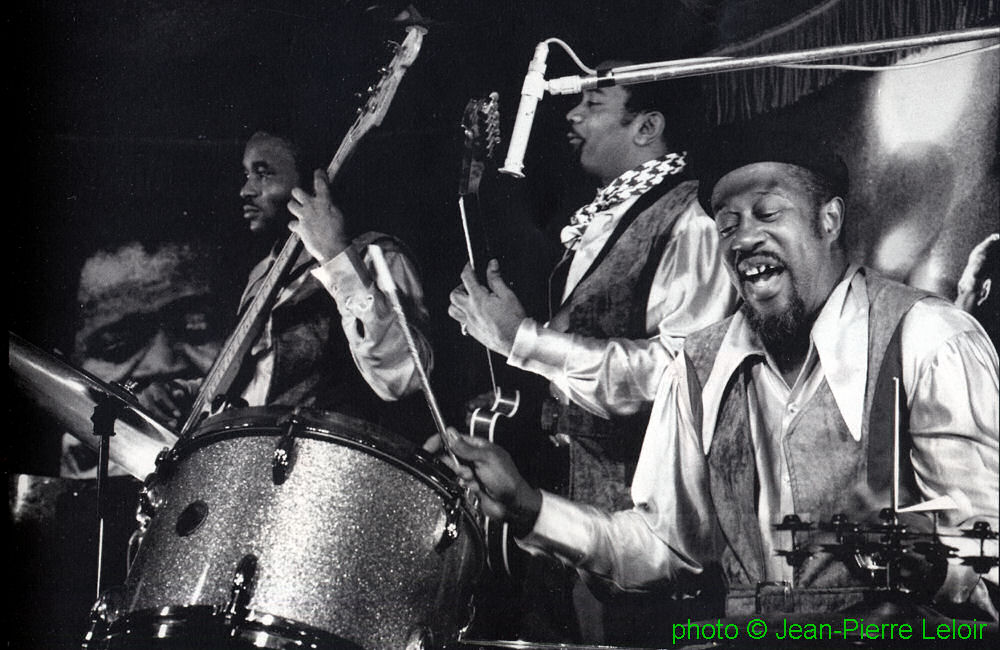 FB: No. Now this is the thing. I had been playing over a year. And Odie Payne and I knew one another ’cause we had gone to drum school back in 1946 together.
SKF: Did he go to the Roy Knapp School too?
FB: That’s right! And you know Marshall Thompson? He went there.
Anyway, Odie Payne and I were very good friends. Then he said, “Man, you think you can get me in on some of them blues dates you’re doing?”
I said, “Sure.” So I got in touch with Eddie Boyd and then I told him about Odie Payne. Then he started playing with Odie Payne!
And then Billy Stepney. He got around there and I turned him on. Then S.P. Leary. I went down South on tour with Little Walter and there I ran across S.P. Leary. And he and I got to talking. I said, “Look, man. You play well. Why don’t you come on up to Chicago and I think I can get you some work.” And he said to me, “Would you do that for me?” I said, “Sure I’ll do it.”
I went to Chicago an about a month later here comes S.P. Leary right down to where I was playing. And I told him, “Don’t worry about a thing. I’ll turn you on.” And I went over and saw Howlin’ Wolf and I turned him on. And S.P. Leary started playing with Howlin’ Wolf.
A lot of the drummers use to come to me and want to know beats and things. A lot of them did. But a lot of them didn’t go to school and they had to learn from what they saw or what they’d heard. At the time, I was the most popular drummer around because I was headlining all the big shows, working for the studios, and making records. So everybody came to me.
SKF: Did you know Al Duncan?
FB: Yeah. Al Duncan. Yeah! I knew all the blues musicians in the city. Everyone.
SKF: What do you think was Clifton James’s big contribution?
FB: Oh man, he’s a damn good drummer.
SKF: His playing really centered on the tom-toms.
FB: Well, like I said, this was part of my work. I play the whole [drum]set. And a lot of the guys liked that tom-tom work I did. So they went on and copied it and did it too.
SKF: So Clifton [James] is a few years younger than you?
FB: Yeah, he is.
SKF: It’s amazing trying to figure out who did what first and who influenced who.
FB: Well, see, I went into the Army back in 1945. I had already graduated from high school. Before that, I use to work to the Army shows at different clubs. And I went into the [military] service and came out in ’46 and use to hang around with Gene Ammons, and Sonny Stitt, and all the rest of the guys. I was playing jazz!
SKF: You’re originally from Chicago then?
FB: I live here. I was born right here. I’m a steady Chicago drummer. Right here.
I came out of school playing, but I re-enlisted [in the Army] in ’47 and went to Europe. And while I was in Europe I — Erskine Hawkins and Coleman Hawkins and James Moody, Kenny Clarke — I met all these guys and I played with them when I was in Europe.
See, I was in the 427th Army Band and they use to be playing in Paris. Every weeked I use to leave Germany and go to Paris on a weekend pass — and that’s where we’d meet. And they had went on tour in Europe with — I think Dizzy Gillespie had a group and they went over there. And James Moody and Kenny Clarke [from Dizzy’s band] stayed, and they had a group over there with Coleman Hawkins.
SKF: You knew Kenny Clarke too?
FB: Yeah. Every weekend me and a couple of the guys in the [427th Army] band, we’d go to Paris and we’d sit in with them.
SKF: So you got a chance to talk with Kenny?
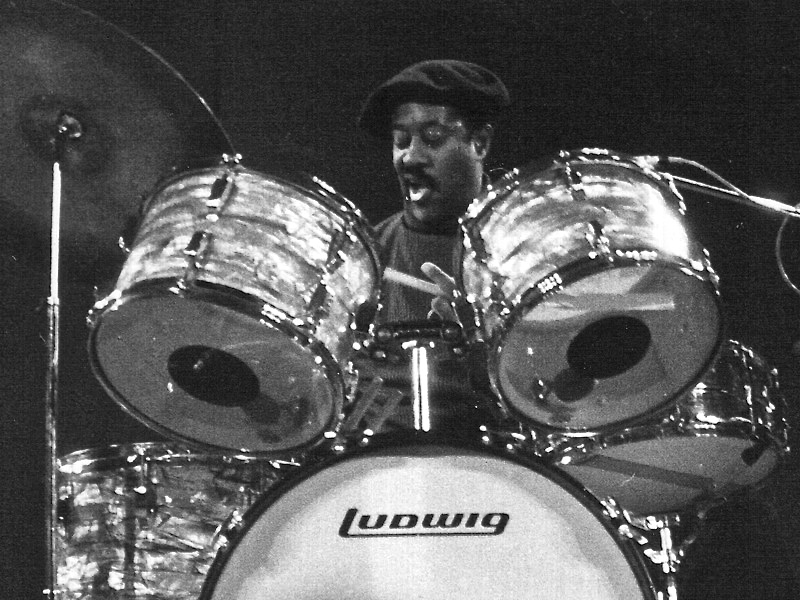 FB: Not talk! I played with him. Then when I came back to the States in 1950 — the music in Chicago had changed. Sonny Stitt — guys that were good friends of mine — Gene Ammons, Bennie Green — everybody had gone to New York and [were] playing with different groups. So I had to find a way to get back into stuff.
Then I ran across a good friend of mine named Elgie Edmond. He was a drummer. And he said, “Well, man. The only thing in town now is blues. I’d get in on that.” I said, “Well, I ain’t doing nothing. Sure, I’ll try it.”
SKF: Elgie Edmonds was from the Roy Knapp School too?
FB: That’s right. He went there.
SKF: But to hear him on record he sounds like he had a tough time playing blues.
FB: That’s right. He was playing drums much longer than me. He was a much older fellow than I was. And by he and I being good friends — he taught me a lot too. Showed me a lot of brushwork. He was a hell of a good brush player.
SKF: Was he a jazz drummer too?
FB: Yeah!
SKF: He was a better jazz drummer than [he was] a blues drummer?
FB: That’s right.
SKF: Because on [Chess] records, the difference between you and him is like night and day.
FB: That’s right. See, he had a style of playing for himself. And I had a — well, mine was a much modern style. That’s what it was.
SKF: He was more of a swing style drummer.
FB: Yeah. Mine was more up to date.
SKF: On some of those records he sounds like he wasn’t recording with a full drumset. Like maybe he just had a snare drum in the studio.
FB: Yeah. That’s right. He was a hell of a good player.
SKF: If you just heard him [Elgie Edmonds] on [Chess] records with the blues guys — you wouldn’t get that impression.
FB: No, because alot of the things that he was doing was from the old school of drumming. Things that I was doing were from the much modern school of drumming. He kept his style and it didn’t change. And that’s why his style got kind of dated. I was a new style and I was coming up from Gene Krupa, and Art Blakey, and Sonny Greer. Sonny Payne. That’s where I was. I was in that class.
[SKF NOTE: The next two pages in my typed transcript and smaller than the normal 8.5 x 11 sheet of paper. The large of the two page ends with a very good question about The Aces. Unfortunately, Fred Below’s answer is not included. Then the smaller of the two pages begins mid-sentence with Fred speaking about, I believe, The Aces. And then that smaller page ends with a good question and, again, Fred’s answer is not included.
My best guess is these were full pages and, using a scissors, I cut pieces for use in my History of Rock Drumming. Memo to Self: Don’t do that again. Make photo copies.]
SKF: How about Frank Kirkland?
FB: Frank I taught…. Well, I showed him too. He was a good friend of mine and I showed him and most of the drummers — the ones that was able to do their work — they all use to come to me and I’d show them what I could.
SKF: Elgie’s not still alive is he?
FB: No, no. He’s dead. He was one of the old drummers from…. oh, man. He goes back to Erskine Tate. Way back.
SKF: So how old was he when he was with Muddy Waters?
FB: I guess he was with Muddy in 1949. When I came back from overseas in 1950 he was with Muddy Waters. So, he stayed with Muddy up until he died.
SKF: You think he was in his fifties or sixties playing with Muddy?
FB: Yeah.
SKF: As far as influencing what became rock and roll — would you say it was more Muddy Waters’s band or moreso The Aces?
[SKF NOTE: The typewritten transcript ends. The text from the second, smaller page follows.]
FB:… got the different kind of tunes that we were doing. Then you noticed that the beat and everything was changing. And then The Moonglows was coming out and we were doing the background work with them.
SKF: That same band?
FB: Yeah.
SKF: When did you notice the beat changing from a shuffle or triplet feel to a straight eighth-note feel?
[SKF NOTE: The second, smaller page ends. What follows is the final transcript page. For me, Fred Below’s telling of the audience reception to Little Walter and his band was stunning. It was my first time hearing how popular the band was. And I was hearing it straight from the drummer’s mouth.]
FB: We’d travel places, down to St. Louis and all down the Mississippi and down to Florida. But not in little places. In the big places. We went down to the Million Dollar Palms which was down there in Florida and, man, I ain’t never seen a place that size in my life. [SKF NOTE: Probably The Palms in Hallandale, FL.] It was so large that you could drive your car into the place.
They had about three to four bands playing in there at the same time — and we was drawing the crowd just with the four of us: Little Walter, Robert Jr. [Lockwood], [Luther] Tucker, and myself. And everything that we was playing was new. And the style that we was playing. And this is what ticked it on: We had as many Whites as Blacks in the place — and the place was just overloaded!
SKF: What were the other bands playing?
FB: The other band was playing jazz. That’s it. Whatever the jazz was.
We came in and it was a new thing. Everything new. And country-and-western groups? We use to be on the show with them. Like Hank Snow and Tex Ritter. They’d play a set and then we’d play a set.
SKF: They were probably afraid to come on after you guys.
FB: No, no. It was just different because they didn’t know where to class our type of music. Cats use to make bets on us: “Man, this band here is going to outplay them.”
The only reason we outplayed everybody was because nobody was playing what we was playing — except blues musicians coming from the South that came up to Chicago.
Man, if we just had the right kind of promotion, The Beatles wouldn’t even have stood a chance. I’m telling you the truth. The Beatles wouldn’t even have been The Beatles. But we never got the big time promotion and things like that. We did the job, but we just couldn’t get on.
SKF: Well, that music is still hanging in as strong as The Beatles. I’ll tell you that.
FB: And if you notice today, the music that we cut back in the ’50s is still here. And the people are still playing it. And every once in awhile I hear a little rock and roll tune going on out there — those are the beats that we did way back in 1950. And it’s 1980. So there must have been something to what we was doing because they’re playing it now.
And alot of the modern musicians think they’re playing something new, but it’s not new.
SKF: I’m hoping that when kids read this [the Modern Drummer History of Rock Drumming] they will realize that what they’re playing today didn’t start with Ringo Starr and Charlie Watts.
— end —
 Fast forward to 2003. [Kareem[ Abdul-Jabbar was in D.C. on a book tour and…called Catlett at home. He mentioned a French DVD he’d found..,
  SKF: Somebody said that you and Scott LaFaro were responsible for freeing up Bill Evans.


You must be logged in to post a comment.