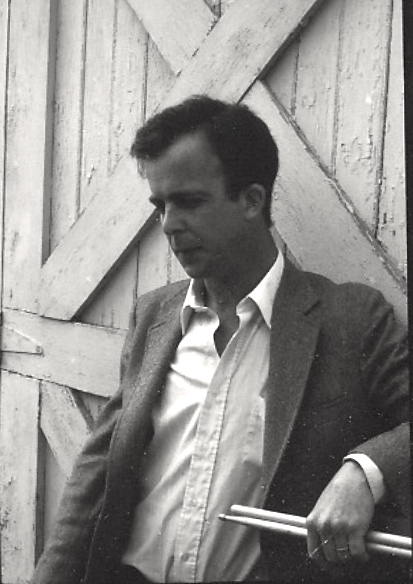
Barry Keane: Playing What’s Right for the Songs


1981_aug_sept_barry_keane_md_0001

SKF NOTE: I always enjoy speaking with Barry Keane. Barry and I first met in 1980 or 1981 when I interviewed him for the August-September 1981 Modern Drummer. We spoke about Barry’s experience as a studio drummer, with Anne Murray and others. And we spoke about Barry’s work as percussion orchestrator with Gordon Lightfoot — which I first witnessed in concert at Saratoga Performing Arts Center in New York.

Two days ago, April 12, I was glad to say yes to Barry’s invitation to An Evening with Gordon Lightfoot at Collins Center for the Arts in Orono, Maine. Mr. Lightfoot is one of the major singer-songwriters — certainly of my generation, and likely for all time. And the band I heard two days ago, except for guitarist Carter Lancaster, are the same musicians I heard in 1980-81.

Barry is playing the same drumset he had in ’80-’81. We have a long-running joke that the drumheads are the same too. But the point is: Barry’s drums sound great. And he, along with Gordon and the rest of the band, create one sound that can only happen, I suppose, when the same musicians have been together between 40-50 years.

Sitting in the audience I am listening to each song as one sound made up of many parts. I can also shift my attention to the sound of keyboard player Mike Heffernan, or Rick Haynes’s solid bass, or to Barry Keane’s brushes, triangles, woodblocks, or the wake-up tom-tom fills of The Wreck of the Edmund Fitzgerald.

The audience is there to hear Gordon Lightfoot and his songs. And the bandmembers are excellent at creating musical parts for themselves that also perfectly fit Lightfoot’s songs.

My friend, Jason Carey, is with me two nights ago. He is surprised Barry leaves so much space in his drumming. After the show, Jason asks Barry if he’s ever tempted to play more. Before Jason finishes is question, Barry is shaking his head saying, “No. No. Because that wouldn’t be right for the songs.”

Here, then, is my 1981 interview with Barry. He is now touring parts of the States with Gordon Lightfoot. If you have a chance to go — go! You will hear great songs, great musicianship, and get a crash course in how a band sounds as a world-class team.

[SKF NOTE: 6/17/17 – Barry Keane’s full interview is now available on MD‘s Archive Page.]

end

Posted in SKF Blog | Tagged , , , , | 6 Comments

Happy Birthday: My Pivotal Moments with Steve Gadd

steve_gadd_0001

Steve Gadd circa 1978

SKF NOTE: A belated happy birthday to Steve Gadd. Paraphrasing bassist Ron Carter when asked how Elvin Jones changed drumming: Listen to drummers before Steve Gadd hit the scene and listen to drummers after.

There are many excellent pop and jazz recordings and videos of Steve Gadd’s drumming. The pivotal Steve Gadd cuts in my life — and the reasons why — are as follows:

Chuck Mangione St. Thomas (1972): Loads of musical (key word: musical) chops from Steve Gadd on a four-piece drumset. Plus a heavy dose of What the heck is he playing? which is always fun.

Bob James Night on Bald Mountain (1974): I was living in Davenport, Iowa, working for the first time as a full-time drummer when I bought Bob James’s One album. Steve Gadd’s playing on Bald Mountain scared me, letting me know I still had much to learn.

Mike Mainieri Love Play (1974): Nice overall album. Steve Gadd and the rest of the band build slowly, tastefully over nine minutes to a killer crescendo. Still a great song, IMO. Oh, and putting this post together this morning, hearing this song for the first time in a long time, I said, “Ah ha! So that’s where that little riff I whistle and hum all the time comes from.”

Joe Cocker Catfish (1976): Steve Gadd as minimalist, playing exactly the right sounds — and no more. A perfect musical interpretation. And it shows Steve — with tons of technique — has the musical maturity to use it only when necessary.

Again, Happy Birthday, Dr. Gadd.

end

Posted in SKF Blog | Tagged , , , , , , , | 1 Comment

Roy Haynes: Bird Would Say Cool Your Volume

Roy Haynes

SKF NOTE: This dialogue is from my interview with Roy Haynes at his home on November 15, 1978. According to my notes “It was raining, traffic was heavy, a chilly…evening, and I was nervous about meeting him. We had spoken on the phone a few times.

The week before [this interview] I saw Roy perform with the bassist and guitarist from his Hip Ensemble at Sonny’s Place, a small Long Island jazz club in Seaford, NY. The trio was hot. The music ran the gamut of emotions and it was always swinging. Roy Haynes is both amazing to watch and to listen to. He sat behind a set of Smokey Vistalite Ludwig drums, eyes closed in relaxed concentration, playing with that precise, crisp sound that earned him the nickname Snap, Crackle, Pop.

I asked Roy at one point if Charlie “Bird” Parker was much of an influence on Roy’s drumming. Here is Roy’s answer.

Roy Haynes: Bird never told me too much. I would think it all worked in.

I remember one time Bird telling me…. Any time we’d go into a new place we hadn’t worked before — like a hall or a club — he would say always just cool it as far as your volume is concerned. Because you don’t know what the place is going to sound like.

I still use that today with my group. I tell the guys, just feel it out first and then we’ll get involved as we go.

It’s fashionable today to go in a place and start blasting right away. Because a lot of people want to hear that. They figure if it doesn’t have enough volume it’s not happening. That there’s no energy involved. You dig?

But that’s the only thing I remember Bird telling me as  far as my playing.

end

Posted in SKF Blog | Tagged , , , , , , | 3 Comments

Drumming Beyond Playing ‘Awesome Grooves’

scottkfish_barndoor_drumsticksSKF NOTE: Drum sticks! Most of the how-to stuff I see and read now is about learning to play the drumset with drum sticks. Groove is a buzz word, i.e. How to play a funk groove, or Here’s a guy playing an awesome (another buzz word) groove.
Where is the how-to stuff about the great drummer qualities having more to do with the heart (emotion) than the head (logic)? Here are some examples I’m thinking about this morning:

A good sense of time. There is no one definition of keeping good time. Sometimes keeping good time requires precision drumming. In other situations good time means an ability to stretch time without losing time. The drummer’s main function, I’ve heard it said often, is to keep time. Tony Williams, when he was still playing with Miles Davis’s Second Great Quintet, said it was not his job to keep time. If the other musicians didn’t know where the one beat is, Tony said, they don’t belong on the bandstand.

Where are drummers learning how to play soft mallets on the drumset? Max Roach is the first drummer I heard — not saw — use soft mallets. It was on the Clifford Brown & Max Roach recording of Delilah. Mallets aren’t simply stick substitutes. I’ve never seen a drummer rely on a gig on his soft mallets because he forgot his drum sticks.

Or Alan Dawson playing the entire Indian Song using one drum stick and one maracca. Where did Mr. Dawson learn to create that sound?

Drummers playing standards or songs where lyrics are essential to the song? The best drummers know the song lyrics. Is anyone teaching drummers that?

Singing drummers! Is there a manual for how to sing and play drums at the same time?

Learn to listen. Be a good listener. These truisms pop up all the time in music conversations. Okay, but what are drummers supposed to listen to? What are other musicians expecting drummers to hear? And when listening drummers do hear it — what are they supposed to do with it?

Drumming at its roots is absorbed through the ears. Yes, drumming has a visual component. But a drummer who looks great, sounds lousy, and can’t get along with any other musicians is not of much use.

These are just some of the drumming things I’m think about this morning.

end

Posted in SKF Blog | Tagged , , , | 1 Comment

Max Roach: Drum Solos Are Like Creating Poems, Paintings

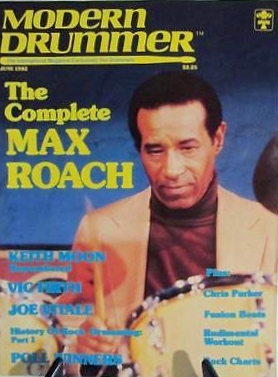
1982_roach_md_coverSKF NOTE: Max Roach was, for me, an early and lifelong musical influence. Not long after I tried emulating Max’s drumming style, I discovered a new challenge. If I was going to play like Max at all, I had to know songs, song structure, melodies.
I bought every album I found with Max Roach on drums. It didn’t matter if Max was the album leader or sideman. The music of Max with Clifford Brown will always be special. The Brown/Roach Quintet introduced me to Max.

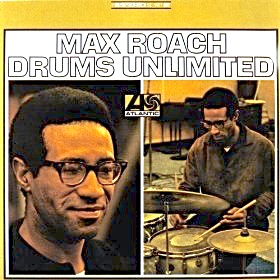
Max Roach’s Drums Unlimited album is another strong influence. From photographer Chuck Stewart‘s album cover photo of Max’s Gretsch drum set, worn drum heads, different size hi-hat cymbals, and a good look at how Max holds his drumsticks, to the Max’s classic drum solos, For Big Sid and The Drum Also Waltzes. Incredible.

So it was an honor meeting Max in 1982 at his home and being able to ask him directly about his pioneering drum solo pieces.

Scott K Fish: I wanted to ask you about the development of your solo pieces like Conversation and For Big Sid.

Max Roach: It was just compositional form. After you get past, say, the techniques of an art form — and we’re dealing with [the art form of] music — even though you play a melodic or an instrument of indeterminate pitch, no matter what you do on that instrument — if you are running up-and-down that instrument with all kinds of pyrotechnical things, it doesn’t necessarily have to make sense. It doesn’t mean anything. Even though you’re playing the right changes and all the right notes coinciding with the chordal progression.

What makes a piece an art piece is design. Design.

If you play any instrument, if you don’t create design…. If the artist doesn’t know how to utilize space and sound, and the dynamics of soft and loud — all the little things — and repitition and sequential dealing with all the rules that make up what we know as an art piece — and then some more –then it’s not [an art] piece anyway. Whether you’re playing an instrument of determinate or indeterminate pitch.

I hear some people who run up-and-down the piano and it’s not musical. All I can say is, “Well, he’s got good technique.” But I never say he’s playing music, or [that] he’s creating some design.

So when I build a solo it’s design within the structure of something, sometime. Basically it’s design. Like creating a poem, a painting, or anything else. It’s how you use [design] to set up certain things.

Space is important and dynamics are important. And things like sequences or sequential things are important. And how you relate to certain timbres on the [drum]set itself is important.

And that’s how you build a solo.

drums_unlimited_roachSKF: The initial idea for [your drum solo] pieces. Where do they come from?
MR: Well, they come from maybe a phrase that [I] improvise with. They can come from a time signature. All the possibilities. Because you…. After you master the techniques and you’ve got good hands, good feet, good coordination; your separation’s together and you know how to use all four limbs equally but still [separately] — now the next step is ideas.

You have to create and invent new ideas that do things. And each idea has to be different. It has to be a different challenge. If this idea is dense then maybe the next idea you’re playing can be very open. Or there are gradations between dense and open and dense.

You use also all the techniques…involved in creating a musical composition or creating a poem: periods, question marks, call-and-response. All these kind of things.

It can be done within the context of a [musical] piece that’s being played [or] if you’re playing within a solo context.

Every piece has its own personality. And when you write a piece, you write the personality of the piece, eventually. You may start a piece and you may have an idea of what the piece is going to be like. It may be quiet. It may be busy. It may be relaxed. It may be peaceful [or] it may not be. Whatever! That is the basic nature of the piece you’re going to deal with.

Now, when someone improvises within that piece they have to understand the piece was written for a certain mood or a certain feeling. When you improvise, you have to improvise within that [certain mood or feeling]. You can’t say, “This is a very simple modal piece” and then come in like you’re playing Giant Steps or Not So Quiet, Please.

It has a different feeling to the piece.

end

Posted in SKF Blog | Tagged , , , , , , , | 5 Comments