“I really think that you can communicate all kinds of feelings to audiences, to people. It can be a real touching human thing. If you can communicate feelings and ideas without words, you can make an impression on people. The idea is to be able to take what you feel and transmit that to someone else.”
SKF NOTE: Music critic, manager, and record producer Jon Landau wrote, ” Al Jackson kept perfect time, played with extraordinary simplicity, was exceptionally powerful, got the toughest sound and left the vocalists with the maximum amount of space in which to do their thing.”
Mr. Landau quoted Jackson as saying, “In some tunes, the straighter you play it, the better. You try to stay out of the way because you are selling the tune itself and not the drummer. He could get fancy — but what would it really matter? You’d be taking away from the tune and the artist. The simpler you keep it, the better.”
Photojournalist Valerie Wilmer wrote a posthumous piece on Al Jackson. In it she spoke with Duck Dunn, a bassist who worked closely wit Jackson on almost all Jackson’s recording and performances.
“I’d go out and I’d play with other drummers, jam, and they’d always ask me, ‘How does Al do this?’ and ‘How does Al do that?’ They wanted to know how he tuned his drums. Other drummers tuned their drums better than Al ever hoped to tune ’em.
“Anybody who appreciates the commitment, the experience and dedication required for the playing of top flight professional jazz, must realize the tremendous demands on the person playing it. By the same token, the music is sophisticated enough to be a challenge for the audience.
“You cannot, just for the price of a big amplifier and an electric guitar, expect to plumb the depths of music in six months, no matter what your genius. It takes years and years of experience even to scratch the surface of the most elementary kind of music that has any significance.”
Source: Bill Evans Blindfold Test Pt. 2, by Leonard Feather, Down Beat, July 23, 1970 // Bill Evans Photo
SKF NOTE: When I was in school — with a couple of exceptions — I hated math. But loved drumming. The exceptions were a couple of math teachers passionate about math. Their passion transferred to me. I enjoyed their classes and I learned math.
All those school years of dreading math class came back to me while reading yesterday about Troy Kryzalka’s Number Drummerprogram. His lessons look like fun. Who know how my school math might have changed if Number Drummer was around!
Mr. Kryzalka says on his web site, “Over the past 15 years, there has been many benefits to this approach, not to mention the spectacular performances that students were able to create.” I would love to learn more about the “many benefits.” Until then, be sure to visit Number Drummer online.
Holy Name students learn math to the beat of a drum
Jay Grossman9:29 p.m. EDT April 25, 2016
Number Drummer creator Troy Kryzalka has worked in education for over 15 years, and has delivered his integrated math and music learning approach to thousands of children and educators. Using movement, body percussion, and real instruments, students simultaneously performed multiple math skills at a variety of levels.
Principal DeAnn Brzezinski remarked that “it was fascinating demonstration of math and music all rolled into one spectacular show!”
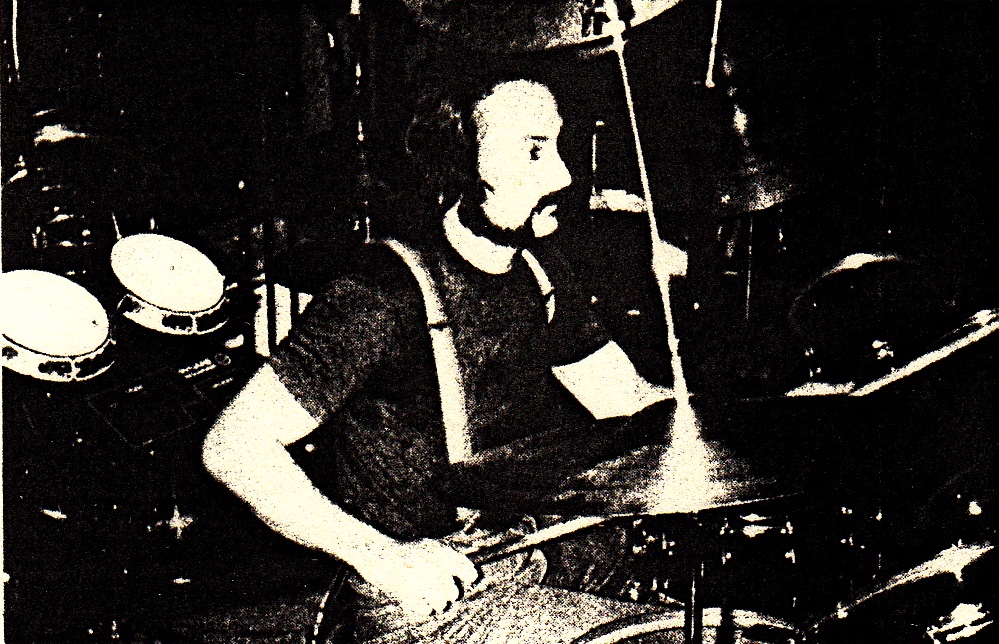
SKF NOTE: September 10, 2015 I posted my 1981 Modern Drummer obituary for a terrific guy, Roberto Petaccia. I wrote in part:
“The first time we heard from Roberto was through a letter: ‘My name is Roberto Petaccia and I am contacting you in regards to my interest in writing for your magazine.’ I called him up because he had many good ideas. We kicked around some idea and he submitted several articles, some of which have already been published in the Rock ‘n’ Jazz Clinic column. The ideas were great and the manuscripts that Roberto handed in were near impeccable, but he would always apologize for them.”
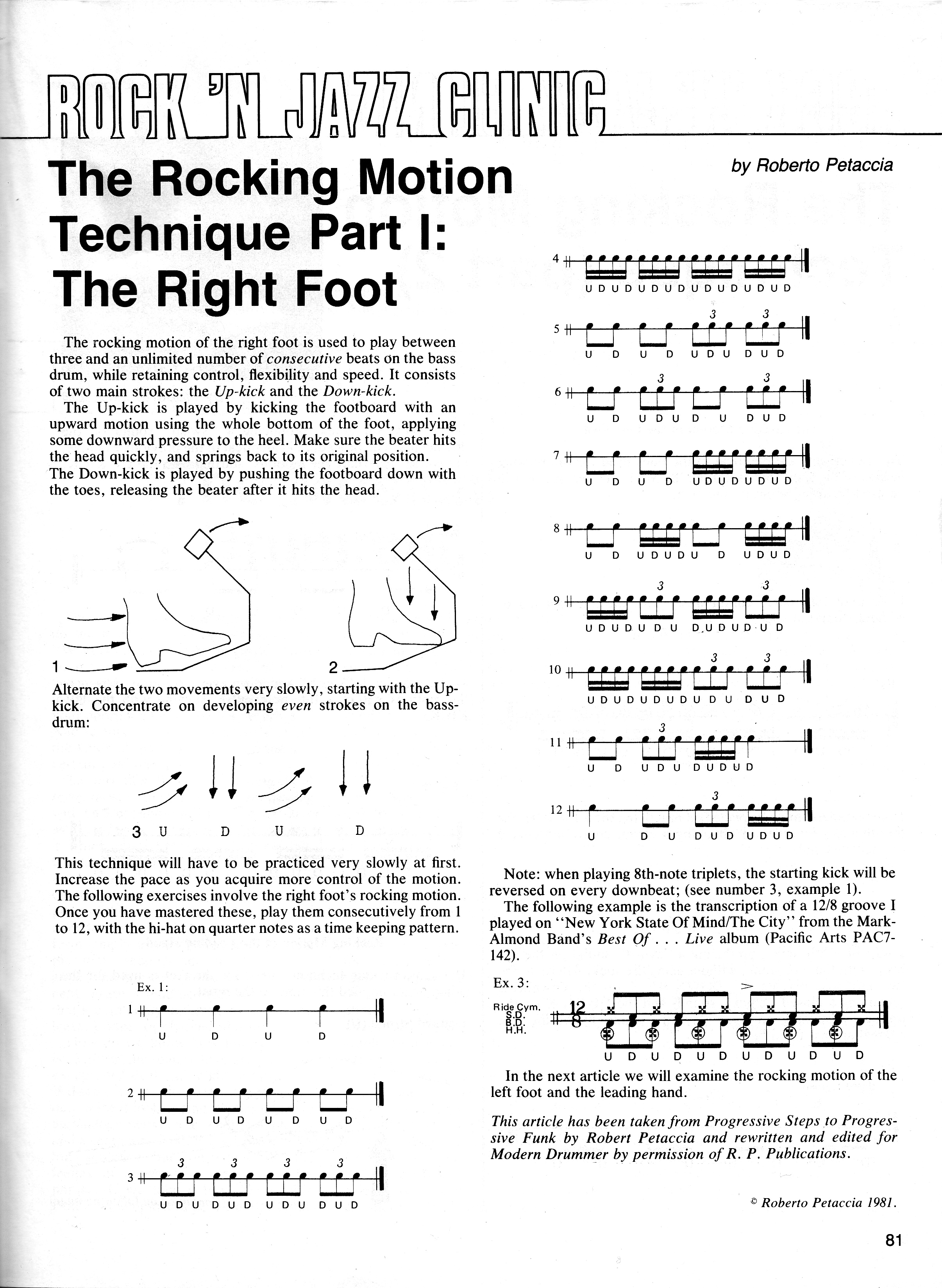
After posting Roberto’s obit I remembered his Rocking Motion technique with the bass drum pedal, and I wrote on Drummerworld, “Roberto was the first drummer, in my experience, to master the heel-toe method of playing a single bass drum pedal. By playing his bass drum pedal with a rocking motion, Roberto was able to strike his bass drum with (I think) heel first and toes second. He was able to play that at different speeds. The technique was designed to produce the same effect later used by the double bass drum beater pedals used on single bass drums.”
Roberto had a drumset assembled in his New York City apartment where he showed me his Rocking Motion technique. Roberto played very relaxed with minimal motion bass drum figures with one bass drum and pedal usually reserved for double bass drums and/or double pedals. His Rocking Motion technique was so logical and worked so well. It was a classic, “Why hasn’t someone thought of this before now?”
Here then is Roberto Petaccia’s The Rocking Motion Technique Part 1: The Right Foot as it first appeared in Modern Drummer.

 “I really think that you can communicate all kinds of feelings to audiences, to people. It can be a real touching human thing. If you can communicate feelings and ideas without words, you can make an impression on people. The idea is to be able to take what you feel and transmit that to someone else.”
 SKF NOTE: Music critic, manager, and record producer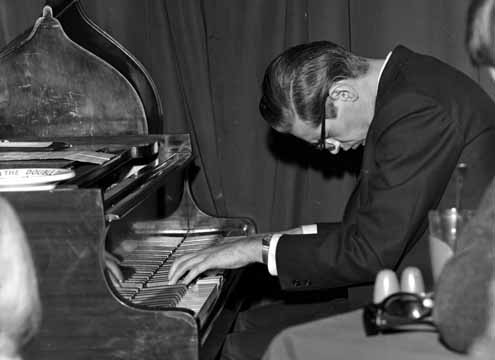

 Scott K Fish
You must be logged in to post a comment.