Roy Haynes: Think Dynamics All The Time

SKF NOTE: Among my boxes of drumming memorabilia are a couple of legal size folders from Charlie Perry full of written material. Charlie was a noted drum teacher and author. His best known method book, perhaps, is The Art of Modern Jazz Drumming, which Charlie co-authored with Jack DeJohnette. Charlie Perry also had an early rock drum method book with Gary Chester.

I studied briefly with Charlie, and he was an early Modern Drummer fan and Advisory Board member. How did I end up with Charlie’s file folders? Who knows? Charlie seemed always to have writing ideas looping through his imagination. It’s probable Charlie handed me these file folders, asking me to look them over, and do something with the contents. Do what? If I ever knew, I have forgotten.

Charlie Perry’s folder has a two-page photocopy of a LUDWIG DRUMMER magazine interview, circa 1966, with vibraphonist Gary Burton, bassist Steve Swallow, and drummer Roy Haynes. At the time, the thee musicians were playing with tenor saxophonist Stan Getz. “One objective in the following discussion is to describe to LUDWIG DRUMMER readers how we approach rhythm section playing in general,” says Gary Burton in opening the interview.

In this excerpt, Gary Burton is talking with Roy Haynes about his bass drum technique.

=====

Roy Haynes: A lot of times [the bass drum] should be felt and not heard.

Gary Burton: Roy, I notice you play the bass drum pretty much all the time, for all levels of intensity. But there is so much control needed with that, which you do very well.

Do you have any guide lines that you go by, to maintain this style? What could you tell a student drummer or offer some suggestions about attaining this kind of control of the bass drums?

RH: I would tell them to think dynamics all the time….

GB: I mean, when to go up and when to go down. When I said you played the bass drum most of the time, or all of the time, I wonder why and how you play the bass drum al of the time?

RH: I play the bass drum very lightly so it can be felt for support only, mainly for the bass player, who should, with this proper support, feel free to play anything he wants.

GB: This is contrary to the usual thought that if the bass drum was being played, there would be less freedom.

RH: For instance, what I like to do behind  bass solo, naturally, is not play the beat itself, but just the beat every now and then. And when I hear I’m getting sort of involved in the meaning of the solo, then I change to something related to it, not necessarily playing any rhythm pattern, just playing different notes, probably melodic, and so forth. Sometimes I would just rather lay out until near the end of the solo, and come back in gradually.

GB: I think what we are going for there is the give and take. If a soloist takes a very dominant role, you kind of want to let him take over. You know, it would be interesting to me if I heard you laying out when I was playing a solo, sometime.

RH: Right.
Posted in Drum/Music News, SKF Blog | Tagged , , , , , | Comments Off on Roy Haynes: Think Dynamics All The Time

Wm. L. Shirer and Segovia: Pioneers Cross Paths in 1930s

segovia4

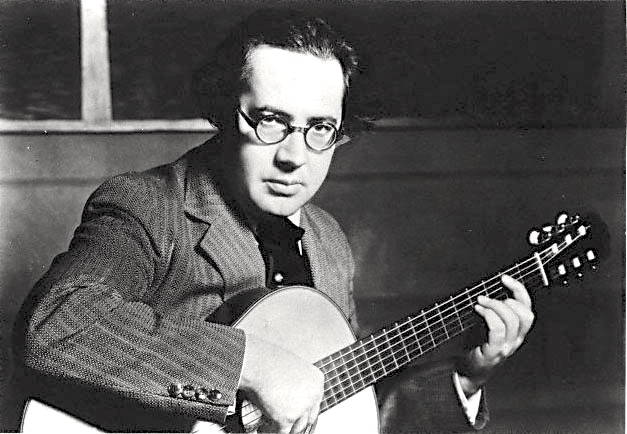
SKF NOTE: Reading last night, I found this intriguing account. In the 1930s, at the start of their legendary pioneering careers, reporter William L. Shirer, and musician Andres Segovia were each renting half of the same house. Their living room gatherings remind me of Yo Yo Ma‘s collaborations with his Silk Road Ensemble many decades later.

His mood improved by leaps and bounds when Andres Segovia, whom Shirer had first heard in Paris and later in Vienna, moved into the other half of the villa to spend a few summer weeks by the sea. Most afternoons Bill, Tess, and Segovia sat in their beach chairs by the water, reading and talking. Shirer had brought back musical recordings from India and Afghanistan, Iraq and Turkey, and some nights Segovia joined Bill and Tess in their large living room to listen to them. “The evening invariably wound up with Segovia playing some of the works he had been practicing,” Shirer wrote. He was astounded when Segovia played Bach and Mozart on his guitar. Before Segovia left the house for good, he gave Bill and Tess a Spanish edition of Cervantes’s Don Quixote.

Source: The Long Night: William L. Shirer and the Rise and Fall of the Third Reich, by Steve Wick (Palgrave Macmillan 2011)

Andres Segovia Photo Credit

Posted in SKF Blog | Tagged , , , | Comments Off on Wm. L. Shirer and Segovia: Pioneers Cross Paths in 1930s

Montblanc’s Miles Davis Fountain Pen Makes Me Smile

davis_miles_montblanc_fountain_pen_1

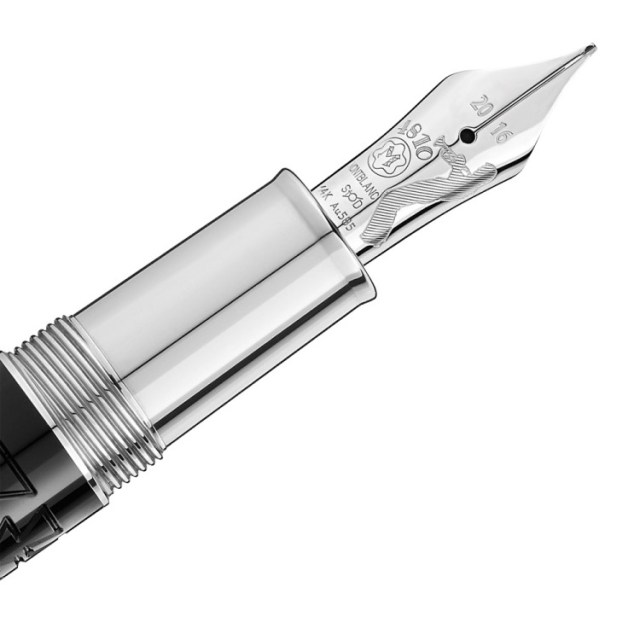
SKF NOTE: Thank you, Colleen Morgan of The Moodie Davitt Report, for bringing Montblanc’s cool Miles Davis fountain pen to my attention. The workmanship is beautiful. And if I had a spare $900…? Until then, that Montblanc’s Great Characters Edition Miles Davis Fountain Pen exists makes me smile.

=====

Great Characters Edition Miles Davis Fountain Pen

Details [As described on the Montblanc web site.]

This Great Characters Edition is honoring one of the most revolutionary and influential jazz musicians of all time – Miles Dewey Davis. He was not only a trumpeter with an outstanding sound but a pioneer in virtually every phase of the evolution of post-WWII American jazz, from cool jazz up to the rock-jazz-funk fusion, which finally got him inducted into the Rock & Roll Hall of Fame.

The overall shape of the writing instrument is inspired by the trumpet, emphasized through the trumpet finger buttons on the clip, while the blue cone recalls ‘Kind of Blue’, one of the greatest jazz albums of all time.

The pattern on the cap and barrel highlights the diverse movements Miles Davis represents: Jazz Fusion (Mixed shapes and techniques), Modal Jazz (Oriental), Hard Bop (African), Cool Jazz (Nonette) and Bebop. The cap ring with ‘2006’ engraving evokes his induction to the Rock & Roll Hall of Fame in 2006, while the shape of the cone stems from the special ‘Heim’ mouthpiece he used for playing. The Au 585 solid gold nib is engraved with his silhouette.

davis_miles_montblanc_fountain_pen_2

Learn More

Posted in Drum/Music News, SKF Blog | Tagged , , , | Comments Off on Montblanc’s Miles Davis Fountain Pen Makes Me Smile

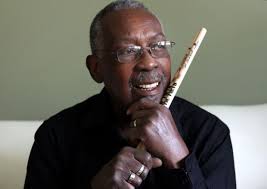
Clyde Stubblefield: I Do Not Appreciate Not Getting Paid

stubblefield_clydeSKF NOTE: I look forward to the day it is standard practice in the recording industry to make sure musicians are paid for using their sampled sounds. That this is still an unresolved issue is heartbreaking.


Drummer Clyde Stubblefield, comes to Ardmore Music with James Brown Dance Party
DECEMBER 27, 2016 — 1:36 PM EST
by A.D. Amorosi, FOR THE INQUIRER

These days, [Clyde Stubblefield] drums live whenever he feels the funk. The one thing that gets his goat, though, is the hip-hop sampling of his famed signature pulses, without payment to him. It’s said that Stubblefield may be the most sampled man in hip-hop — and the last one to get his financial due. “I can dig that others try to do what I do, and am happy when people try to play what I play,” he says, “but I do not appreciate not getting paid.”

Full Story

Posted in Drum/Music News, SKF Blog | Tagged , , , , | Comments Off on Clyde Stubblefield: I Do Not Appreciate Not Getting Paid

New Live Music: Papa Jo Jones with Count Basie (1938-40)

The release of Savory Collection Vol. 2 has all the elements of my favorite jazz discoveries. At first blush we have 22 first time releases of Count Basie’s big band (1938-1940) with the exemplary rhythm section of Count Basie (piano), Freddie Green (guitar), Walter Page (bass), and Papa Jo Jones (drums).

These are live radio broadcasts preserved on aluminum discs by Bill Savory. His is a new name to me. But from what I’ve read of Mr. Savory in the Wall Street Journal, the New York Times, and The Jazz Museum in Harlem — he was a brilliant, audio engineer with a love for great jazz. I look forward to learning more about him.

Most of Bill Savory’s recordings were kept private for 60 years — and were almost lost through neglect. Savory’s son sold the bulk of his father’s recordings to Founding Director and Senior Scholar Loren Schoenberg of the National Jazz Museum in Harlem.

17jazz-savory-jumbo

Bill Savory (Courtesy New York Times)

According to the NYT, “Because of deterioration, converting the 975 surviving discs to digital form and making them playable is a challenge. Mr. Schoenberg estimates that ’25 percent are in excellent shape,’ he said, ‘half are compromised but salvageable, and 25 percent are in really bad condition,’ of which perhaps 5 percent are ‘in such a state that they will tolerate only one play’ before starting to flake.”

That’s another concern of mine, especially for existing audio and/or video interviews with great drummers. What’s going to happen to those archives when the interviewers are gone?

I look foward to hearing this music and learning more about Bill Avory, and also, the yeoman’s work by audio engineer Doug Pomeroy in restoring this music.

Posted in Drum/Music News, SKF Blog | Tagged , , , , , , | Comments Off on New Live Music: Papa Jo Jones with Count Basie (1938-40)