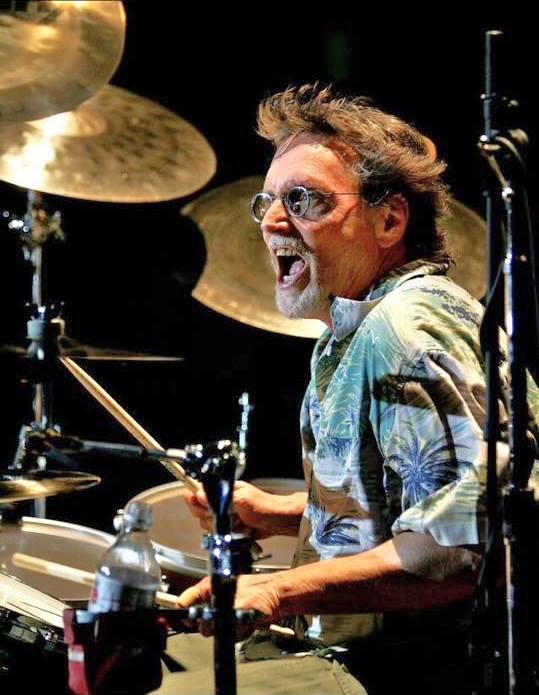
Richie Hayward’s Interview Lesson

Photo by Hank Randall

SKF NOTE: If the circumstances for conducting a drummer interview aren’t right – don’t conduct the interview. Say, “Thanks, but no thanks.”

That is one lesson I learned from my disastrous attempt to conduct a feature interview for Modern Drummer with Little Feat drummer Richie Hayward.

Let me say unequivocally: I love Hayward’s drumming, especially, but not exclusively, with Little Feat. His swinging, easily recognizable style was his own. And I very much looked forward to sitting with Hayward to find out what made him tick.

I have forgotten many of the details of my brief time with Hayward. We met somewhere in NYC, I believe. I remember showing up for the interview a bit earlier than the appointed time, and being met by a tall, muscular guy in a shiny gray suit. He looked to me like a bodyguard. I don’t recall his name.

The bodyguard escorted me along a series of cement block hallways covered in white high-gloss paint. Perhaps we were in the basement of a hotel. I don’t remember. But our walk ended in a very brightly lit room also made of high-gloss cement blocks.

Ritchie Hayward was in that bare room by himself, seated in a corner. He acted nervous, twitching. Hayward’s appearance reminded me of how dogs behave when they are consistently abused by their owners.

While the bodyguard introduced me to Hayward, he told me I had “15-minutes” to interview the drummer. Then Hayward had to be on his way to wherever Little Feat was playing that night.

That was the first time anyone from Little Feat’s management mentioned a 15-minute curfew. MD’s feature interviews had a minimum 7500 word count. That’s 25 single-spaced typewritten pages. Fifteen minutes is barely enough time to get a quote from somebody.

I thought maybe I could still pull a rabbit out of a hat. Maybe once our interview was underway Little Feat’s people would grant Hayward more time with me.

After firing up my trusty audio cassette deck I asked Hayward, “How did you first meet Lowell George?” Little Feat was really an extension of George’s songwriting, singing, and guitar playing. It is no exaggeration to call George Little Feat’s bandleader.

In response to my first question, Hayward answered, “I took the train from Iowa to California and met Lowell George.” Then Hayward stopped talking. And my horror over a bait-and-switch 15-minute curfew grew worse with an interviewee who gave minimal word answers to questions.

When I asked a follow-up question, trying to get Hayward to provide a more detailed answer, he acted annoyed. As if he was thinking, “You asked me a question. I gave you an answer.”

My wish for an interview extension never happened. At the appointed time the bodyguard accompanied Hayward to a taxi cab destined for wherever Little Feat was performing that night.

I remember Hayward getting into a disagreement with the cab driver. The cabbie made a rather innocent reference about working as a rock musician, which set off Hayward into a “How do you know what it’s like working as a rock musician?” exchange.

And that was it for my so-called interview with Ritchie Hayward. I did stick around to hear Little Feat in concert that night. Ritchie was playing a killer sounding brass snare drum made out of a timbale. At some point, Ritchie shared that detail with me.

Overall it was a disappointing interview session. But I learned a valuable lesson. Make sure to have, in advance, agreement on interview logistic details.

And if the logistics aren’t to my liking – just say no to the interview.

Posted in SKF Blog | Tagged , , , , , | Leave a comment

Music I Will Never Hear Again

SKF NOTE: There isn’t enough time for me to listen again to all of the music I’ve collected in my life. At first, that was a sobering thought. All these boxes of music CDs? Father Time says I’m never going to hear many of them again.

Am I dating myself talking about CDs? I’ve digitized them all. Most of my listening is through my iPod – which, in itself, is an obsolete music listening device. My iPod screen has spider cracks all over from my dropping it onto a hard surface.

But it still works.

I don’t stream music. More than likely if I see an album I like I buy and download the digital version. My digital music is not stored on either of my Macbook Pro laptops. Rather, it’s all stored on two or three external hard drives from which I drag-and-drop albums on my iPod; usually enough music to fill about half my iPod’s capacity.

Most of my music listening happens during rest periods. Because my attention is almost always attracted to music, I’ve never liked to use background music during work time.

Some of the music I loved as a young man has lost its appeal. Jimi Hendrix, for example. I ate up the Jimi Hendrix Experience albums as soon as they were released. And drummer Mitch Mitchell was inspirational.

A few years ago I remembered not having listened to the Hendrix Experience in a long, long time. As it did at age 16 when “Are You Experienced?” was first released, presently it made sense to listen anew to Hendrix’s kick-off album.

I don’t know why the magic from Hendrix’s album was gone. But it was. Where at age 16 the music was full of surprises; revisiting the album I found no surprises.

I’ve discovered I’m more inclined to listen to albums I’ve never heard, by musicians I’ve loved forever, than I am to re-listen to their albums I’ve heard many times over.

For decades there was no one in my life with whom I can share the music I love. With such people in my life I know I would have a different attitude toward my lifelong favorite albums and songs. For example, in the 1980s I created a history of jazz drums by recording, in chronological order, favorite vinyl drum tracks onto 90-minute cassettes.

At different times I gave one of those cassettes to Jim Keltner, Neil Peart, Paul T. Riddle, and maybe others. It was fun giving these friends a chance to hear some drumming they’d never heard before.

If I had a family member, or a neighbor, interested in drumming I would have shared with them lots of my favorite music.

Or teaching a class. My key hesitation about teaching a music class involving drum history? It seems the internet is overloaded with such classes.

There are certain artists I do still enjoying hearing over and over. Miles Davis’s First Great and Second Great Quintets are examples. Just about any artist on 1950s-1960s Blue Note or Prestige albums.

Probably I shouldn’t fret over the music in my collection I will never hear again. I am always listening to new music. I think it is healthy to keep certain music close to my heart on my time left here. And to remember other music as stepping stones, getting me from where I was when I first listened to today and beyond.

Posted in Revisiting My Life in Music, SKF Blog | Tagged , , , , , | Leave a comment

Drummers, Not Drums

SKF NOTE: While musician Jim Gordon was serving time in prison, he was said to have all of his musical gear used during his career locked in storage.

Some months after Gordon’s death an acquaintance called me at home. “Do you know for certain what happened to Jim Gordon’s drumset? And to the contents of his storage locker?”

Back-to-back, two answers came to mind.

Idea A: I don’t know what happened to Gordon’s gear. But I agree it’s important the gear wind up in the right hands.

Idea B: Gordon’s drum gear, minus Jim Gordon, is little different from drum gear found in music stores and drummers’ basements nationwide.

Essayist Joseph Epstein, speaking in 2016 to Hillsdale College on the importance of reading biographies said, “When I come upon an artist, a philosopher, scientist, a statesman, an athlete I admire, I find myself interested in his or her background. Which is to say, in their biography. In the hope of discovering what, in their past, made possible their future eminence.”

That is exactly how I’ve felt about the drummers I’ve interviewed over the years.

Freelance writer Ramodhi Kuruppu hit the bullseye when, in his 2014 blog post, “Drum Dies with Drummer,” said, “I learned that one drummer‘s style cannot be followed by another. It’s always different.

“Above everything when the drummer dies, the drum dies too. Because only a drummer will know his beats and the degree of pace to keep with his companions,” reasoned Kuruppu.

I agree.

In the early 1970s I remember hearing Gene Krupa had a house fire in which he lost memorabilia and, I believe, the drumset he played at the famous 1938 Benny Goodman Carnegie Hall Concert. That was very. sad news. How awful for Krupa to lose such a landmark set of drums.

Rolling Stones drummer Charlie Watts was an avid drum collector. He died leaving a treasure trove of drum sets once belonging to famous drummers like Krupa, Tony Williams, and Art Blakey.

Now what happens to Watts’s drum collection? Do they remain closed in their black trap cases piled onto warehouse shelving?

Here’s another thought: I know it’s possible to authenticate some drum gear. For example, maybe someone has the drumset Elvin Jones used to record “A Love Supreme.” I’ve seen photos in online drum forums of Elvin’s last drum sets, of the set Carmine Appice used with Rod Stewart. Paul Motian’s niece has all of Motian’s cymbals.

On the other hand, how many recordings are there of famous drummers using another drummer’s cymbals and or drumset?

Imagine my surprise when drummer Mel Lewis told me the “great Gretsch sound” on several of his live albums were, in fact, a vintage Ludwig Black Beauty snare drum.

What about Slingerland endorser Buddy Rich playing Fibes drums? Yamaha endorser Steve Gadd playing his Ludwig snare drum?

There’s an inspiring video of Tony Williams playing with saxophonist Stan Getz at Montreux on a small Gretsch kit with Paiste cymbals. Steve Gadd played the same festival with Chuck Mangione. In a video clip floating around YouTube, Gadd tells listeners the Gretsch set Tony plays belongs to Gadd.

There are plenty of true stories of drummers using gear other than what we see them using in endorsement advertising. As I’m writing this I come across Steve Maxwell’s video showing a Billy Gladstone snare drum made for Gene Krupa. Maxwell tells us Krupa used the snare to record his “The Mighty Two: Louis Bellson & Gene Krupa” album. But, says Maxwell, Krupa is shown on the album cover playing a Slingerland snare.

Refocusing, I think my point is: many times we hear fantastic drummers and – we might assume we know what gear they’re using. But we really don’t know. When someone announces they have so-and-so’s drumset – what does that mean exactly?

It’s the same as novelist Jack Carr owning Ernest Hemingway’s typewriter used to write Hemingway’s novel, “A Movable Feast.” The typewriter’s a cool artifact that was once a great novelist’s creative tool, but now it sits on a shelf.

Yes, I do enjoy studying how the great sounding drums were designed and built. Memorabilia does make me feel nostalgic. Part of me wishes preserving a drummer’s gear also preserves the drummer.

But, I can’t shake the idea that when the drummer dies, the drum dies too. And I never feel as excited about a drumset, or cymbals, as I do when my favorite drummers are alive and making music with them.

Posted in SKF Blog | Tagged , , , , , , , , , , , , | 1 Comment

The Jazz Network Worldwide

SKF NOTE: Jazz promoter JaiJai Jackson provides a real service to jazz musicians, including drummers, with her Jazz Network Worldwide and her Not Just Jazz Network.

Jackson comes from an esteemed musical family. Legendary jazz bassist Chubby Jackson is her father. Drummer Duffy Jackson is her brother.

My introduction to Ms. Jackson’s multi-faceted musical network was through her Linkedin page. She is always generous in opening her page to jazz promoters of various stripes, like me, where I can share some of my blog posts.

About a week ago, for the first time, I came across Jackson’s website, where she was featuring drummer Jimmy Ford and his trio. Ford has impressive musical credentials. He’s also a drum maker!

I enjoyed this video of Ford and his trio playing Thelonious Monk’s “Monk’s Dream.” Ford, his drums, and his trio sound great.

Thank you, JaiJai Jackson for the introduction.

Posted in Audio, Drum/Music News, SKF Blog | Tagged , , , , , , , , , , | 1 Comment

Interviewing Jim Gordon

Interviewing Jim Gordon
Scott K. Fish, Special to the Piscataquis Observer • March 31, 2020

Thirty-eight years ago, Monday, January 11, 1982, I was alone in a single room at a New Jersey boarding house. “Bitter Arctic Winds Blow In and Sting New York Area” read the NY Times headline that day.

This was my home for about 2 1/2 years while working full-time as managing editor of Modern Drummer magazine — a new magazine devoted to drumset players.

I loved the work — a once in a lifetime chance to capture for posterity, interviews with great drummers; the musicians who supplied the spark and beat to popular music of all types. Before MD, drummers had to vie for space in monthly music magazines with every other musician. Popular drummers made it into print, but in-depth interviews were rare, and lesser known drummers of musical historic significance were ignored.

My old-style landline phone surprised me when it rang that night. I wasn’t expecting a call. I really wasn’t expecting a call from drummer Jim Gordon.

Derek and the Dominos, Traffic, The Everly Brothers, Joe Cocker, George Harrison, Delaney and Bonnie, and a long list of recording studio hits for The Beach Boys, The Byrds, Steely Dan, Gordon Lightfoot, and many other artists and bands — that is Jim Gordon’s body of work.

Mental illness was taking a toll on Jim Gordon. This legendary drummer was at a low point. Most of his calls to work with bands or in studios had dried up.

Gordon’s good friend, Jim Keltner — another excellent drummer — had called me days earlier, asking, Would Modern Drummer be interested in interviewing Jim Gordon?

Keltner hardly finished his question when I said yes. Unequivocally.

Keltner told me, in general terms, Jim Gordon was having a tough time. Maybe, Keltner reasoned, an MD interview would boost Gordon’s morale.

With a yes from MD, Keltner next had to ask Gordon if he was interested. Maybe he would be, but maybe not. Keltner would let me know.

But Jan. 11, before hearing again from Jim Keltner, Jim Gordon called me at home. I answered Jim’s “how-to” questions about MD interviews, the interview process. I always gave drummers copies of their interviews, as they would appear in print, for approval, before publication.

Jim Gordon surprised me when he said okay to the interview — that very night. I was not as prepared as I would have been normally – not by a mile. Neither was I sure if I had the equipment in my room to record a phone interview.

But I also had a strong sense that if a Jim Gordon interview was going to happen, it was that night or never.

Using a cheap cassette recorder, two used 90-minute cassettes, and a Radio Shack suction cup mic attached to my phone — I recorded an interview with Jim Gordon.
MD published the Gordon piece in January 1983. Five months later, Jim Gordon murdered his mother and was imprisoned in California, where he still resides.

Mine is the only Jim Gordon interview in existence. A few times, after his tragic shift, major networks asked to use the interview for exposes on Gordon. I refused. Except for some audio excerpts posted on my blog Jim Gordon’s interview has remained in my box of interview tapes.

Until now.

Starting last week, after 38 years, I am posting the audio of my full interview with Jim Gordon. The tragedy of 1983 should not diminish Gordon’s significant contribution to popular music and drumming.

One drummer on a web forum, after hearing Part A of the interview, said of Gordon, “He sounds just like any other normal person. Hard to comprehend how bad his mental illness was at the time and where it would lead him in less than a year and a half. If you have never known anyone who struggles with mental illness you may not understand. [B]ut if you have it is hard to have anything but sympathy for the man.”

True.

Here’s the start link for the Gordon interview audio.

Posted in SKF Blog | Tagged , , , , , , , , | 4 Comments