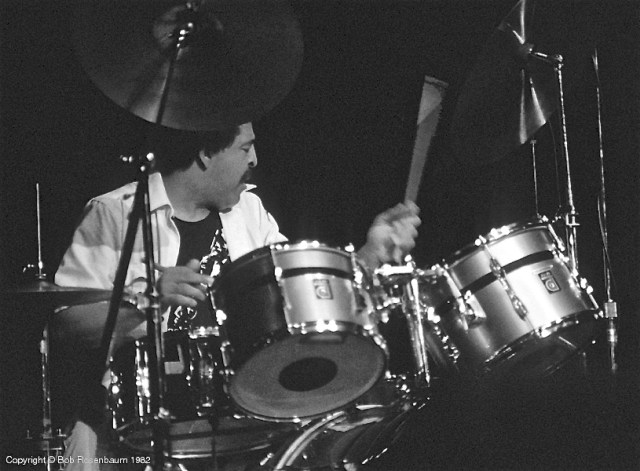
Max Roach: Every Drummer Should Play a Melodic Instrument

820006_maxroach_scottkfish_ludwig_ad

SKF NOTE: This exchange with Max Roach took place on July 15, 1981 at his home in Connecticut. The back story is posted here

I asked Mr. Roach if he thought musicians should be aware of the business side of music. He said, yes, musicians should be aware to guard against people taking advantage of them. But, said Roach, musicians should leave the business side to professional music business people, and concentrate on the creative side.

=====

Max Roach: When [I] teach up there at U. Mass., or I get to advise a student, I tell him to concentrate on the art. Concentrate on developing technique in every aspect.

I am a firm believer that every drummer should play, should also perform on, a melodic instrument. Mallet instrument, preferably.

And, of course, keyboard harmony on piano.

I teach theory…at the school. That was my major in school, not percussion.

When I get a student who plays a melodic instrument, I insist they learn how to play drums. Just keep time.

So, say I have the reed section. I insist they have a jam session amongst themselves — and create their own rhythm section out of the reed section.

The drummers…should do the same kind of thing. They should have the melodic and harmonic properties available to themselves — and learn these properties. It all helps, even though their major is percussion. [W]hen [a drummer] sit[s] down, [they’re] not just sitting in there as a percussionist, and that’s all [they’re] aware of. You’re aware of everything that’s going on around you.

And I find — especially working with M’Boom today, some of the most interesting and original compositional concepts are coming from percussion players. I listen to some of Tony Williams‘s work. I listen to some of the things Billy Cobham hears. It’s interesting, and it’s another concept.

So, I encourage students who are drummers and percussion players to do some writing as well.
Posted in SKF Blog | Tagged , , , | Comments Off on Max Roach: Every Drummer Should Play a Melodic Instrument

J.R. Mitchell: All The Time, Music Has to Swing

JR_Mitchell_KoolFest_82_wiki

SKF NOTE: J.R. Mitchell was an interesting man to interview in 1983. A multi-faceted musician, Mr. Mitchell played drums, taught college classes in jazz history, had his own record label, and played, in his own words, “creative music.”

Before meeting Mitchell, I would have described his “creative music” as avant garde jazz.  But Mitchell’s “creative music” went beyond avant garde jazz.

At one point I asked Mitchell to describe the function of the drumset in the music he described as “creative music.” His response includes a view of musicians getting too deep into analyzing music, too attached to charts and written notes.

=====

J.R. Mitchell: Well, in creative music one very rarely uses the bass drum. In a big band you have to [use the bass drum] because it helps push it. But the bass drum is actually only supposed to be used for accents. Other than that, in terms of keeping time, the sock cymbal does it…either on [beats] 2 and 4, or 1 and 3.

Scott K Fish: Unless you’re playing like Elvin Jones.

JRM: Well, Elvin’s shit is poly.., but I bet you if you notated it and said, “Elvin, this is what you just played,” he wouldn’t be able to play it. It’s fine to analyze. But, some artists [analyze] so much that they forget that one [thing] music has to do all the time is swing.

I was playing with Jacki Byard‘s big band.., reading the charts right down. Jacki had given me the music ahead of time. [But], he told me at the rehearsal, “Man, you’re not swinging. You’re reading the music, but you’re not pushing the band.” And that’s what was happening.

I played in George Russell‘s ensemble. The music was real interesting and…very challenging. But in all the time I played in it, [Russell’s] band never swung. And it wasn’t just me. The music was very creative.., very rhythmic, but it never swung. [You] couldn’t really pop your fingers to it or…dance. And it happens when musicians get so technical.


Posted in SKF Blog | Tagged , , | Comments Off on J.R. Mitchell: All The Time, Music Has to Swing

Keith Copeland: Latin Drummers to Study

SKF NOTE: This excerpt is Keith Copeland’s expanded answer to my question:

Let’s consider somebody who wants to study the great jazz drummers, but so far his only listening/playing experience has been in rock. He has no idea where to begin. Can you name some key drummers you’d recommend? And also some particular albums?

Keith gave a great response on jazz drummers. Without my asking, Keith also included latin drummers.

The audio here is not the best, but you should have no trouble understanding Keith. The drummers he cites here are:

Daniel Ponce

Steve Berrios

Ignacio Berroa

Steve Gadd

Ralph MacDonald

Johnny Rae

Walfredo de los Reyes Sr.

Willie Rodriquez

Alex Acuna

Don Alias

Willie Bobo

Grady Tate

Airto

Dom Um Romao

Armando Peraza

Mongo Santamaria

Carlos “Patato” Valdez

Francisco Aguabella

Posted in Audio, SKF Blog | Tagged , , , | Leave a comment

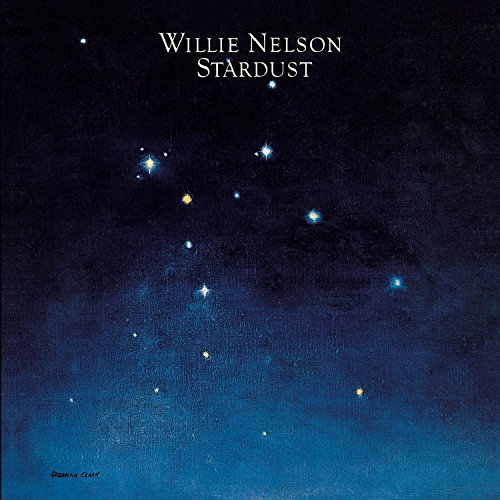
Paul English on the Making of ‘Stardust’ (1981)

stardust

SKFNOTE: In 1981, Willie Nelson‘s drummer and friend, Paul English, interviewed with me by phone. Here’s what Mr. English had to say about the making of Nelson’s classic Stardust album.

Paul English: We done Stardust in three days. We’ve never taken over three days to do an album.

Scott K Fish: Never?

PE: Never. We don’t know what we’re gonna do when we go in there.

Alright, when we done Stardust, Willie had eighty songs. And we got the music and everything, but…. We got the lead sheets ’cause [Willie] didn’t want to do them wrong. This is the type of a song you’re supposed to revere. That’s what we thought. Well, that’s our thinking still.

And we weren’t trying to jazz them up or anything like that. No. They were good when they came out. So, [Willie] just wanted to make sure he got the melody straight on.

And then Booker T. [Jones], who was living in California, we got ahold of Booker T., and Booker T. played with us — and that was a real inspiration for us, you know.

See, Willie never tells us how to play. So we get to create ourself. If I’m playing fancy, he might say, “It’s too busy.” But, like [Willie] told me one time, if I wasn’t a better drummer than he was he wouldn’t have hired me.

Posted in SKF Blog | Tagged , , , , | Comments Off on Paul English on the Making of ‘Stardust’ (1981)

Saving an Old Birdseye Maple Snare Drum

SKF NOTE: Thank you, Lee Vinson, at The Boston Drum Builders, a website devoted to Boston’s early 20th century drum makers, for your help in bringing to light this old snare drum I bought at a yard sale. The snares are stamped “A.A. Young, Lynn, Mass” — which led me to Mr. Vinson’s web site and email address.

The shell is 14.5 inches by 3 inches. With new heads, some cleaning, some lubricating — it will be interesting to hear how this old drun sounds.

Any one know where I can buy 14.5 inch batter and snare heads?

P.S. A.A. Young was born and is buried in in Maine not far from where I’m living.

=====

Hi Scott,

Thank you for writing. That’s an interesting little drum you have there!

Well the snare wires are certainly A. A. Young’s doings. The rest of the drum may be as well. It does make sense that the drum would still be in that part of the country!

I’ve only come across a very small number of Young’s drums and each of them are quite different. I did see another set of snare wires like that once. It seems Young was very much a DIY kind of guy, willing to piece drums together from whatever he could come up with. Just about every nugget of information I could mine is in the blog post you already found.

I’d be especially curious to know what the snare mechanism looks like. [H]ow many plys [is] the shell? Is there a vent hole with a grommet on the shell?

The thumbrods and claws are pretty nondescript, the same variety used by many makers of the era. The pencil markings are interesting but I don’t know that they can be traced to a specific maker..

-Lee

Hello Scott,

The snare mechanism is a design by William McIntosh commonly used by Boston’s Geo. B. Stone & Son. More on that here:

But the shell is very un-Stone like, so I would rule them out as a maker. Again, it’s hard to tell where Young was getting his components from and how much if any he was manufacturing for himself. Regardless, the bird’s eye maple is really striking and despite some extra holes everything looks to be structurally sound which is great.

New calfskin heads would bring this guy back into working condition if that’s the direction you decide to go with it. I’m happy to help if I can be of any further assistance to you!

Posted in SKF Blog | Tagged , , , , | Comments Off on Saving an Old Birdseye Maple Snare Drum