Neil Peart: I Take Enormous Care on Every Word (1984)

London-crowd-credit-Neil-Peart-1024x768

POV shot from behind the kit. Photo: Neil Peart

SKF NOTE: In our 1984 phone interview, Neil Peart spoke, in part, about how Rush writes songs. This exchange is from my full transcript of that interview, much of which was never published because there wasn’t room for it.

Scott K Fish: In 1980 you spoke of the Rush songwriting process. You said, “The three of us try to establish the same feeling for what the song should be. Then you bring the technical skills in to try to interpret that properly, and achieve what we thought it would be.”

Can you [rephrase] that [in] English?

Neil Peart: Nothing could be plainer! It’s verbalization. When we’re working with a set of lyrics, we determine: What should this song be? What kind of mood do we want? If it feels like a light, slow song, should we make it a heavy, fast song?

We verbalize the possibilities. We discuss the emotional context of the songs. Is this song ironic or direct and to the point? Is it accusatory or confessional? It’s the attitude the character of the song has. The attitude of the song is talked about before any music is applied. Even the tempo and rhythmic feel will be verbalized first.

That’s where the relationship between us becomes critically important.

It’s usually a first person song, occasionally a narrative song. “Manhattan Project,” the story of the birth of the A-Bomb is a documentary, a third person narrative about a seemingly cold, historical event. We were very conscious of personalizing it, of putting in tension, aggression, and all moods that would be involved in it.

We were talking about such an enormous event, we had to think big musically. We orchestrated a string instrumental solo in the middle. That was [producer] Peter Collins’s bit of input.

Geddy [Lee] suggested the “imagine a man” device. Imagine a time when the war was going on. A place in the desert. Imagine a man walking back-and-forth. Inviting the audience to share this image instead of saying, “Here’s the picture.”

It was a great little piece of inspiration.

SKF: You said in 1980 you don’t put much importance on lyric writing. Still true?

NP: Yeah. If I remember, part of my reasoning was the amount of time I spend on it. I might spend one or two months every two years writing lyrics. And I don’t think about it all the time.

If I see a neat phrase that would make an interesting title — I’ll write it down. An image I like. A line that springs into my head while riding my bicycle. I collect all those things very informally. Page after page of scratchings.

When it’s songwriting time I can literally say, “Okay, today I’m writing lyrics.” There’s no waiting for inspiration. I’ve collected all the inspiration months before.

I lavish enormous care on every word, rewriting until I die. In average [Rush song] lyrics I guess I have a couple hundred words. So I’m very conscious of every word’s value.

Often, the line I started with doesn’t exist at the end. It becomes the foundation.

I’ve heard this applied to story writing. You apply your foundation, build up the story, and take the foundation out, because you don’t need it anymore.

###

Posted in SKF Blog | Tagged , , , , | Comments Off on Neil Peart: I Take Enormous Care on Every Word (1984)

Monk’s Cure for Drummers Who Won’t Keep Good Time

MUSIC_020_Paul-Motian_JohnAbbott

SKF NOTE: One of my most memorable drummer interview stories: Thelonious Monk’s cure for drummer’s who can’t keep time. This is from Paul Motian‘s 1980 interview. If I can locate Paul’s telling of this story on tape I will digitize and post it.

=====

“One time I was playing with Monk and I think the tempo picked up a little bit. At the end of the set I went over to him and said I was sorry; that I might have rushed a little bit on that number.

“Monk said, ‘Well, if I hit you in the side of the head you won’t rush!’

“That’s great advice,” Paul Motian laughed. “I’ve never rushed after that.”

Posted in SKF Blog | Tagged , , , , | Leave a comment

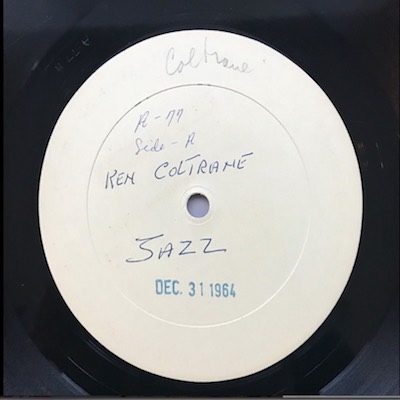
‘A Love Supreme’ Test Pressing for $20,000?

A-Love-Supreme-test-pressing

SKF NOTE: It will be interesting to see if this test pressing is worth $20,0000 to someone. No mention in the report if anyone has played this test pressing to see if it is, in fact, the John Coltrane Quartet’s ‘A Love Supreme.’

=====

Ultra-Rare Test Pressing Of John Coltrane’s ‘A Love Supreme’ For Sale
By Paul Sexton
February 2, 2018

An ultra-rare test pressing of one of the most celebrated jazz albums of all time, John Coltrane’s 1965 masterwork A Love Supreme, is now for sale on eBay. Collectors may need a sharp intake of breath when they discover that the “buy it now” price is listed, at this writing, at $19,999.99.

Academy Records added that it had bought the test pressing from “a guy whose thing is hunting through thrift stores, garage sales. We couldn’t find another copy to know how much to sell it for.”

Full Story

Posted in Drum/Music News, SKF Blog | Tagged , , | Comments Off on ‘A Love Supreme’ Test Pressing for $20,000?

Triplets, a Hi-Hat, and Ears: Perfect Art Blakey

SKF NOTE: Art Blakey shows us on the title track from Lee Morgan’s 1964 Tom Cat album, that perfect drum accompaniment doesn’t require a bazillion notes played on multiple drums and cymbals. No. Quarter note triplets, a hi-hat, and ears work perfect.

This whole album is excellent. Lee Morgan (trumpet), Curtis Fuller (trombone), Jackie McLean (alto sax), Bob Cranshaw (bass), and Art Blakey (drums).

Posted in SKF Blog | Tagged , , , , | Comments Off on Triplets, a Hi-Hat, and Ears: Perfect Art Blakey

Kasiva Mutua – A Human Being Doing an Amazing Job

SKF NOTE: I’ve had a soft spot since the early 1980s for what might seem to be unlikely musical collaborations. Bruce, an airline steward I met through Modern Drummer magazine, told me stories of how his job enabled him to move percussion instruments from one country to another. He liked to pass along the instruments without instruction, without telling the musician recipients something like, “Here’s how this instrument is played in China.”

Bruce liked to see and hear what the new percussion instrument owners would create on their own. I never heard the results of Bruce’s musical experiments, but I always loved the concept.

In the mid-1980s Nashville based studio musicians Edgar Meyer, Jerry Douglas, Bela Fleck, Mark O’Connor, and others released several albums that fit neatly into no musical genre. The music was a mix of bluegrass, classical, jazz, pop — experimental music that often worked well. And even when the experiment missed, I still liked listening to them, and supported the musicians for their pioneering work.

Edgar Meyer, Mark O’Connor, and other players from that group began recording experimental music rooted in Appalachian folk music with Yo-Yo Ma. Ma came out with a few excellent albums recorded with Argentinian and Brazilian musicians. Then Yo-Yo Ma brought together, recorded and toured, with the Silk Road Ensemble with musicians representing “dozens of artistic traditions and countries, from Spain and Japan to Syria and the United States.”

Again, to my ears sometimes the Silk Road Ensemble music works, sometimes not. But I always listen.

So it is that this news story about Kenyan drummer Kasiva Mutua caught my eye. First, for her willingness to break through senseless customs about women playing drums, then for excelling at drumming, and then for her role in the musical collaborative group, The Nile Project.

I listened this morning to a couple of Kasiva Mutua interviews, and also, to bit of The Nile Project. Looking forward to listening some more.

=====

cnn.com – 1/8/2018
Told not to drum, this woman is breaking a centuries-old taboo
Story by Stephanie Busari and Barry Neild
Photos and video by Edward Kiernan

Today, Mutua’s uplifting rhythms are in demand at music festivals and in recording studios around the world.

“Drumming has been a subject of taboo to women in Africa and me rising as a percussionist and going publicly with it and making a living out of it is problematic to some people,” she says.

Having learned traditional drumming from her grandmother, she took her skills to local contests, eventually defying expectations to win prizes and recognition.

And she’s using her energy and profile in Kenya and beyond to encourage other young women into music, with the aim of inspiring all-female bands.

“Women can do whatever they want,” Mutua says.

“It’s not about genders anymore, it’s about delivery,” she says….

…I feel like once you’ve proved to the world that you are just a human being doing an amazing job, people tend to accept you better.”

Full story

Posted in Drum/Music News, SKF Blog | Tagged , , , , | Comments Off on Kasiva Mutua – A Human Being Doing an Amazing Job