SKF NOTE: This unpublished phone interview with William Smokey Dacus (pronounced Day-Cuss) has been on my mind for 35 years. In my view, it deserves publishing. It should be available to music historians and drum historians — especially, but not exclusively, to country music historians.
Smokey Dacus was the first drummer to play in a country band. Legendary bandleader Bob Wills had the idea, in Smokey’s words, to add oomph to Wills’s fiddle band. “So he hired me,” says Smokey.
Smokey went from working in bands and orchestras where everything he played was written, to Bob Wills and the Texas Playboys where nothing was written. Plus, Smokey had no role models. No other drummer was asked to do what Bob Wills asked Smokey to do. How Smokey adapted is a key piece of drumming history.
I was working on a five-part feature series for Modern Drummer magazine in1981 called The History of Rock Drumming. One part was called “Country Drummers.” I was originally talking with Smokey for some basic information on Bob Wills and the Texas Playboys’s influence on the early rock-and-roll musicians like Elvis Presley, Jerry Lee Lewis, and Roy Orbison who created their brand of rock from a country music foundation.
While I was interviewing Smokey I realized what a pivotal drummer he was. So I kept the tape rolling, thinking I would have little trouble, if any, persuading MD Founder Ron Spagnardi that Smokey Dacus was worth a feature interview.
I was wrong. Yes, I did include Smokey in my Country Drummers segment, but the full interview has been sitting in a box since 1981. I found it again about two weeks ago, thankful I have a venue with Life Beyond the Cymbals where I can publish this interview myself.
As sometimes happens, looking back I wish I was more familiar with Bob Wills and the Texas Playboys’s music at the time of this interview. But sometimes ignorance produces interview questions I might not have asked.
SKF NOTE: I received some good news this week from drummer Jeff Neuhauser. After much research and writing, Neuhauser’s profile of exemplary drummer/drum teacher Roy Knapp, was accepted as a Wikipedia entry.
The Chicago-based Roy Knapp School of Drumming came up several times during my interviews and conversations with noted drummers while I was managing editor of Modern Drummer magazine. While I did have bits and pieces of the Knapp School story, Neuhauser has done a great service by piecing together a fuller story.
Roy Cecil Knapp (October 26, 1891 – June 16, 1979) known as “The Dean of American Drum Teachers” was an American drummer, music educator and sought-after studio musician skilled as a tympanist, percussionist and xylophone soloist. He was a longtime network orchestra member on shows broadcast during radio’s golden age in Chicago, Illinois.[1][2][3][4] And he was a founding member of the National Association of Rudimental Drummers (N.A.R.D.).
Notable students
Knapp became widely recognized as a teacher. His roster of former students includes:
Gene Krupa Louie Bellson Hal Blaine Mel Torme Dave Tough Baby Dodds George Wettling Fred Below Odie Payne Ed Shaughnessy Mousey Alexander Alan Abel Fred Anderson Elgin Evans[6] Others include: John P. Noonan, Duanne Thamm, James Salmon, Gordon Peters, Bobby Christian, Mark Walker, Jamal Mohamed, and Mike Balter.
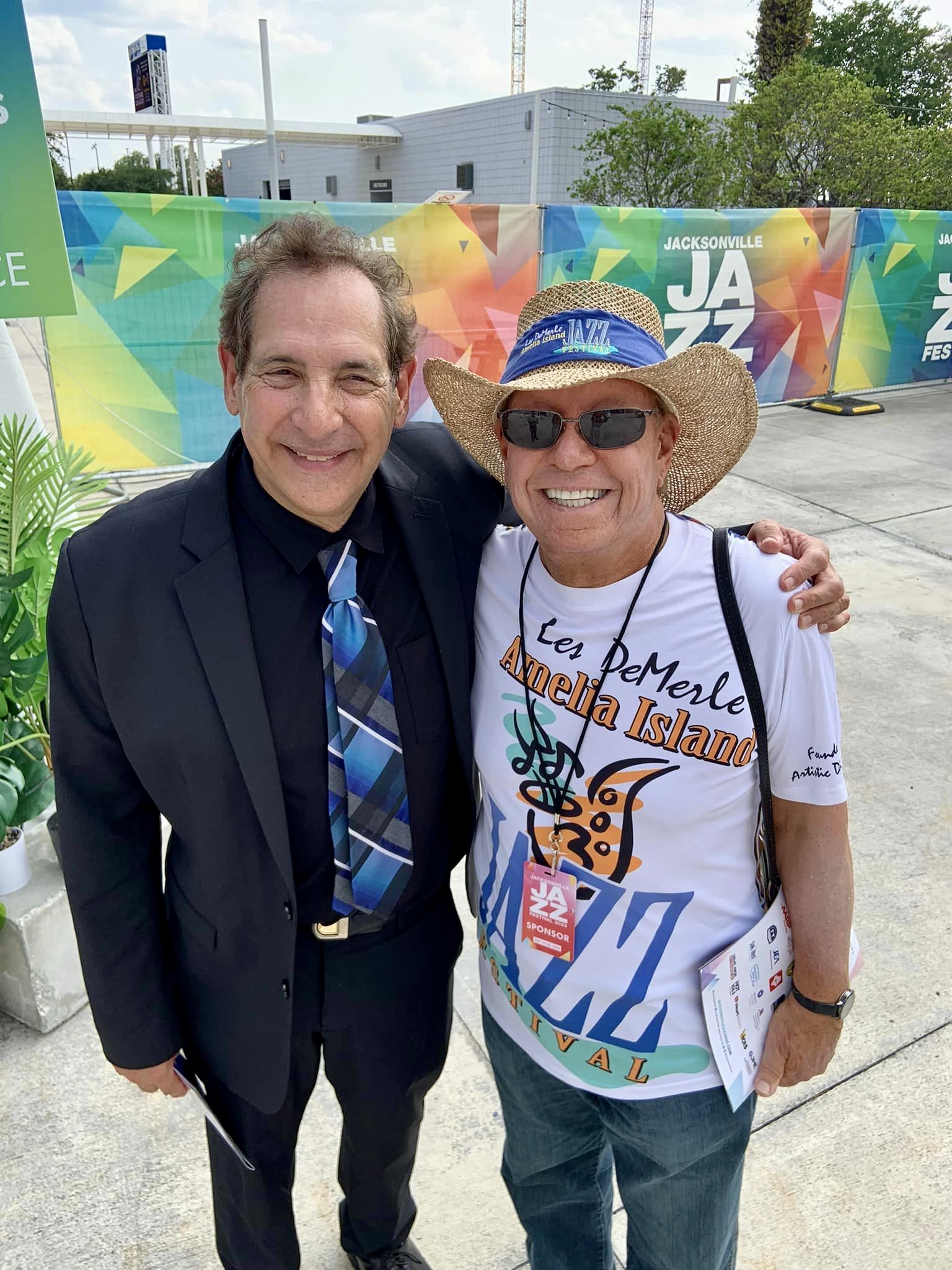
SKF NOTE – May 28, 2024, drummer Les DeMerle notified us through his Facebook page that drummer Danny Gottlieb was inducted into the Jacksonville Florida Jazz Hall of Fame.
Gottlieb performed at this year’s Jacksonville Jazz Festival. DeMerle is Artistic Director of the Amelia Island Jazz Festival.
Thank you to DeMerle for these photos of him with Gottlieb.
SKF NOTE: This is part of a longer interview that took place on April 3, 1982 after an Elvin Jones drum clinic at Professional Percussion Center in New York City. Taking part in the interview were Max Weinberg, Jaimoe Johnson, me, and Candy Johnson. Candy was Jaimoe’s wife and the late Allman Brother’s Band bassist Berry Oakley’s sister.
Jaimoe has gone through a few ways of spelling his name. Today he is legally Jaimoe. At the time of this interview he was Jaimo Johnson.
This interview was meant to be included in a book Max and I were writing. Max wanted to take the book in a different direction. I didn’t. So we amicably went our own ways, with Max publishing his book, The Big Beat. Jaimo’s interview stayed with me.
=====
Max Weinberg: What do you like most about being a drummer?
Jaimo Johnson: Well, tonight ladies and gentlemen, we have Jaimo Johnson with us here in the studios. He’s going to try to give us a little insight on what he do for a living.
Drums, man, they really intrigue me. I don’t know why. But, I used to be an athlete and I probably would’ve been an athlete, a lawyer, a doctor, or some shit like that.
But, the athletic thing? The drums is a kind of parallel ally of sports. And the drums? They’re just real physical. You do a lot of energetic things; a lot of fine things, for the drums. It’s an incredible instrument.
That’s just about it.
MW: The physical aspect of it?
JJ: Yeah.
MW: It’s like being a ballplayer in some ways.
JJ: Yah. And it’s like Charles Faroles (sp?) told me. He said, “Brother Jai, you need to get you one of them speed bags.” He say, “That’s what all the great drummers used to use.” And they did.
Because, it’s like (Charles) Honeyboy (Otis) told me. I said, “Man, how do you play in a small area like that?” He said when he was in the drum and bugle corps in Germany, they’d take a silver dollar or a fifty-cent piece, (and) draw a circle in the middle of the drum.
And he just learned to play like that. That’s why his drumhead would be completely white except for one spot where he’d worn the white coating off.
That’s why I tried to get into martial arts stuff. Because it would give me the physical endurance. Then you’ve got that direct thing on where it’s like (a) bullseye. You can close your eyes. You don’t even have to look at ’em.
MW: You know where it is.
JJ: You know where it is. I used to blindfold myself and practice because one of my eyes is bad. I figured if I went blind, would I be able to play my drums?
MW: Yeah. That’s definitely a consideration.
JJ: And I used to blindfold myself and practice.
Then I found that the easiest, the best way that it came out, is to put Vitalis (Hair Tonic for Men) in my hair. And that shit will burn your eyes when you start sweating. So I had to close my eyes ’cause they were burning up!
I found out that I could play them better.
Scott K Fish: Without the Vitalis?
JJ: Without the towel, because….
Candy Johnson: Honey, I don’t think we ought to give these secrets away. (Laughs)
JJ: …you were on the gig then. You were on the gig then. There’s a whole lot of difference in putting something over your eyes and closing your eyes. You’re up there and you’ve got to play.
I tell you, when I go out I want to go out the way Sonny did: right behind my drums. Or with a saxophone in my mouth.
SKF: How would you define a successful drummer?
JJ: I would define it as being able to make a living at your trade with what you’re doing. And the biggest challenge is, you can always practice. And you can practice things that you want to play. But, when you get on the gig, you’re playing things that you didn’t even practice.
CJ: Without losing the quality of it.
JJ: Yeah, without losing the quality of it.
CJ: Making a living at it without losing the quality.
JJ: The biggest challenge is to please yourself and to please the people. Now, it’s easy to please myself. But, I’ve got to figure out a way to do this where I can please the people and I can please myself too, by not doing anything but going out there playing. And playing what we’re going to play.
Because people pay you to come, and they tell you what they want to hear, and what you need to do. When they come to hear you, they come to hear you play. Now, if you don’t play 100-percent, everything is falling apart. You’re not going to fool anybody but yourself.
And when you start doing that you lose insight of that talent that you’ve got.
So, when these people pay you to come tell you what they want to hear, I think you should sit there and play what you want to play.
Now, playing what you want to play can come under being selfish, or it can come under being a musician. The whole thing is to strictly add to the music.
MW: Be supportive. Help (the music) along.
JJ: Exactly. Not showboating and all that kind of mess. But, basically, I’d say it is to please the people, please yourself, and make a living doing what you’re doing.
MW: Do you think your idea of success has changed from before you joined the Allman Brothers?
JJ: No.
MW: It has basically remained the same?
JJ: Yeah. I know financially it made me realize that there’s a lot of things I want to do. And you don’t have time to do a lot of things you want to do. So you make a lot of money — which sounds ridiculous when people say, “Those damn musicians are making 20 million dollars a year and so-and-so and so-and-so.”
But, if you take that 20 million dollars a year and invest it in something that is going to give somebody else a job, then that is the whole purpose of wanting to have that money in the first place. To do things that you want to do. And the money basically breaks down the barriers.
CJ: Obstacles.
MW: It makes it easier to get things done. If you had gotten better as a drummer all these years and weren’t able, really, to support yourself just by drumming; but you were playing great, and people dug what you played, would that be a successful drummer? Would that make you feel like a success?
JJ: That’s kind of hard to say. It’s like being a part-time musician. It’s like something that you learned when you was a kid, and you’re good at it, and you do it as a hobby, but you make money at it. But you do something else, really, to make a living.
CJ: That keeps it a hobby and not a profession.
MW: So one of the important ingredients is that you can support yourself by doing it.
You must be logged in to post a comment.