SKF NOTE: DrummingNewsNetwork.com is an impressive web site where it’s hard to imagine a part of the drum world not covered.
A few months ago, DrummingNewsNetwork.com owner, Paul Rogne, and I, had our first phone conversation.
Two weeks ago Mr. Rogne asked if, every Thursday, DNN could feature one of my blog posts. It might be my most recent blog post or it might be a post from the Life Beyond the Cymbals archive.
I happily to say yes to the offer. And I look forward to working with Paul Rogne and DrummingNewsNetwork.com.
SKF NOTE: Drum pioneer Jonathan “Papa Jo” Jones playing his signature “Caravan” drum solo in 1978. This video is brand new to me. The web has a few excellent videos of Papa Jo drum solos. This 1957 “Caravan” drum solo is another.
But the 1978 performance with the Mary Lou Williams trio, new me, is maybe new to you too. I love 1978’s close-up camera work on Papa Jo’s hands, sticks, and his signature old drum set.
Making available these notable music videos is one way the internet really shines. Sometimes I wonder how access to these videos would have changed my drums and drumming research and writing earlier in my career.
Maybe not so much. Radio, albums, album liner notes, photos, magazines, books, personal interviews – these are all valuable sources for story writing. Videos do add a visual dimension. We see drummers we’ve only listened to and read about.
Most valuable to my research is the video of the drummer I’ve only heard about; maybe read about briefly, or about whom someone shared with me only a brief anecdote or memory.
Still, I think almost all musician videos made public on the web are a blessing. How good for the 1978 camera crew to have captured Papa Jo for all time, and how good of Pascal Savelon to post it for us to enjoy and study on YouTube.
SKF NOTE: Buddy Rich endorsed Ludwig drums, Rogers drums, and several other drum brands. But in my mind it’s hard to separate Buddy Rich from Slingerland drums. On DrumForum.org one knowledgeable person said Buddy endorsed Slingerland 1938-1946, switched for a time to endorsing other drums, and then came back to Slingerland 1968-1977.
That makes sense. Those were formative years in my life. For a young drummer, Buddy Rich’s mastery of the instrument was the impossible dream. The gold standard.
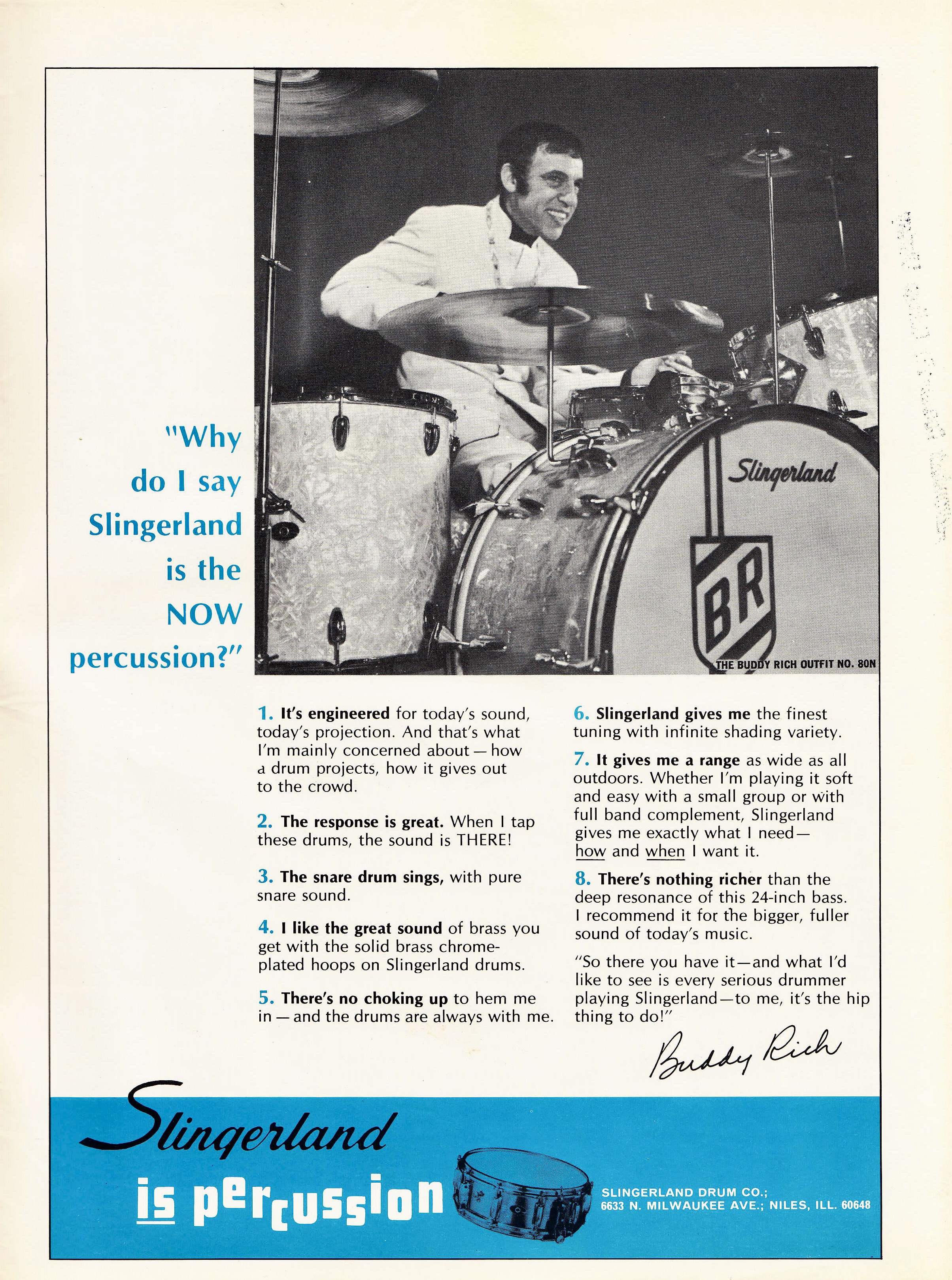
Whether I was watching Rich performing on tv, on an album, or in concert, he was always playing a Slingerland drum set that looked exactly like the set in this 1968 drum ad.
During Buddy’s tv appearances he often played loaner drum sets provided by the tv show. How those drum sets sounded was always a toss-up. One time Buddy sat down behind a four-piece Ludwig set that sounded as if a stage hand had just assembled the drums straight from their packing boxes, with no attempt to tension the drum heads for a good sound.
Whenever I heard Buddy playing his own drums they sounded great. The crispest snare in the business with deep, punchy toms and bass drum.
Sometimes I would see on tv Buddy struggling a bit playing on an unresponsive loaner snare. Even so, Buddy always sounded great. There was always a takeaway, a lesson learned, watching Buddy Rich play drums.
SKF NOTE: Piecing together for my History of Rock Drumming series the mystery that was Motown‘s drummers, I called Motown’s offices for help, and Brian Holland spoke with me! I didn’t ask to speak with Mr. Holland. I imagine the woman answering phones at Motown, after putting me on hold, announced, “There’s a guy on the phone from Modern Drummermagazine. He wants to talk with someone about Motown drummers. Anybody want to talk to him?” And Brian Holland was nice enough to come to the phone.
Backgrounder: The Rock & Roll Hall of Fame Web Site says, “Brian Holland, Lamont Dozier and Eddie Holland wrote and produced many of the songs that are most closely identified with Motown. These include “Stop! In the Name of Love” and “You Can’t Hurry Love” (the Supremes), “Heat Wave” and “Jimmy Mack” (Martha and the Vandellas), “Reach Out I’ll Be There” and “Baby I Need Your Loving” (the Four Tops), and “Can I Get a Witness” and “How Sweet It Is to Be Loved by You” (Marvin Gaye). These classics are only the tip of the iceberg, insofar as Holland-Dozier-Holland’s 10-year output at Motown is concerned. In their behind-the-scenes roles as staff producers and songwriters, Holland-Dozier-Holland were as responsible as any of the performers for Motown’s spectacular success.”
This excerpt on the respected drummer, Benny Benjamin, is from the full interview with Brian Holland.
Scott K Fish: How did you find Benny Benjamin?
Brian Holland: I think Berry Gordy knew Benny or heard about Benny from some big bands back then. Because he used to work a lot of people before Motown got started anyway. I think that’s how we came about with Benny.
He was a great drummer. The timing he had was…. I mean, I could play some things back now and listen to those pickups, and the timing that he had was just unbeatable. I mean really unbeatable.
I’m not saying that because he played with us back in those Motown days. I’m saying that because he had such great timing and with pickups. And he always felt the music as he went along. He would hum the music as he would go along, singing, just as happy as he could be, right along with the music. And he would always say, “Man, that’s a hit. That’s a hit.” And most of the time he was right.
SKF NOTE: Six years ago I wrote about drum photos as drum lessons. As a pre-internet kid, opportunities to see well-known drummers live were rare. Studying every detail of a great photo could command hours of my attention.
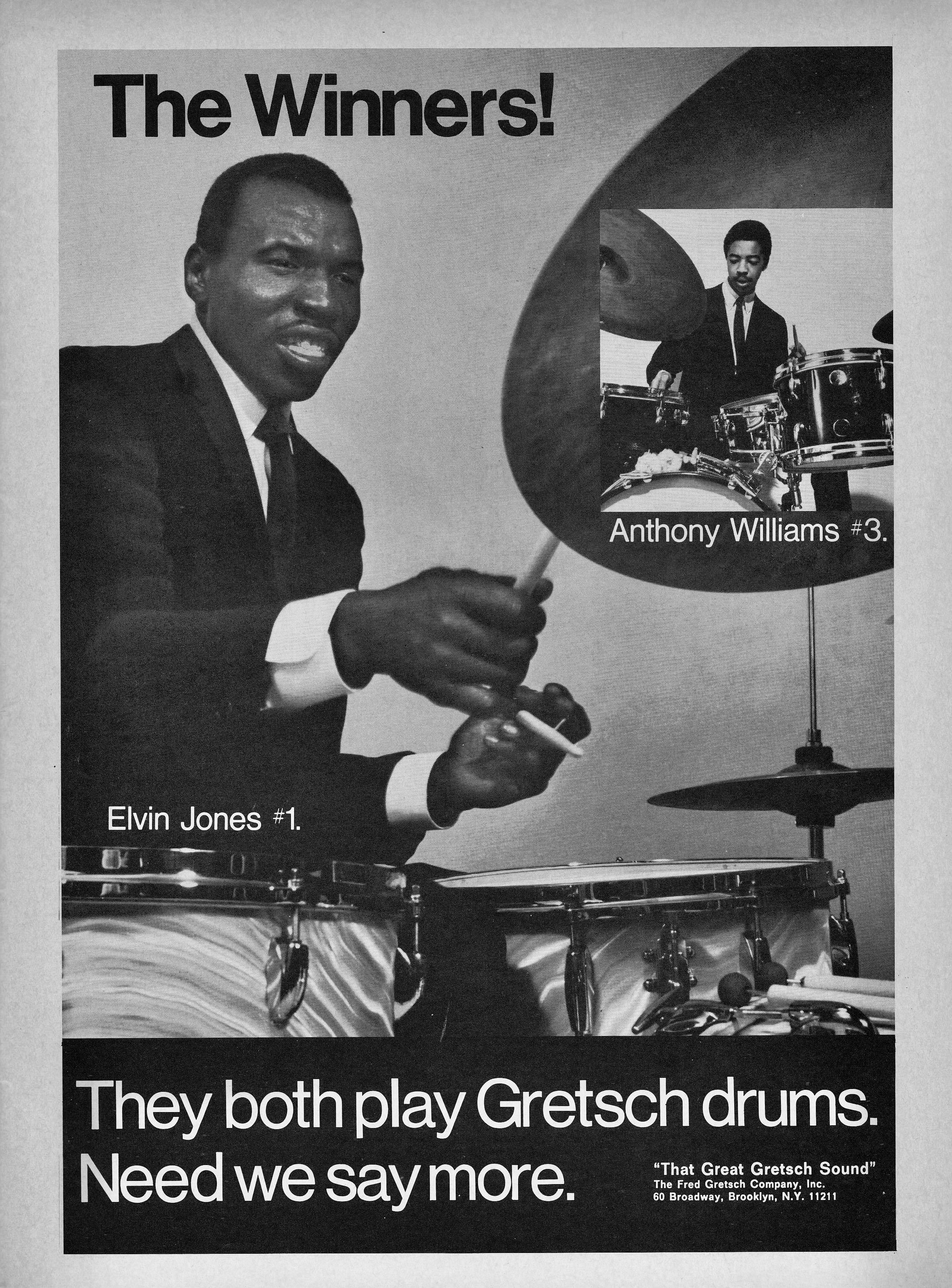
The fine points of this 1968 Gretsch ad with Elvin Jones and Tony Williams is a case in point. How are they each positioning their drums? What about the height and angle of their ride and crash cymbals? Their hi-hat stand and cymbals? If Elvin’s and Tony’s cymbals were set up different from mine – were they right and I was wrong??
Some of my favorite drummers had their ride cymbals mounted on cymbal stands attached to their bass drums. Tony and Elvin were using floor cymbal stands. Why? Is one cymbal stand better than another?
That how drummers set up their kits was a reflection of their physical size only occurred to me later in life. And only much later in life, while on staff at Modern Drummer, I found out the drum sets in those drum ads may not have belonged to the drummers portrayed. Chances are the photographers had a few sets in their studios for the drum ad photo shoot.
But one photo was enough to pique my curiosity. Why not put my ride cymbal on a floor stand and see if I like it?
Did I hold my drumsticks they way Tony and Elvin are holding theirs? If not, why not? Were they using plastic tip or wood tip drumsticks? Either way, why did they prefer wood or plastic?
With this Gretsch photo I’m sure I wondered how the heck can you play drums dressed in a suit?
When I have time now it’s fun to leaf through old music magazines, stopping at drum photos I remember, and those I missed the first time around.





You must be logged in to post a comment.