Mike Johnston marches to his own drum in the online education industry
October 10, 2014 by Kate Brosseau
Mike Johnston brought the beat to Big Kansas City with a live demo of just how legit a drummer he is. Johnston started playing the drums when he was five, and with drumming instructors such as Pete Magadini and Steve Ferrone, he was sure to get the hang of it.
However, the thrill of performing in front of 20,000 fans eluded him….
“I realized that just because [performing] is the world’s dream for me, doesn’t mean it’s my dream,” Johnston said. “I got my thrill from teaching, not playing in front of people, so I quit to teach private drum lessons.”
He began teaching at music stores, but…decided [to] put drum lessons on YouTube. After three years of building credibility through social media, Johnston launched MikesLessons.com to provide live and recorded lessons, making it the most successful educational site in the world.
“I spent three years on YouTube and social media to build trust, and I didn’t charge anything for it,” he said. “I was waiting for organic marketing to take place, and as soon as people started asking for more, I knew that was the time to direct them to MikesLessons.com.”
Remember the “I Wish” Principle
“The moment you say ‘I wish’ out loud, you need to act,” Johnston said. “If you’re wishing for something to exist then there’s a good chance others are wishing for it too.”
Paul Wilson’s grave, videod by Scott K Fish, October 16, 2023.
I just returned from a week’s vacation in St. Augustine, Florida. It is the United States’s oldest continuously occupied European-established settlement and port in the continental United States.
Scattered among the peaceful grounds of the Nombre De Dios grounds in St. Augustine – a mission dating in the U.S. back to 1565 – are a number of marked graves, including a handful of official U.S. Civil War military headstones of members of the 33rd U.S. Colored Troops Regiment.
I took photos of the headstones, including the gravestone of Paul Wilson. Tonight, just back in Maine from St. Augustine, I learned that Paul Wilson was the 33rd USCT’s drummer boy, dead at age 15. What are the odds a lifelong drummer, drum historian, and former managing editor of Modern Drummer would a) be at Nombre De Dios, b) take notice of Paul Wilson’s gravestone, c) take a photo of the headstone, and d) take time to research the headstone and discover a kindred drummer spirit.
How vast is the great heritage of drumming.
Here is an entry of Paul Wilson on one, now deleted, web page: Drummer: Paul Wilson – Age 15, St. Augustine, 5ft 4in, black, black, black. Mustered in December 19, 1863 in Beaufort by Thibadeau. Buried on the grounds of the Mission of Nombre de Dios.
During the Civil War thousands of enslaved Floridians escaped from their owners and found refuge in the Union-occupied towns of Fernandina, Jacksonville, St. Augustine, and Key West, where they were considered “contraband of war” and were not returned to their former owners. They found work on the abandoned plantations in the area controlled by Union forces, built fortifications, worked as teamsters for the Federal troops. As soon as Union policy permitted, more than 1000 self-liberated men from northeast Florida farms and plantations who settled into the swelling refugee camps outside the coastal towns, began joining three Union regiments organized at Hilton Head, South Carolina. Known originally as the 1st, 2nd, and 3rd South Carolina Loyal Volunteers, these regiments were officially mustered into the Union Army as the 33rd, 34th, and 21st regiments of United States Colored Infantry. For the remainder of the war these once-enslaved black men fought to free their families and other Africans Americans from bondage, and to bring a permanent end to slavery in the United States of America. By the end of the Civil War, 186,017 African American men from all over the divided nation had enlisted as “Colored Troops” in the Union army.
The cement basement (a.k.a. practice room) in my Connecticut rental cottage was just big enough for a 3-piece drumset. To my right, was the old wooden staircase leading upstairs to the kitchen. In front of me, an oil burning furnace. I spent many basement hours playing brushes along with piano trio recordings of “standard” songs, i.e. The Very Thought of You, Witchcraft, and Darn That Dream.
My goal was twofold. One, to memorize the lyrics, the words to the standards. Long before, I had read musicians I admire – such as Lester Young – say musicians can’t really play/interpret standards without knowing the lyrics. That’s true.
My other goal was to practice playing strictly as timekeeper; supportive, not getting in the pianist’s way; playing true to the song lyrics, and drumming musically. It’s not easy. The tendency is to toss bits of glitter here and there to make the drums interesting.
Practicing brushes in the basement, I most often played along with three albums, including a Prestige album, Nice N’ Tasty by pianist John Wright, with bassist Wendell Marshall, and drummer J.C. Heard. No bar burners. Just a collection of easy swing tunes and ballads.
Mr. Heard, whether it was swinging a big band, a quintet, or a trio, was a complete drummer. I don’t think we’ll hear or see the likes of J.C. Heard again. Music is always changing, Miles Davis said in his autobiography. It changes because of the times and the technology…available, the material…things are made of, like plastic cars instead of steel. So when you hear an accident today it sounds different, not all the metal colliding like it was in the forties and fifties. Musicians pick up sounds and incorporate that into their playing, so the music that they make will be different.
And so, Nice N’ Tasty, released in 1960, has Heard playing 1960 instruments, recorded with 1960s equipment, with a 1960 sensibility. Relying mostly on his hi-hat and ride cymbal. Sweeping brushes on the ballads. Cross-sticking the snare on swing tune backbeats. A few eighth note/broken triplet snare accents. No solos. Except for one Latin flavor tune – You Do It – it’s entirely possible Heard played this date with a 2-piece set. Snare, bass drum, no tom-toms. I can’t tell if he’s turning his snares on/off, using a tom-tom, or tapping a drumstick against his bass drum beater head.
Today, any number of drummers with a 2-piece set could remake Nice N’ Tasty. No one can remake its sound and feel, nor J.C. Heard’s sound and feel. Nor his touch. Joe Morello surprised me during an interview, saying – with no prompting from me – how much he admired Heard’s cymbal touch. (Heard’s was not a name that came up often, if ever, in drum interviews.) That touch is evident throughout Nice N’ Tasty.
That’s really what makes this album valuable. A moment in time. A wonderful drummer playing classic songs in an elegant setting.
Nice N’ Tasty‘s cuts are available as MP3 files under the album John Wright: Essential Jazz Masters. The songs on Jazz Masters are not in order, so the original Nice N’ Tasty tracks in order are: Things Are Getting Better, The Very Thought of You, Witchcraft, Pie Face, You Do It, Darn That Dream, The Wright Way, and Yes I Know.
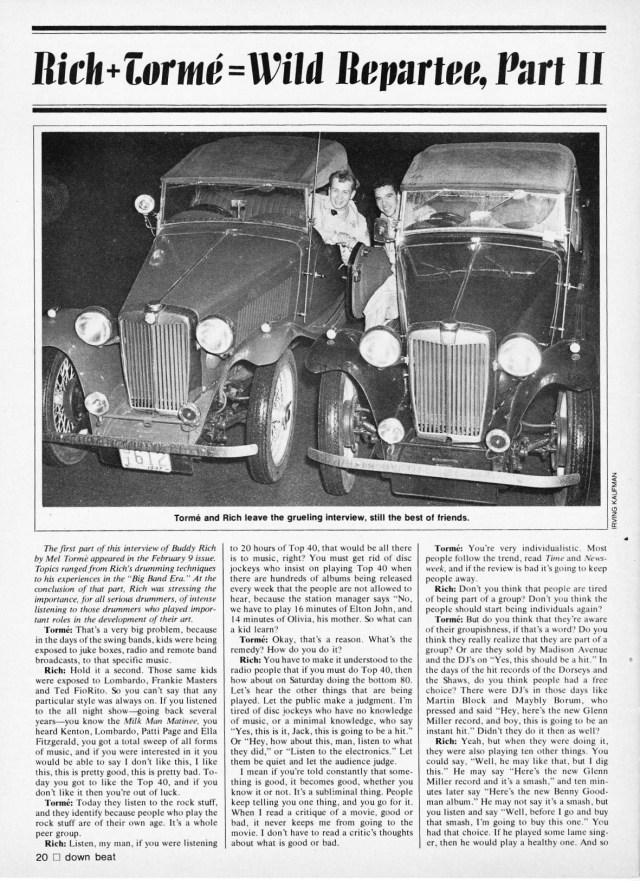
SKF NOTE: This is a wonderful, informative interview of Buddy Rich by Mel Torme. I still have the original Down Beat. This interview is so good that, by comparison, I thought Mel Torme’s book about Buddy Rich, Traps – The Drum Wonder: The Life of Buddy Rich, was a let down.
=====
Rich: That’s the idea of playing. The idea of maintaining some kind of stamina is to be able to get around the drum with the least motion. And that’s the way you do it. You have everything so that instead of having to play out everything, everything is just exactly where your hands would automatically be. It’s the same as having dinner, with a knife and fork in front of you. The position is everything.
Tormé: Once in Vegas, I asked you a dumb question about what’s the key to mastering technique with drums, and you told me that if you can master a roll, both closed and open, that was the center—the core of playing. Why?
Rich: If you can do single strokes and if you do them at an incredible speed, it automatically closes down to a closed roll. And if you lighten up on the speed, you pull back a little and you automatically have an open roll. One roll will take you back to single strokes. The single strokes will give you the flexibility to create rhythmical ideas, rhythmical patterns off of single strokes, and then you gradually follow that into triplets off the left hand, triplets off the right hand, back and forth going into a roll again. Most drummers who can’t roll really don’t have any techniques with the hands. You must have the ability to control your wrist to a point where you can make your roll sound like you’re tearing a piece of sandpaper.

 Mike Johnston brought the beat to Big Kansas City with a live demo of just how legit a drummer he is. Johnston started playing the drums when he was five, and with drumming instructors such as Pete Magadini and Steve Ferrone, he was sure to get the hang of it.


 Scott K Fish
You must be logged in to post a comment.