Mystic Rhythms: Rush’s Neil Peart On The First Rock Drummer JANUARY 06, 2015 2:03 AM ET
At 62, Peart has lived through and listened to a substantial slice of the history of modern drumming. He says he first wanted to become a drummer when he saw The Gene Krupa Story.
“He was the first rock drummer, in very many ways,” Peart says. “Without Gene Krupa, there wouldn’t have been a Keith Moon. He was the first drummer to command the spotlight and the first drummer to be celebrated for his solos, because they were very flamboyant. He did fundamentally easy things, but always made them look spectacular.”
The Original Funky Drummers On Life With James Brown
By NPR STAFF
Originally published on Mon January 5, 2015 9:42 am
All this week, Morning Edition is talking about drums and drummers. For the first installment in “Beat Week,” David Greene spoke with a duo who shared drumming duties for the hardest working man in show business.
From the mid-1960s through the early ’70s, Clyde Stubblefield and John “Jabo” Starks created the grooves on many of James Brown‘s biggest hits, and laid the foundation for modern funk drumming in the process.
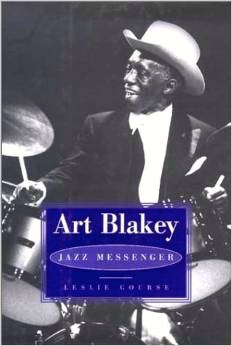
Leslie Gourse: Blakey had learned to play the drums by listening to recordings of [Chick] Webb and Big Sid Catlett, which prepared him to play with several big swing bands in the 1940s. Eventually.., Blakey met those drummers and got advice from them.
“Catlett was a huge man,” Blakey [said]. “He’d sit at the drum and make it sound like a butterfly – so pretty – it had nothing to do with loudness.
“Catlett could play just as soft with a pair of sticks as you can play with a pair of brushes. And Catlett could take the brushes and play with them like sticks. Sid was so big that when he sat down at a twenty-eight-inch bass drum, it looked like a toy. He was a master. I tried to pattern myself on him. He said, ‘Just roll.’
“[Webb] told me…to learn how to space my energy.”
Blakey…had…an act in which he threw different-colored drumsticks around. Webb caught the act and [said], “OK, kid, the first thing I want to tell you: The rhythm ain’t in the air; it’s on the hides.” Webb…told [Blakey] to show up the next morning to practice playing press rolls on a snare drum. “I want you to roll ’til you get to one hundred, and I don’t want you to break that roll,” he instructed. Every day Blakey showed up to follow Webb’s instructions. “I liked to busted my wrist,” Blakey [said]. “I developed a press roll out of that.”
Blakey was trying to improve his music-reading skills when Big Sid Catlett came to a rehearsal of the [Billy] Eckstine band and told him, “Don’t try to read everything; take some and leave some. And when you get in trouble, roll.”
Blakey [said] “One night I had a bottle of whiskey in my coat pocket and I was drinking through a straw from a bottle during the show. When I came off the stage, Sid Catlett grabbed me, hugged me, and picked me up. But when he felt the bottle, he put me down, hit me, and knocked me to the floor. He told me, ‘Next time learn how to master your instrument before you learn how to drink. Next time I catch you, I’ll break your neck.’
SKF NOTE: I especially like Mr. Conquest’s “dump drums.” Harry Partch must be smiling.
Percussion magician’s creations for sale
MIKE MATHER
Last updated 14:27, January 2 2015
Raglan carpenter and musician Dennis Conquest can make the most melodious of musical instruments out of the most unlikely of materials.
“I am a musician, not a performer. But I am a social musician. We are inviting people to come and play on these instruments each day the exhibition is on. From 10am to 2pm there will be an open jam session, for anyone who wants to come along.
“I am just a prolific maker of things. If you have a look in my workshop I have got projects all over the place.
“I have always felt its to gift to have this creativity. It’s a blessing to be able to do this when everyone else is at work and thinking all the usual terrible thoughts. I’m very lucky.”
SKF NOTE: Throughout my years drumming, writing about drums, or selling drums, I’ve heard stories of legendary local drummers. Living in Davenport, Iowa in the early 1970s, local music fans raved most often about Gaetan Caviola. At Modern Drummer, I took several calls from a young drummer, Chris, raving about a local drummer named Dave Weckl. Weckl, of course, became an internationally acclaimed musician.
But most local legendary drummers in my experience, remained local legendary drummers. I once suggested to founder/publisher Ron Spagnardi that Modern Drummer start featuring profiles of local legends, but my idea was nixed.
I’m reading this morning, for the first time, about Kansas City drummer, Tommy Ruskin. I am delighted to know about him, and very sorry my introduction to him is through his obituary. Perhaps there are readers who can share their personal stories of Mr. Ruskin. RIP.
Kansas City jazz community mourns the death of drummer Tommy Ruskin
BY JUDY L. THOMASTHE KANSAS CITY STAR – 01/01/2015
Drummer Tommy Ruskin, a longtime staple of the Kansas City jazz scene known for his sense of humor and jam sessions throughout the region, died Thursday after a yearlong illness. He was 72.
His death is a blow to the jazz community, said friend and internationally known jazz guitarist Pat Metheny, who grew up in the Kansas City area.
“Besides being the best Kansas City drummer of the past 50 years, Tommy was also one of the greatest musicians I have ever known,” Metheny said….
“In every way, Tommy was the complete package; perfect time, the most beautiful touch imaginable, an elegant technique on the instrument and a true improvisational storyteller in his solos.”
Metheny said he started playing with Ruskin when he was 14 or 15 years old.
“And I trace the essential knowledge that I acquired from Tommy in the areas of groove and form as the foundations of everything that I have built on over the years,” he said.
“This is a major blow to all of us who loved him, and the KC jazz community has lost a major force.”



 Scott K Fish
You must be logged in to post a comment.