W.S. Holland: the man behind the Man in Black
John Connor Coulston, MTSU Seigenthaler News Service
10:55 a.m. CDT August 7, 2015
….Bicentennial Mall Park in downtown Nashville.
[O]ne name on the lengthy bill you may not recognize…is one of the architects of early rock ’n’ roll, Sun Records session player and former Johnny Cash drummer W.S. “Fluke” Holland.
“I started playing drums in 1954,” Holland recalled…. “One night Carl (Perkins)…said, ‘We’ve got an appointment with Sam Phillips Thursday at Sun Records for a record audition. Borrow some drums and go with me.’”
In October 1955 Holland, with less than a week of drumming to his credit, headed to Memphis with Perkins, who landed a contract that day.
“When ‘Blue Suede Shoes’ came out, I had to make a decision to either keep working on air conditioners or play in a band,” Holland says. “So, I decided to play in a band.”
He spent the next five years touring and recording with Perkins….
Before he could call it quits, a musician called to ask if he’d join him on tour.
“He didn’t have a drummer in the band, and he wanted me to go on a two-week trip,” Holland remembers. “I went for that two-week period, and it lasted almost 40 years.”
The caller was Johnny Cash.
“We’re gon’ be playing a big building in New York, and I’d like for you to go, cause I think we’re gonna need more noise,” Cash told him….
When asked what it was like to tour with Cash, …Holland’s response is…: These were just the latest in a long line of gigs for what became known as the Tennessee Three.
“At the time we were doing it, we didn’t think anything about it,” he says. “It was just another place to play. Even [during] the prison [shows] there was never any kind of a problem. We just went in and played the shows just like we played anywhere else.”
Holland toured with Cash until the singer fell ill in 1998….
[C]urrent bandmate/manager Ron Haney… convinced him to start his own band, aptly named “The W.S. Holland Band.”
The four-piece group tours across the globe…laying Cash’s songs as well as hits from Elvis, Perkins and other stars of the era.
Smokey Dacus: Pioneer of Western Swing Drumming: Pt. 2 by Scott K Fish
[SKF NOTE: The back story to this Smokey Dacus interview is in Part 1.]
SKF: The playing was different then also. You didn’t have ride cymbals. You were swinging bands with press rolls, right?
SD: Press rolls! A press roll with either a straight rimshot on 2 and 4 or…. When I went to work with Bob I played a press roll with a rimshot in that press roll on the second and fourth beat. Then, if I took a chorus…. I got a damn tape over here a guy sent me a week to ten days ago. I take a whole chorus on drums and don’t play anything but press rolls! But I’m playing syncopated rimshot with both hands through that press roll.
And that was they way you played. You played press rolls. You played your drums. You didn’t just get up there and ride a cymbal or make a hell of a lot of noise. The boys I admired were the boys that played rhythm, that played the drums. If they set something up they didn’t set it up for the crowd to look at. They set it up to play it.
SKF: Was Bob Wills coming from a country music background?
SD: No. The one thing true with all of the musicians in Bob’s band was they had the freedom. Bob didn’t tell them what to play. There wasn’t anything written.
SKF: There was nothing written?
SD: Oh no! Later on, San Antonio Rose was written. But we played it a long time before it was ever written.
SKF: So you were like Basie’s band. Everything was head arrangements.
SD: Yes. When Bob asked me to join him I had the best job in Tulsa by far. I played luncheon music, dinner music each night, and I played three nights of dances up in The Topaz Room. I got my room and my board at the Tulsa Hotel. And on top of all that I got $15.00 a week in money. That was a hell of a good job.
Bob offered me $55.00 a week and I wondered where in the hell he was going to get it! I never did work a week for Bob for $55.00.
I worked for Box six weeks. He paid his band every night at the dance. We’d go eat and he and Mr. Mayall — the business manager, O.W. Mayall — took the tickets and done all that. They’d go back to a table, count up what they made, lay so much aside for the expenses, and then lay so much aside for operating capital. Then we’d split the rest of it. Mayall would decide what each man had coming. He’d be there eating ham and eggs or whatever, and he’d call us one at a time. We’d go back and get our money.
So, I went back in this cafe in Edith, Oklahoma. I never will forget it. Bob said, “Dacus, what am I supposed to be paying you?” I said, “Well, you told me you were going to pay me $55.00 a week.” And he said, “Well, what have I been paying you?” I said, “Oh, anywhere from $65.00 to $70.00.” [Bob] turned around to Mayall and he said, “Mayall!” He said, “That ain’t no good.” He said, “Let’s raise his salary to $65 a week.”
But we were doing better all the time. In about six or seven weeks Bob asked me the same question. He said, “What am I supposed to be paying you?” I said, “Well, over in Edith you said you was going to move it up to $65.00 a week.” He said, “What have I been paying you?” I said, “Oh, anywhere from $80.00 to $90.00.” He said, “Mayall, that ain’t no good. Let’s raise him to $90.00.” And there was some nights, Scott, I would get maybe $90.00 in one night.
I remember one night in Oklahoma City we went out to some people’s house — which we did all the time. So, [Wills and Mayall] would go through the same process whether we went to somebody’s ouse or we went to a cafe.
Mayall and Bob would count the money up. They had a set percentage they worked on all the time. I never did know what it was. But it included the expenses of that trip and a given amount for operating capital. That applied to every job.
But I never will forget. That night he give me $110.00. That night. That was the way it worked all the time.
On the music side of it. [Joining Bob Wills] put me in the position of being the first drummer in country music. There never was, at no time, a sheet of music on the bandstand. Myself, the piano player, and Eldon Shamblin on guitar were the only three people that ever set down on the bandstand. Leon McAuliffe stood up. He had a Dobro guitar with strap around his neck.
SKF: And he stood up all night?
SD: He stood up all night. The fiddle players stood up all night. And even, Scott, when we added horns to the group, they all stood up.
SKF: They never sat down?
SD: Never sat down. No.
SKF: Was that mostly for show? What was the reason for that?
SD: That was just the way we worked. We played one tune after another.
Somebody asked Eldon Shamblin one time, “How could you tell what Bob was going to play?” Eldon said, “Well, if you was one of the old hands, if you were around there long enough, when he picked up his fiddle you could tell what he was going to play.”
He would just hit a kind of an up beat with his fiddle bow. And when he come down — he was playing it! And the rhythm was already set. But nobody sat down. Horns, nobody. Eldon sat down playing a standard guitar. Piano player sat down, and I sat down. Everybody else on the bandstand — that included Leon McAuliffe…. Leon McAuliffe still stands and plays. He doesn’t sit down.
SKF: How many hours a night would you play?
SD: We’d play 9:00 [p.m.] to 1:00 a.m.
SKF: Forty minutes on and twenty minutes off?
SD: Oh no. We’d get on at 9:00. We’d get off at 1:00.
SKF: No breaks?
SD: No! We didn’t take intermission.
Bob was like this: I liked to dance. And maybe some girl would be there, or somebody I knew, or whatever. If I wanted to dance, then I would get down and dance. Tommy Duncan, he’d sit down and beat drums while I went down and danced. We all had that kind of freedom.
Leon McAuliffe loved to square dance. So, boy, the minute we called a square, why down he’d go.
But, as far as the band was concerned, it kept operating — 9:00 too 1:00 — riding down the road.
SKF: What was the band’s rehearsal schedule?
SD: Well, we had our noon program everyday at 12:30. On Thursday night and on Saturday night we played in Tulsa at Cain’s Ballroom — where we did our noon program. On Thursday and Saturday, since we weren’t going out of town, if somebody had an idea they wanted to work on, or if somebody had an idea and wanted to learn a new tune, why, then we might spend 30- to 45-minutes. Most of the rehearsal was oral rather than by instruments. Because there wasn’t anything written anyway.
You told somebody, “Well, why don’t you play it this way. Why don’t you play this and I’ll play this. Okay?” We made them up. We didn’t write them.
A while ago I mentioned Earl Hines. Well, Bob loved Blues tunes. Earl Hines’ recording of Rosetta was absolutely one of my tops. Bob decided he wanted to learn Rosetta. This was getting up in 1937 or 8, you know. Bob had a great big two-story house. All his family lived with him. All of his sisters and brothers, and Aunt Lou [sp.?] and Uncle Peak [sp.?] — the whole bunch. So he had to have a great big house. We’d go out to Bob’s and rehearse on a night. Like we were off — which had to be like a Sunday night or something — if we hadn’t played a theater someplace that day.
So, okay. Bob wanted me to bring my old 78 of Earl Hines Rosetta. Bob lived right on the Northwest corner of Second and Peoria in Tulsa. Now, right straight across the corner on the Southeast was one of these little, long, one-story grocery stores. Just a flat roof.
So, okay. I brought my record and Bob played it. He’s learning the words and the melody and all. But he kept breaking meter. When he’d sing, “Rosetta-aaaa,” he’d hold it too long. After about 30-minutes of that I couldn’t stand it anymore. I’d been [with the band] about three years then. I went over to the phonograph machine and I took that 78 of Earl Hines off there and I started to the front door.
I said, “Bob, you’ve got the right to play anything you want to play. But you do not have the right to mutilate!” And I walked out on the front porch and I sailed that 78 catty-corner across the street and it come down on top of that grocery store over there. We laugh about it yet. As far as we know it’s still laying up there. He just wasn’t going to tear old Earl Hines’ band up like that.
SKF: Did he ever get it right?
SD: No!
SKF: He never did?
SD: Never did. And he never got it the same way twice! There’s 32 bars. A standard chorus. Depending on how big a breath he got when he’d sing, “Rosetta-aaaa,” it might wind up with 31 bars. The next night it might wind up 31-and-a-half. And the next time we played it — it might wind up 33 and-a-half. Our piano player, Al Stricklin, tells this story in is book, My Years with Bob Wills.
SKF: Coming from bands where you read music for everything, to be thrown into a band where your depending totally on your ears — was that difficult for you?
SD: That’s the good part of the story, Scott. As soon as I tell you the good part, then I’ll tell you the hard part.
I didn’t know what it was like to have the freedom of playing whatever you felt like playing. Thee was no sheet of music there that said you play this here, you do it this way. You played whatever you felt like! All of us played all together by feeling. And it was great. I never looked at a piece of music in all of the years I was with Bob. I could watch somebody dance out there. I’d watch somebody fight over in yonder corner — whatever.
I didn’t have anything [sheet music] to look at. There was no straight-jacket you had to stay in. You played whatever you felt like.
An example of that: Johnny Gimble went to work with us. Johnny tells this one and just laughs about it. Johnny said the first night, Bob came over to him, he said, “Alright, son. When I point this fiddle bow at you I want you to play everything you know.” And Bob turned around and walked back over in front of the band.
And old Gimble was just standing there thinking, “My Lord!” Bob turned around and walked back over to him and says, “But, if you want to play the lead then you play it.”
You played whatever you wanted to play. Now, if [Bob] liked it, he’d let you know. If he didn’t like what you played — he’d let you know. But you had the freedom to improvise or play anything you wanted to.
To me it was great. I discovered for the first time…. When I was like 11-years old I learned to play Green Corn, Green Corn, Bringin’ in the Jimmy-John on a 5-string banjo. I was brought up on country music in the first place, but I was a country boy gone to town. And when I went to work with Bob, I didn’t know it, but I realized that I was back playing the kind of music I really liked. And on top of that, I didn’t have to read it because it wasn’t even written. That was great.
I played a lot of Dixieland — particularly when we were playing a nightclub or something — before I went to work with Bob. Maybe we had a bad night. Maybe wasn’t nobody there. Okay, we’d shut down [at] 11:00 or 12:00 o’clock. The place was empty. All we were getting were our tips anyway. We’d go over to another nightclub where some of the other boys were playing and we’d set in and play with them.
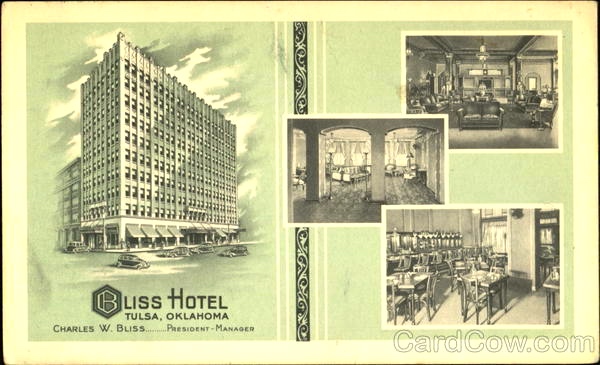
Bliss Hotel Tulsa
When they shut down at 1:00 or 2:00 o’clock, there was a bunch of us that lived in the Bliss Hotel, and we’d go back to the Bliss Hotel and jam until daylight. In those cases, when you were jamming, I played a lot of Dixieland because I loved it.
Okay. When I went to work with Bob — what the hell do you play? There’s nothing there to tell you what to play. There’s nobody in front of you [giving] you any indication of what you were supposed to play. And I fought it, uh, terribly hard.
I played a press roll on some tunes, [that] would work fine, Scott. Then on Maiden’s Prayer or something like that — you didn’t play a press roll. I went to the wire brushes in both hands and played smooth, swishy, hotel-easy brushes.
And so, different styles would work on different tunes. But what do you play that is basic with all tunes? I just sweat blood over that, Scott. The only thing that I knew for sure — the banjo played on the offbeat — just plank, plank. If you’ve every heard a banjo it goes clank, clank, clankety clank. That’s all there is to it! That’s why I ain’t that crazy about banjo players.
And the bass fiddle — he didn’t play four beats. If I played four beats I’d play four beat by myself on my bass drum. But, you see, whether or not you could do anything on a bass fiddle in a string band was how hard you could slap it. That was where the rhythm was.
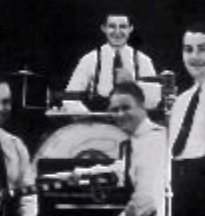
William “Smokey” Dacus
So, when I listened to that slap on the bass fiddle I begin to notice I could be way up front…. Maybe I’d got down to dance or something and I went up there and got a Coke up at the bar. When I couldn’t hear the rest of the music very well I could still hear the slap of that bass fiddle. Frankly, I didn’t understand it then, but it was the tonal frequency of that slap that just cut like a knife. You could hear the slap of that bass fiddle two blocks from the dance hall! That’s all you could hear two blocks from the dance hall, but you could hear that.
So that slap and the banjo — they played together. When Eldon came in the band he played rhythm guitar and choked the second and fourth beat.
Now my problem was: What do you play? Like I said, I had come up playing in this concert band before I ever graduated high school. The main objective there is to take 70-pieces and make it sound like one. You don’t hear single instruments. You hear the whole thing.
So with that in mind I took a brush in my left hand and played on 2 and 4. That brush blended with the choke of the guitar, the whack of the banjo, and the slap of the bass.
Well, that left my right hand free to do whatever I wanted to. To blow my nose or whatever!
So I would play [ride] cymbal. Or I would close my sock cymbal and play on my sock with my right hand, still playing my left hand with a brush underneath it. I learned I could play on all four beats with my brush! It just added a little bit to the first and third beats. In other words, it was a matter of accent. I didn’t accent the first and third, but you could feel it under there. Again, it was a situation of frequency.
SKF: What rhythm were you playing on your closed hi-hat?
SD: The standard rhythm. Like a bounce rhythm. I would play that on my sock cymbal with a stick. The first and third beat on top of the closed sock was just a click. That’s all it was. But when I hit the second and fourth on a closed sock, why, then the sound just melted into the rhythm guitar.
That’s when I finally found out. I had to figure it out — what I could play on drums that matched every other instrument in the band. And I still play it.
We were playing in San Antonio, this big thing, a year ago. There were about five or six bands. Tompall Glaser was there. When it come time for us to play, all these kids — there were six of them standing off there in the wing up there watching me play.
Tompall called me down to his room the next morning. He said, “Why don’t you come on down here. I got something I want to tell you.” I went down there and he had Leon MacAuliffe sitting down there because they’ve been great friends for years.
[Tompall] said, “You notice them bunch of drummers standing off over there in the wings watching you? I said, “Yeah. I don’t know what the hell they expected to see, but they was all over there watching me.” They said, “I wish you’d look at that old man up there. He’s playing a brush in one hand and a stick in the other — and you can’t do that.”
Because a brush is a hell of a lot lighter than the stick, you know? So you got a different weight in each hand. But way back there in the [1930’s], Scott, I had to learn how to compensate for that different weight.
The night before last in Austin, I walked in and Tammy Wynette’s band was there. I had used her drummer’s drums once before. I asked him, I said, “Is it alright if I use your drums if I don’t play in [the key of] A or in any of them damn offbeat keys? And he said, “Yeah.” I said, “You got any brushes?” He said, “I got one.” I said, “Hell, one’s all I ever need anyway!”
SKF: Tammy Wynette’s drummer had one brush and that was it?
SD: That was it. ‘Cause they don’t know how to use two. Most of them ain’t got any. That’s why, when I leave here — like when we went to the Smithsonian — I don’t take anything except a pair of sticks and a pair of brushes. I take a par of each one of them just in case I drop one of them or lose it.
SKF: What was your drum setup? Snare, bass, hi-hat, cymbal?
SD: Period.
SKF: You weren’t ever playing many fills?
SD: No. I don’t play lead. I told Bob when I went to work, I said, “Look, if you want me to play lead, then I want to set up out there on the front row with the rest of them. If you want me to play rhythm, then I’ll set back here in back.” He said, “I want you to play rhythm.” I said, “Great. I’ll set up here behind the band and that’s what I’ll play: rhythm.”
That’s what I tell the kids today. What they do, Scott, just to tell you the truth…. And I don’t mean this critical at all. But, you know, they’ll come to the end of an eight bar phrase and they got a two bar turnaround. So what [a drummer] tries to play in that two bars is about eight bars. And it won’t go in there! On top of that — they rush. They got all these wild licks they’re going to play and they got this one time.
When they come up to that turnaround — boy! — they fly into them damn things and all their tom-toms. They’ve got to hit everything they’ve got. Like they were sorting wildcats. When they come at the en of that two bar turnaround they’re going about 20-miles an hour faster than they was when they started!
A drummer — most of the time nowadays — has some kind of a complex. If he is just playing rhythm for the guys standing up there playing lead, he will think he ain’t doing nothing.
I don’t play for the audience. I play for the guys that are standing on the bandstand in front of me. And all the guys I’ve ever played with kind of like it for a drummer to play for them instead of play[ing] for hisself.
Smokey Dacus: Pioneer of Western Swing Drumming: Part 1 by Scott K Fish
Introduction
William “Smokey” Dacus
This unpublished phone interview with William Smokey Dacus (pronounced Day-Cuss) has been on my mind for 35 years. In my view, it deserves publishing. It should be available to music historians and drum historians — especially, but not exclusively, to country music historians.
Smokey Dacus was the first drummer to play in a country band. Legendary bandleader Bob Wills had the idea, in Smokey’s words, to add oomph to Wills’s fiddle band. “So he hired me,” says Smokey.
Smokey went from working in bands and orchestras where everything he played was written, to Bob Wills and the Texas Playboys where nothing was written. Plus, Smokey had no role models. No other drummer was asked to do what Bob Wills asked Smokey to do. How Smokey adapted is a key piece of drumming history.
I was working on a five-part feature series for Modern Drummer magazine in1981 called The History of Rock Drumming. One part was called “Country Drummers.” I was originally talking with Smokey for some basic information on Bob Wills and the Texas Playboys’s influence on the early rock-and-roll musicians like Elvis Presley, Jerry Lee Lewis, and Roy Orbison who created their brand of rock from a country music foundation.
While I was interviewing Smokey I realized what a pivotal drummer he was. So I kept the tape rolling, thinking I would have little trouble, if any, persuading MD Founder Ron Spagnardi that Smokey Dacus was worth a feature interview.
I was wrong. Yes, I did include Smokey in my Country Drummers segment, but the full interview has been sitting in a box since 1981. I found it again about two weeks ago, thankful I have a venue with Life Beyond the Cymbals where I can publish this interview myself.
As sometimes happens, looking back I wish I was more familiar with Bob Wills and the Texas Playboys’s music at the time of this interview. But sometimes ignorance produces interview questions I might not have asked.
Enjoy!
Scott K Fish: Maybe you could give me a little biographical sketch of yourself up to the time you joined Bob Wills.
Smokey Dacus: Well, I’ll be as brief as I can, Scott. The only thing terribly important is a common thread that runs through the period before I went to work with Bob. It was this:
When I graduated from high school in Blackwell, Oklahoma I had no thought, no intentions to go to college. I had the desire, but there was no way I felt I could go. Of course, I had a choice of maybe going to [the public] University of Oklahoma (OU) down in Norman. I’d have to work and pay my way through school. OU in Norman would be about my only bet because it was a State college and you had no tuition to pay. But that was really out of the question.
So I took a job at a local glass plant there in Blackwell. One day at noon I was sitting out on the loading dock eating my lunch out of my little lunch bucket. This fellow by the name of Roy Smith came out. He was all well-dressed, which would’ve meant he wasn’t a local boy. He was from Tulsa University (TU). He set down and told me they were organizing a Tulsa University dance band. An eight-piece band they were going to call the 8 Collegiates.
They were going to make this thing up out of different youngsters [from] across the State. They had heard that, for a high school graduate, I was probably the best dance drummer they had heard about. So, [Roy Smith] was looking for a drummer.
Well, he explained to me the 8 Collegiates would get all the school dances, and [Tulsa] University would serve as a sort of booking agent for the civic clubs in town. They had their occasions, their parties, their annual dances — this and that. [TU] figured they could get us enough work in Tulsa — plus getting paid for the school dances — that we could pay our way through school!
I never will forget the first Semester’s tuition was $114.00. Which seemed to me like quite a bit, anyway. Plus your room and board and all that stuff. But, it was a chance for me to go to college. If [Roy Smith] was right, it would be great. If he was wrong, I really hadn’t lost anything. If it didn’t pan out the way he had it all drawn up, Lord, I could come back home and go to work at the glass plant.
I went to Tulsa in August. [Smith] was a Phi Delta member and I lived at the Phi Delta house.
I don’t know how they got information that I was probably the best dance drummer. I graduated high school in 1915. I had been playing weekly for a couple of years with the local city band — a bunch of grown men. Every Wednesday night, why, we’d rehearse marches and whatnot in the basement of the Elks building. Then every Friday night, [at] the little round thing [gazebo], you know, down in the City Park, we had a free concert. Remember! This was back in the Thirties. 1929.
So I was able to read. I could read snare drum parts, bass drum parts, and so on. That was evidently where they got [their information].
Then I was playing around locally whenever I could at the Eagles Hall and whatnot.
But, anyway, I went to the University [TU] and everything worked out real fine. In the second Semester, one night, I went down to a dance by [Joe Lindy’s] local band — just to hear somebody else play. They had a drummer that was one of these stick twirlers, you know. He was a showman! He could twirl stick in both hands and everything else, but… when they’re up in the air, you’re not playing rhythm. You know?
My whole enjoyment from playing was to play a good…solid…rhythm for the other boys on the bandstand playing lead. The brass section, the reed section, or whatever. I never did care about showmanship. I cared about playing a solid beat.
So, this kid — oh man! — he was really showing off. Well, I was known, at least. They wanted me to sit in. I sit in and played about 30-minutes. And I didn’t twirl sticks. I didn’t do anything. I just played solid rhythm for the other boys.
Joe Lindy worked for an oil company and [worked] on the side playing trumpet. It was his band. He fired his drummer that night and gave me a job! They liked that rhythm instead of a show. That was where I started really [drumming] professionally.
But then I wound up playing with a hotel band there playing luncheon and dinner music. And we played three dances a week in the hotel.
Well, sufficient to say — well, Lord — I was making so cotton pickin’ much money then, I don’t feel like I needed an education. Besides, playing was more fun than going to school.
SKF: What were you studying at TU, Smokey?
SD: I was majoring in English and Psychology. TU was really a petroleum school. Tulsa’s the oil capitol of the world. But, I had been raised up there in the oil fields around Blackwell and ThreeSands. I didn’t care anything about [oil], so I majored in English and Psychology.
So I was playing in this hotel band in tuxedos. But the common thread I mentioned was: everything I played — luncheons, dinners, or dances — was written. That was when you used to go to Jenkins Music Store [and] pay 75-cents for an orchestration. The cotton pickin’ thing was at least a half-inch thick. There was a piano score, scores for at least four violins, a full reed section, three trumpets, the trombone — the whole bit!
Well, we didn’t have all those [instruments]. So we would just take out the pieces we needed for our group. But everything we played was read. Okay.
Original Sheet Music
The arranging was cut-and-dried and very distinct. On occasion it would be an 8 beat, designed to give a shuffle rhythm to the sax, the trumpet section, or whatever. In other places it would be what we call a 2/4 [rhythm]. That was “Dixieland,” but it was still in 2/4 because we used — not bull fiddles — we used bass horns. When you’ve got a tune like Song of India, Chinatown[, My Chinatown], or China Boy, when you really got up and really wanted to get with it — your bass drum was written four beats to the bar. What we called a “4 beat.” If you really wanted to swing and get with it.
So there were different types of rhythm. There was 4 beat. There was 2 beat. There was Dixieland — which is a 2 beat on the bass and like a rimshot or a woodblock — which was common then for Dixieland. But all those types or styles of rhythm. First, they were distinct and separate from another style. Secondly, they were always written.
And so, I was playing in this hotel band and Bob Wills approached me. Somewhere along the road I had gathered the reputation of being the best dance drummer in town. And Bob came to me in late ’34 and he wanted me to come play drums with him.
Well, at that time, his type of music had two names. It was either a fiddle band or a string band. That’s the only way you referred to them. And they did not use drums! They had no use for a drummer because their rhythm was a bass fiddle and a banjo — which was the basic rhythm.
Now, you add a guitar to that, well, he kind of helped it a little. And the piano player, if he wasn’t taking a chorus, well, then the piano player played rhythm. Just chords. So the rhythm section at its high point included the bass fiddle, the banjo, the guitar, and the guy chording the piano.
Well, also at that time, the way you played a bass fiddle in a string band or a fiddle band was you pulled or you noted the bass fiddle on the first and third beat in a bar. Then [the bass player] slapped [the bass fiddle] on the two and four beat: mmm-slap, mmm-slap, mmm-slap. They didn’t play 4/4 on a bass fiddle because, in the first place, it was too hard on their fingers. And in the second place, they couldn’t do anything with it.
Well, when they slapped it was that bass string slapping against the neck of the bass fiddle — which made a click. And that was the rhythm.
So, [Bob Wills] came to me and I said, “What in the hell do you want with a drummer in a fiddle band?” I thought he’d lost his mind! And he said, “I want to take your kind of music and my kind of music and put them together and make it swing.”
SKF: You and Bob Wills were playing two different styles of music then. Were there bands or musicians you and your band were trying to emulate?
Sonny Greer
SD: Sonny Greer! Sonny Greer was the drummer with Duke Ellington at that time. Sonny, hell, he didn’t weigh 130 pounds soaking wet! He was one of my favorite drummers. But, my bands were Duke, [Count] Basie, McKinney’s Cotton Pickers. I don’t know whether you remember them or not.
SKF: Sure.
SD: Those were my people. Those were the people I looked at.
SKF: Had you ever met Sonny Greer?
SD: Oh yeah. You know, you just do when you hero worship somebody.
And I was in Oklahoma City at one of the high points of my life. [It] was out at Crystal Lake. McKinney’s Cotton Pickers were playing out there. You know, then we had huge ballrooms. And they were there.
Well, that was my first chance to see and hear McKinney’s Cotton Pickers in person. So you know where I wound up! On the back of the stage. And here’s this 28-piece band. Now you talk about swing and get it! I mean, they went!!
And the drummer — I can’t recall his name now — he had a bass [drum], and a snare, and a sock [hi-hat], and one cymbal. That was it. [I] set back there behind that whole band and that’s all the equipment he had. And there was where I developed the statement I use all the time now, Scott, when I walk in…. ‘Cause I don’t own a set of drums now.
McKinney’s Cotton Pickers. Drummer Cuba Austin standing near drum
[SKF NOTE: The drummer was probably Cuba Austin. Also, as of this writing I am unable to find any verification of McKinney’s Cotton Pickers having 28 musicians. The largest number I’ve found on record is 21.]
SKF: You don’t?
SD: No. I haven’t owned a set of drums since 1941. There’s no point in it. I don’t travel on the bus. I fly everywhere I go. And we go to Nashville, or Los Angeles, or wherever the hell we go — you just call ahead and tell that you want a set of drums. The guy in the van brings tom-toms, floor toms, every damn thing. Five times as much as anybody can play! And he’ll set them up.
I go in with my sticks and my brushes and I sit down and I play for two hours. I get up, put my sticks and brushes back in my pocket. He tears [the drums] down, puts them back in the cases, back in the van — all for $25 dollars. So what’s the point of owning anything?
I come to the conclusion years ago that the more drums a guy has got, the less he’s apt to play.
Sonny Greer had a pretty decent set of drums, but really not what kids have today. But [Sonny] played everything he had. And the little fellow was so short and so little. Sonny damn near had to stand up to play!
[Crystal Lake] was where I learned you didn’t have to have a whole lot of drums around you to play a damn good rhythm. Because that McKinney’s Cotton Pickers, I mean, they would just get and go.
Along with Earl Hines, those were the people I listened to and copied and enjoyed.
SKF: When you say you are the first drummer in country music — that’s literally true? There were no country bands per se….
SD: No! There was nobody using the drums. They didn’t need it.
Well, see, in those days, Scott, there was no such thing as a drummer’s throne. You had a hell of a time. You had these folding cane chairs that you had to get, an empty Coca-Cola crate, or something to sit on. Well, I always sit on my trap case.
As Bob’s band enlarged it got a little harder to really do all that needed to be done with a sock cymbal and a brush in my left hand. Whether my right hand was playing on the sock or not — it still wasn’t there. I had to step up a notch. Well, in my system I was playing I couldn’t quite step up. So I would take my right hand, turn my stick around, hold it by the little end, and with the butt end of that stick I would slap [my] trap case right down to the right of me where I sit. Well, that made the same racket that the bass fiddle made when he slapped it, except mine was a damn sight more potent than his.
SKF: You were hitting on 2 and 4?
SD: Yeah.
SKF: Instead of using your snare drum?
SD: I hit the snare too.
SKF: Snare and trap case together?
SD: Yeah. But I had to augment it a little bit. So I turned that stick over, hit my snare with the brush on 2 and 4, and hit that trap case [with my stick] on 2 and 4. I looked like I was riding a galloping horse going ninety miles an hour! But I guarantee you could feel it, you could hear it, for a half-a-mile.
One emcee at a Nashville event introduced me by saying, “Here’s the guy that invented suitcase rhythm.”
SKF: What kind of drumset did you record with in the studio?
SD: I’ll give you this example: When we did the album in 1973 — which was for the last time. That was when Bob had his last stroke, Scott. I didn’t have any drums. This kid from out of Big Springs, Texas brought his drums over there for me to play.
I was sitting there in Sumet-Burnet Recording Studio in Dallas. I set up his bass [drum] and one cymbal. I said, “Look, son, it don’t take much drums to play rhythm.” He said, “You mean you’re not going to use anything but the bass and the sock?” I said, “Hell, that’s all you need.”
And I played with both brushes on the sock. With both brushes. Then I would change and pick up a stick on the closed sock. That’s all I was playing on! Just sitting there playing real easy. This kids said, “Well, ain’t nobody going to hear you.” I said, “That’s what he’s [recording engineer] got knobs for in yonder.”
I recorded everything Bob ever made from 1935 to 1941. Every one of them. Fiddle tunes and all. You don’t have to beat your brains out in a recording studio.
SKF: How was it different in the studio in 1935-41 compared with today? For awhile you couldn’t record with a bass drum in the studio, right?
SD: Well, yeah, you could if they had a crapper [?] about 40 feet from the microphone. Because we had one microphone out in front for the whole band. The only way you balanced it was the proximity to that microphone.
If you had to sing — you got up to it. Leon played his Dobro guitar about belt level. When it come time for Leon to take a chorus he moved out front to this one microphone. Bob let it down for him, put the microphone right over top his steel guitar. [Leon] played his chorus, then he moved back. Bob would raise the microphone and Tommy Duncan [would] sing. If fiddles played, they went to the microphone. Everybody went to the microphone because you couldn’t bring the microphone to them.
In a recording studio then, the bass fiddle had to get back about 20-feet in whatever corner they could get him. And I got just [as] far as I could. Then I would put a quilt or something over the bass [drum]. Of course, I learned from the first recording session like that. Immediately afterwards I took the front head off of my bass drum. Because all bass drums had two head then.
SKF: Just to clarify, what year was this, Smokey?
SD: ’35. When I got back home I took the front head off of my bass drum. I went down to S.H. Kress & Co. and bought me a 36 square yard of this heavy muslin. Then I put it over [the front of my bass drum], put the head back on, put the rim back on, and tightened it down. Took a pair of scissors and trimmed it off. Okay. All you got then was thup. You didn’t get any ring. That worked pretty good. So I took the back head off and put [muslin] on it.
SKF: Did you play your bass drum wide open in concerts?
SD: Oh yeah. Sure. But you had to stop the ring in a recording session.
SKF: How about tuning with calf drumheads?
SD: [SKF NOTE: Smokey tells me he also played tympani with the TU Symphony.] You buy tympani in sets: an E and F. Okay, so now I was involved with tones and tuning and frequencies. I wasn’t that technical about it. There’s just some things I do, basically.
I always kept my bass drum tune to G. Basic reason for that is, that’s the one string on the bull fiddle [the bass player] will hit more times than he’ll hit anything else. I wold tune my snare, as close as you could tune a snare, to F. And tune it from a frequency rather than a tonal standpoint. So I tuned them like that and played them that way all the time.
SKF: [SKF NOTE: I asked Smokey if he ever had to contend with drums that had non-tunable calfskin heads on the bottom. He misunderstood my question. I think he thought I was asking about snare drums. Smokey’s answer about gut snares vs wire snares is interesting, so I didn’t interrupt him.]
SD: You take them damn [gut snares] off , you go to Jenkins Music Store and you buy a set of these little round wire snares, see? Then it didn’t make a damn what you did to the bottom head. You’re still going to get the same sound. You take the gut snares off, throw them away, put a set of wire ones on.
SKF: You didn’t like gut snares?
SD: No. Because we played in an armory — which is not what you’d call acoustically efficient — and [there was] a hell of downpour of rain outside. When I patted my foot on the [calfskin] bass drum [head] it would go anywhere from four- to six-inches and come back. But if you hit a snare it was kind of like hitting a wet blanket. If you kept tightening it during the night, then you damn sure better undo it before you put it in the trap case. If you don’t, you get back home and the next day it would be busted.
SKF: Right. The heads stretch.
SD: You’d better believe. So, you could allow that looseness with the little twisted coiled wire snares underneath it and still get away with it.
SKF: How did you become familiar with symphony music? Did you have a teacher when you were a kid?
SD: No. The only lesson I ever had in my life I gave myself.
When I was in junior high school, they had a high school band. They got to go with the football team. They’d go 20 miles over to Poplar City [???] —which was a hell of a trip. On a couple of occasions they went about 80 miles down to Oklahoma City. That was something else!
I figured there was some way I could learn to play in the band I could go on trips with the football team. I mentioned when I was 11-years old I learned to play on a 5-string banjo. But I was playing by ear. I knew when it was right and when it was wrong, but I didn’t know what the notes were. So I sent off to Sears & Roebuck and bought a $12.50 banjo.
I made a remark or two earlier that I wasn’t too crazy about banjos. But the reason why I ordered the damn thing is I got a $2.50 instruction book — free! It was the instruction book I wanted.
So, I took that thing and learned the notes, what I was playing, and the hardest thing for a percussionist — drummer — to play: the rest. The rest is what’s hard. I taught myself to read. I didn’t like that banjo, so I discovered I could take a [four string] tenor guitar, tune it like a banjo, and play just like I was playing the banjo. Only the sound was a hell of a lot better to me.
When I was in junior high school there was a boy that played an E-flat Bass Horn — about 8,000 yards of gas pipe that you blow through. His sister played piano. We got us a little band together. Then I got a job playing snare drum in the high school band. The bandleader wanted to have a high school orchestra. To do that you had to have what they called a trap set. Somebody’s got to play the bass and a set of traps, and I could play them. So I played snare drum in the high school band I traps in the high school orchestra.
Well, the first dang thing I know I got an offer to come up to Eagles Hall and play a dance. One night I was up there playing. I think I was about a junior in high school. My dad wasn’t too fond about that. I was playing with this old man, his wife, and somebody else. We’d play one square dance, one round dance, one Rye waltz, and one Schottish. We’d play a round like that all night long. Never played two round dances together or nothing.
So I got a job and I got paid for it. But my dad found out that I was playing up at Eagles Hall. Well, about 10:30 my dad come a walking in, got me by the damned ear, off the bandstand and led me right out that front door, downstairs, and home! That was the most embarrassing moment in my life. I was playing, I was professional, I was getting paid — and my dad got me by the ear and took me home. But I had been playing in high school quite a bit.
SKF: When did you start noticing more drummers being used in country music?
SD: Well, I don’t know how to say this because everything I’m telling you is exactly the way it was! I thought Bob had lost his mind and so did everybody else. But what Bob knew that none of the rest of us really paid any attention to — the people didn’t really dance to the piano, or the fiddle. They danced to the rhythm!
As Leon MacAuliffe tells it, Bob said he had a good band playing good together, but he needed a little more oomph for the people to dance to. So he hired me!
Well, in spite of what everybody thought, including me, it was the right way to go if you’re going to play dances. And, of course, with Bob Wills I played more Dixieland rhythm. I played on the beat and with the bass fiddle with my right foot. And with my sock, my snare, and my hand I played on the 2 and 4. When you had a hell of a strong first and third beat going out there, and you had a hell of a strong second and fourth beat…. Sometimes we played to as many as 5,000 people. And the halls were a block long. You couldn’t really hear the music, but you could feel the beat. And that’s what they danced to: the beat. So it turned out that, hell, Bob was right.
SKF: The Bob Wills band varied between 13 and 20 musicians right?
SD: Well, we started with eight. Then you kept adding. [Bob would] add one because he knew what he wanted to sound like. So he kept adding. But two or three years later, a few — I can only think of two or three fiddle bands that dared try to use a drummer. But by then I had established some kind of a pattern of what a drummer was supposed to do in a fiddle band. But until that was established, nobody would ever bother using [a drummer.]
The first time we ever went to The Grand Ole Opry they wouldn’t let the drums sit out on the stage.
SKF: You mean the Grand Ole Opry would let the band play, but you had to set up off the stage?
SD: Back behind the curtain.
SKF: How did that make you feel?
SD: And all I could use was a snare drum. Couldn’t use a bass [drum] or none of that stuff because they just would not tolerate it.
SKF: What would they say to you? What was their reasoning?
SD: They would tell Bob, “You can’t do that.” And Bob would say, “Well, okay. Let’s pack them up and go home.” Then they’d try to compromise, but not for a long time. I think Bob was the first one that ever took a horn on the stage at the Grand Ole Opry.
Original Grand Ole Opry stage
SKF: What do you think made Bob such a successful bandleader?
SD: Well, there’s a whole bunch of things you could talk about for an hour-and-a-half. But the basics were real simple. He knew people. He could communicate with the people on the dance floor. He could feel, he could sense, whether they wanted a fast tune, a slow tune or whatever. He was in communication with the people all night long.
And when you finished a dance, you don’t pack up your instruments and go out and sit in the bus. You visit with the people who are here. And we did! Thats’w why we could get down and dance with anybody that was there. We went to people’s houses and ate. We even played funerals for people. We played at a good many funerals.
So we visited with people. We weren’t in any hurry. And we knew the people we were playing to because they were faithful people to us. They were making us a pretty good living.
[For example,] we were playing in Holdenville, Oklahoma one night. And we about 2,700 or 2,800 people there that night. There were babies sleeping on pallets on the bandstand. [People] brought their babies, put them on the bandstand, and let them go to sleep. They’d come in their overalls and whatnot, but we knew 95-percent to 98-percent of the people there either by first name, last name, or both!
SKF: Obviously you’ve influenced country drummers who came after you. Bob Wills and the Texas Playboys are often credited as having an influence on the early rock musicians or rockabilly music. Do you feel you had an influence on what the early rock drummers were playing?
SD: Well, yes, I do to an extent, although it’s not anything that I talk about. Have you ever seen this double album Columbia released, the Bob Wills Anthology? [SKF NOTE: Smokey reads from the album liner notes.] “Smokey Dacus is the archetypal country drummer. His influence stretches to the present. For the special approach to drums in country material which he pioneered has become standard fare in modern road and studio bands.”
Well, I had to get my dictionary and look up that word archetypal to see what the hell I was. I didn’t know if it was good or bad. The definition of that word is: “The original from which all things thereafter are copied.”
I don’t know if that’s true or false, but it is true to some extent. That’s one I don’t generally talk about much.
I played with a stick in one hand and a brush in the other, which is out of balance. Up ’til then there was only one way to play. You played with two sticks. Or if you was a hotel drummer, like I had been, you played with a pair of brushes, one in each hand. Lawrence Welk’s drummer uses them a lot today, but only on certain tunes.
But to take one in one hand and one in the other — that presents a problem. Because you get the body as well as the beat. That’s the only way I know…. I was hard-pressed to find a body and a beat back in 1935.
SKF: So what’s ahead for you, Smokey? What are you up to now?
SD: Oh Lord! A bunch of senile teenagers. Al Stricklin, the piano player, is 74-years old today. He’s older than I am. Hell, I ain’t 74. I’m in the 70’s, but I ain’t 74. What is today?
SKF: Today is the 29th.
SD: February 26th we go to Fort Smith. We play a political rally, a fundraising thing or whatever it is. From there we’ll go to Mustang, Oklahoma on the 27th. The following Saturday, March 6th, we’re in Witchita. There are a couple of other dates there in March and April. June the 26th we go to Houston, Texas. We go to Austin, Texas on June 30th for the Texas Bar Association. We play Larry Gatlin’s Celebrity Golf Tournament on June the 28th. We’ll play the Royal Oaks Country Club Pro Am in July. I go to Del Royal’s Celebrity Tournament June 3rd, 4th, and 5th. Charlie Pride’s Tournament on the 11th-13th.
We’re all retired!
SKF: Yeah, your schedule sounds retired. What do you call your band?
SD: The Original Texas Playboys. We’ve got five of the original eight, Scott.
SKF: Are you still recording?
SD: Oh, hell yes. Maybe three months ago we went into Tyler, Texas. We record for Delta Records out in Nagodoches, Texas. My Lord, the first royalty check from Delta was more than I ever got from Capitol in all the years I recorded for them.
SKF: How many albums have you done for Delta?
SD: Of course they’re afraid we’re going to kick the bucket — which is a mighty possibility — so they’re trying to get everything in the can that they can get. In 33 hours we recorded 45 tunes. Because it don’t take us too damn long. If we can’t play it now, we never could play it. And the only rehearsing we do is oral. You know, “What are we going to record? Okay. How are we going to start it? Okay. How’re we going to end it? Okay.” And that’s it.
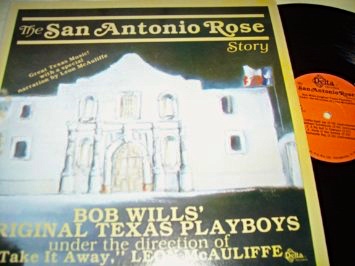
[Delta] released Faded Love and they released The San Antonio Rose Story, which we did in that session two-and-a-half months ago. And that was probably the hardest thing we’ve done since we quit back in ’41.
When we first recorded San Antonio Rose it was just a fiddle tune, Scott. There wasn’t any words and there wasn’t any music. It wasn’t written down anywhere. Irving Berlin wanted to buy it. He sent this guy to Tulsa and he wanted to buy San Antonio Rose. There only thing was, there wasn’t any words to it, no sheet music, no nothing.
Well, [at the time] sheet music was a big deal. So [Bob Wills] said, “Okay. Berlin said he’d buy it if we had some words to it.” Bob told Everett Stoller, the trumpet player, “Write some words to that and send it to him!” Everett wrote some words that night and we played them the next day.
And we had played it all this time but it was just all in our heads. Then we had words so we had to call it The New San Antonio Rose. By the time this happened we had two trumpets, trombone, and three saxes. Man, which was to us, a full brass and a full reed section.
So [David] Stallings of Delta Records wanted to release an album of the San Antonio Rose Story. We got two old 78’s. One of the first time we ever recorded it, when it was just a fiddle tune. When Bob played it himself.
So we sat in the [Delta] studio and listened to that dang thing for 15- or 20-minutes and said, “Okay. Let’s wax it.” We set up and recorded it just exactly, note for note, the way we recorded it the first time.
Then we got the [horn version], listened to it, and said, “Okay.” We set up and recorded the bed for the trumpets and saxes. Then Leon sung it. We did everything except the horns. [David Stallings] got these two professors [to record the original horn parts.]
It’s note for note the way we recorded it. And that’s the hardest damn thing, really, to try to play. Forty-seven years later to play something note for note the way you played it before. That gets a little touchy.
Of course, the ghosts get to walking around in the studio. You know, ‘cause we could see Bob walking all around among us while we were doing it. It was kind of ghosty and kind of scary.
And they’re getting read now to release our third album, Texas Fiddle. We’ll go back sometime this summer, sit down and play 35 or 40 more. When we were recording from 1935-1941 there wasn’t such a thing as an album. There was a 78 rpm record. It had two sides and that’s all. So when we’d go to a recording session we’d record 20, 25, 30 [songs], because there was only going to be two tunes on each one.
So we’ve got about five albums. We’ve got at least two more that we’ve cut. And then we’ll go back and do it again some this summer before something happens to us.
Lettermen Drummer Anton Fig To Release All-Star Solo Album
by VVN MUSIC on AUGUST 8, 2015
in NEW MUSIC,NEWS
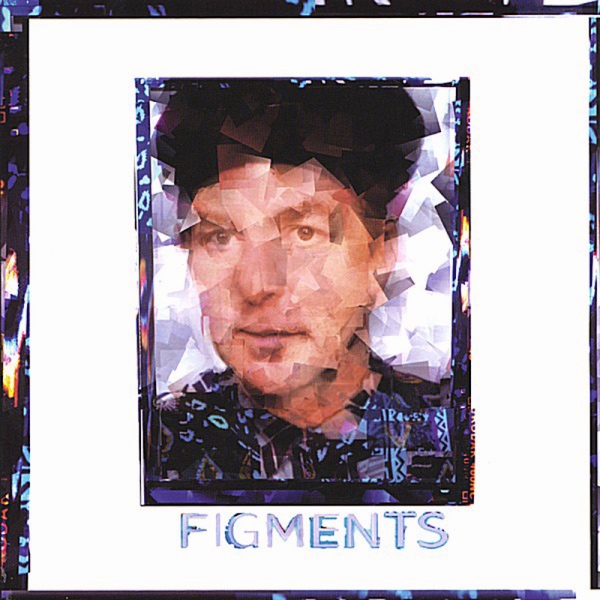
He spent the last 29 years as the drummer for Paul Shaffer’s World’s Most Dangerous Band/CBS Orchestra on the David Letterman Show but now Anton Fig is ready to break out with his first ever solo album.
Over those years, Fig had the opportunity to work with a huge list of artists and some of those musicians are returning the favor guesting on Figments which will be out on August 14.
Figments’ stellar cast includes Beach Boys mastermind Brian Wilson, Richie Havens, Ace Frehley, Al Kooper, Donald “Duck” Dunn, Chris Botti, Randy Brecker, Ronnie Cuber and Lew Soloff, Fig’s longstanding Letterman bandmates Paul Shaffer, Felicia Collins, Will Lee.
[D]rawn from…songs…Fig had written/co-written…. “I…realized I had accumulated all these songs,” he explains. “[I]t was time to realize them by matching each song with the right musicians and singers, with my drumming and production as the through-line.”
Originally issued in a limited-edition pressing in 2002….
“About 80 per cent of the record,” he says, “was done in my apartment in Manhattan. People just came over and sang and played. It was beautiful to have Richie Havens singing in the bedroom.”
In 1986, Anton accepted an offer to join Late Night With David Letterman’s house band, a gig that would last for nearly three decades….
“It’s gonna be different going out there again,” Anton says of his return to the road, adding, “David Garibaldi, the drummer from Tower of Power, recently told me, ‘Everything you’ve done in your life is just to prepare you for what you’re about to do next.’ So that’s how I’m approaching it.”







You must be logged in to post a comment.