Les DeMerle: A Drum Teacher’s Greatest Disservice

SKF NOTE: This exchange is from my 1984 Modern Drummer interview with Les DeMerle. The back story is here.  We had discussed the greatest service a drum teacher can offer students. I circled back to that topic and asked Les, “What about the greatest disservice a teacher can give a student?”

Les DeMerle circa the time of this interview

Les DeMerle circa the time of this interview

Les DeMerle: Honesty is the key service. There’s alot of drum teachers out there that I feel aren’t really qualified. You can’t jump into teaching too soon. Even at the beginner’s level. You should really have a certain amount of knowledge and direction and your own style. And be open-minded.

There are alot of guys who are locked into a system and they preach that one particular system. If it’s a technical approach — that’s fine. But on the bandstand it’s a different thing. You have to get the natural quality out of the individual and deal with the way he approaches the instrument.

If I get a student who has only one way of approaching a certain thing because his teacher taught him that for five years — it’s like untying a bunch of knots to get that student to be loose again.

There might be one way to do certain things. But, to me, the most natural players — which is what we strive for — do it several ways.
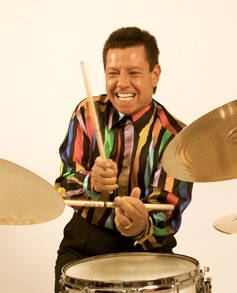
Les DeMerle

Les DeMerle

Let’s use Buddy Rich as an example. I’ve seen him play a whole set with matched grip. He doesn’t always do that. But that night he felt like playing matched grip. Maybe it was with the butt-end of the sticks.

Certain teachers would say that you should never do something like that. Usually those students come in stiff to begin with. They are so scared because they’ve been taught one regimented way for so long.

The idea is to loosen it up.

Scott K Fish: Buddy used the term attitudinal playing in a recent interview. Can you hazard a guess as to what he meant by that?

LD: I would think he was saying that you should play with a good attitude. He hears everything. Just that alone is such a courtesy. Even though he’s such a force, he’s still one of the greatest sidemen in the world. I’ve heard him sitting in with trios playing as tasty as Marty Morell did with Bill Evans.

end

Posted in Uncategorized | Tagged , , , , , | Leave a comment

Keith Moon Obituary

SKF NOTE: Found among my clippings in a box in my basement. Sad day. Keith Moon was a very early influence on me from about age 16. I was fortunate to see Moon with the The Who in concert twice.

moon_keith_obit

end

Posted in Drum/Music News | Tagged , , , , | 1 Comment

Alan Dawson on Innovators

SKF NOTE: From my interview with Alan Dawson published in Modern Drummer‘s 10th Anniversary Issue in 1986. Here Alan is talking about drum innovators.

Alan Dawson: Innovators are very few. Innovators trod a lonely path. I don’t know who’s the next person who’s going to come along and revolutionize the music itself or drumming. There’ll be somebody. When the people latch onto him after, of course, initially putting it down — which is how the history of things goes — the people who will latch onto it will do whatever it is very well.

Scott K Fish: Who do you feel are the last drum innovators we’ve seen?

AD: As I go along I start to find more people who are derivatives. I would say, certainly, that Jack DeJohnette is innovative in his approach. But I’d say he’s probably derivative from Tony Williams and Elvin Jones. By the same token, Tony is derivative from Elvin and Max [Roach].

But the people who are setting trends, just in listening to them and listening to comments of people who listen to them, I’d say probably Jack DeJohnette and Tony Williams may be two of the most influential drummers of the 80’s.

SKF: Do you think there’s a difference in being an innovator and being innovative?

AD: Maybe I’m splitting hairs a little bit. When I think about an innovator I think of the person who really seems to have taken something, and seems almost completely in another direction when he bursts on the scene. And people don’t understand what he’s doing. They have to catch up. A person can be somewhat innovative if he can take somebody’s style and make something else out of it.

SKF: So an innovator is someone whos style can’t really be traced back to anybody?

AD: Yeah. It actually is. Eventually you probably can. When I first heard Max Roach I certainly wouldn’t have been able to say, “Well, yeah, he sounds like Jo Jones.” He didn’t. But, he still was influenced by Jo Jones. So, I would consider Max an innovator, yet in retrospect, I know that his style didn’t come out of nowhere.

When somebody’s reactions to the very same things everybody else has been exposed to turns out to be so completely different — you can think that person couldn’t have been exposed to so-and-so at the outset. Later you find differently.

SKF: Would you consider Elvin Jones an innovator?

AD: Yeah. Yet, I realize — and Elvin will tell you — that he came out of Roy Haynes among other people. Elvin doesn’t sound like Roy Haynes, but it’s obvious to me where he came from.

Just like Roy Haynes doesn’t sound like Jo Jones, but it’s obvious to me where he came from. Jo was one of Roy’s strongest influences in that formative stage.

In my formative stage Jo Jones had a tremendous influence on me. Max Roach had a very strong influence on me. But not as strong as Jo, because I wasn’t quite as young and impressionable. Since then there’ve been plenty of other players who I’ve listened to and admired.

If I stop splitting hairs I’d have to think that the last great drum innovator was Tony Williams.

end

Posted in SKF Blog | Tagged , , , , , , , , , | Leave a comment

Roy Haynes: You Got to Have ‘Ding Ding Da Ding’ Within Yourself

762005_haynes_vistalite_down_beat
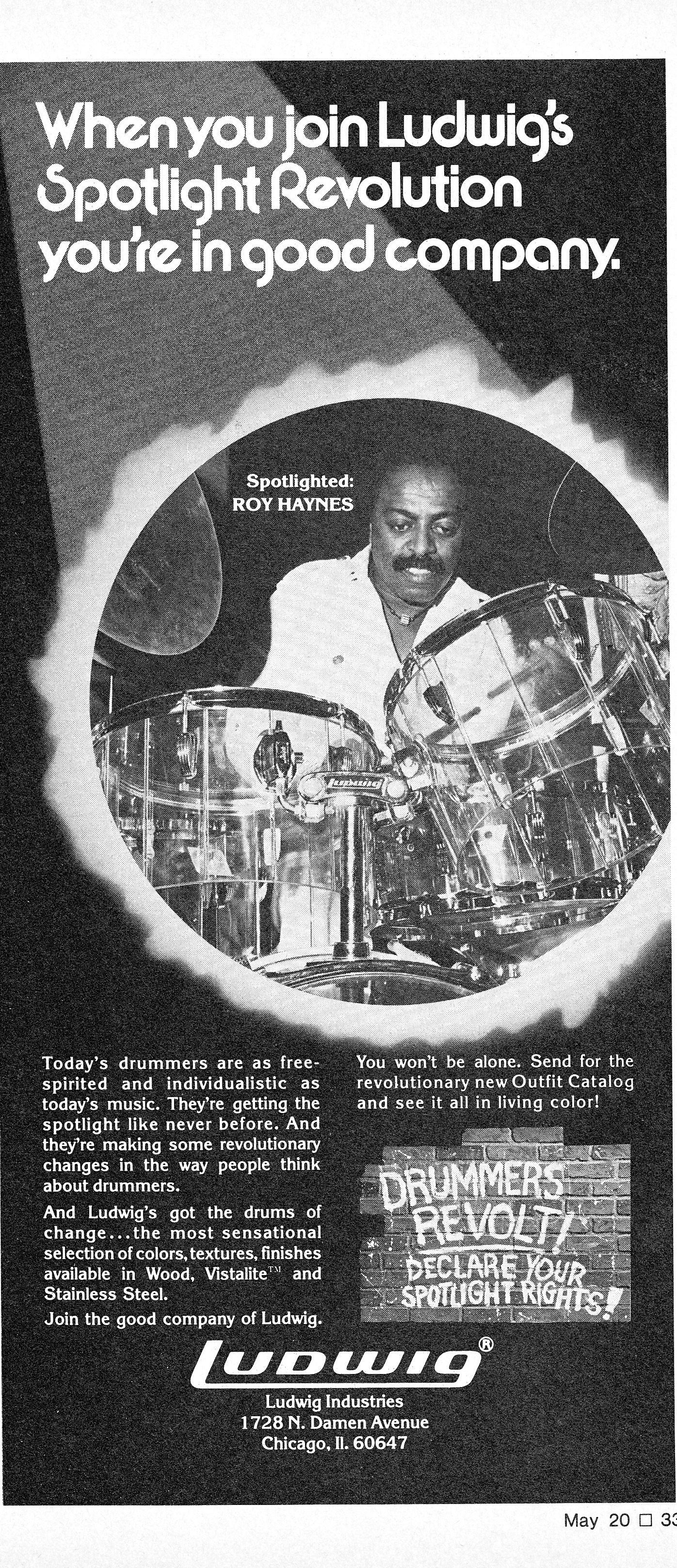
September 20, 2015. I found this Roy Haynes Ludwig Vistalite ad in the May 20, 1976 Down Beat.

SKF NOTE: This segment is from my interview with Roy Haynes at his home on November 15, 1978. According to my notes “It was raining, traffic was heavy, a chilly…evening, and I was nervous about meeting him. We had spoken on the phone a few times. The week before [this interview] I had seen Roy perform with the bassist and guitarist from his Hip Ensemble at a small Long Island, New York jazz club. The trio was hot. The music ran the gamut of emotions and it was always swinging. Roy Haynes is both amazing to watch and to listen to. He sat behind a set of Smokey Vistalite Ludwig drums, eyes closed in relaxed concentration, playing with that precise, crisp sound that earned him the nickname Snap, Crackle, Pop.”

Roy Haynes
Roy Haynes

Roy Haynes: [Charles] Mingus used to say the damndest thing about me years ago. He’d say, “Well, Roy Haynes. Yeah. You don’t always play the beat. You suggest the beat. I don’t know what the heck I was doing, but I know that the beat is supposed to be there. If I leave out a beat — it’s still there. If I’m playing fours or eights or twelves, and I play four-and-a-half bar and leave out a bar-and-a-half — that don’t mean I don’t want it to sound like that! But, if I’m playing with a horn player — sometimes they get confused. They get hung up ’cause I didn’t play a bar-and-a-half.

You got to use a little imagination in there. That bar-and-a-half still counts. I’ll come out in the right place — where it should be — to make it even. And they’re somewhere else at that point. I didn’t always play the beat which I though was very good. You don’t always have to say ding ding-da ding ding-da ding. You know? It’s there. So if one of those saxophone players has to depend on that, then you know he’s not right or something.

You’ve got to have ding da da ding within yourself. [John] Coltrane had it. [Lester Young] Pres had it. Miles [Davis] had it. So it’s beautiful with them. But there’s so many other people who don’t have that thing — and you got to carry them. Now how you gonna be inventive and create when you’re trying to lift them up?

end

SKF NOTE: The morning of September 9, 2015 I found more pages from my Roy Haynes interview with more details about Roy’s Vistalite drums. Several registered users of the Drummerworld web forum commented on Roy’s Vistalite’s, surprised to know Roy played them, and hungry to know more specifics about Roy’s Vistalite drumset.

=========

The first time I saw Roy perform he was playing a five-piece Vistalite outfit. A year later his set had grown! The two mounted toms had multiplied to six, one floor tom, and a single-headed bass drum. The set was augmented by temple blocks, Vistalite bongo drums, ratchets, a tambourine, and probably several percussion things Roy didn’t happen to use that night.

“It’s interesting.” Roy spoke about his set. “With the set I have now, the see-through drums — people love ’em! And somebody will come into a club and they’ll get wrapped up with the drums right away. Even before you play you got it made,” he smiled.

“I read a review about myself in some paper and the reviewer wrote, ‘Roy Haynes’ drums look better than they sound.’ That’s the worst thing I’ve ever seen about myself,” he laughed.

“I like sounds,” Roy said of the added percussion. “It adds, rather than just hitting the drums, seeing how great and fast you are.”

end

Posted in SKF Blog | Tagged , , , , | 7 Comments

Kojo Odu Roney: I Want to Make Them Smile When I Play Drums

[SKF NOTE: This young man, Kojo Odu Roney, is encouraging. He appears to have a very good head on his shoulders and he plays jazz well. Roney has a few YouTube videos. He’s fun to watch. Above all, he has a great feel to his playing. Kojo closes one video by saying, “I want to make the great ancestors of jazz proud of me and my development. People like Tony Williams, Elvin Jones, Art Blakey, Max Roach, Philly Joe, Papa Joe, and Buddy Rich. I want to make them smile when I play the drums.” ]

SOUTH BRONXArts & Entertainment
See a 10-Year-Old Jazz Prodigy Perform for Free in Crotona Park on Friday
By Eddie Small | July 23, 2015 4:43pm @eddie_small

CLAREMONT — This SummerStage performer may have mastered the drums, but he still isn’t old enough to drive.

Kojo Odu Roney, a 10-year-old jazz drummer…has been playing since he was a toddler….

Roney was able to confidently play with jazz ensembles by age 4 and began his professional music career at age 8, when he went on his first tour of Europe.

He said he instantly fell in love with the drums and aims to practice them every day….

“I try to practice about seven hours. That’s on a good day,” he said. “On a bad day, it’s about three hours.”

He comes from a family of musicians. His father, Antoine Roney, is a jazz saxophonist and his uncle Wallace Roney plays the trumpet.

Roney’s dad said he has fun playing with his son and compared him to “one of the great drummers” like Elvin Jones and Tony Williams. “He’s playing, he’s performing at such a high level, and it’s really rewarding to see that.”

But as soon as he stops playing the drums, he is just a regular kid…. [T]hen when he gets on those drums, he’s like a 40-year-old jazz cat.”

Full Story

Posted in Drum/Music News | Tagged , , | Leave a comment