SKF NOTE: His distinct, revolutionary, much imitated bass playing, Larry Graham tells the interviewer, is Graham imitating a bass drum and a snare drum. That bass style help land Graham his gig with Sly and the Family Stone.
“After we didn’t have drums…I kind of missed having that backbeat,” says Graham. “I started thumping to make up for not having a bass drum.” He “compensated for the snare drum” by “a little thumping and plucking.”
SKF NOTE: Thank you once more to Bret Primack (aka Jazz Video Guy) for this swinging 12 minutes with jazz greats on the front line and in the rhythm section. Kenny Clarke swinging ‘til the cows come home on this one. Straight ahead, no slouching. A nice addition to anyone’s jazz drum video library.
SKF NOTE: There will always be drummers interested in drum history, and drummers who aren’t interested. That’s my conclusion after years concerned the who-cares-about-drum-history? side would bury the we-care-about-drum-history side.
Based on my experience, if the former prevails, important pieces of drum history won’t be preserved. Pieces of history considered old today will be ignored or, even worse, trashed. And once a piece of unique history is trashed — a letter, a photo, an autograph, a tape recording —it’s gone forever.
Just in the last decade or so a number of important albums were released because someone discovered or remembered old tape reels on a shelf or in a box. Here are three examples:
When the “who cares?” attitude prevails, today’s opportunities to hang onto historical drum artifacts and memories pass unattended.
In my life I’ve rescued excellent out-of-print albums from Goodwill and Salvation Army stores. When asked to reuse (tape over) my Modern Drummer interview cassettes, I kept them instead. From then on I bought my own blank cassettes to use for interviews.
The internet has become an amazing source of historic drum memorabilia. Free or very inexpensive platforms give drum fans — from novices to experts — a place to share all kinds of interesting drum memorabilia.
Some of my favorite web places for drum history are:
I am optimistic, right now, the preservation of drum history is alive and well. And I am hopeful, yet not fully convinced, a majority of up-and-coming drummers are taking advantage of this wealth of available information.
Have a majority of up-and-coming drummers ever taken advantage of available historic information? I don’t know. My best guess? Up-and-coming drummers with deep interest in drum history have always been a minority. A very dedicated minority.
RIP Chester B. Fish Jr.
Scott K. Fish, Special to the Piscataquis Observer • March 30, 2019
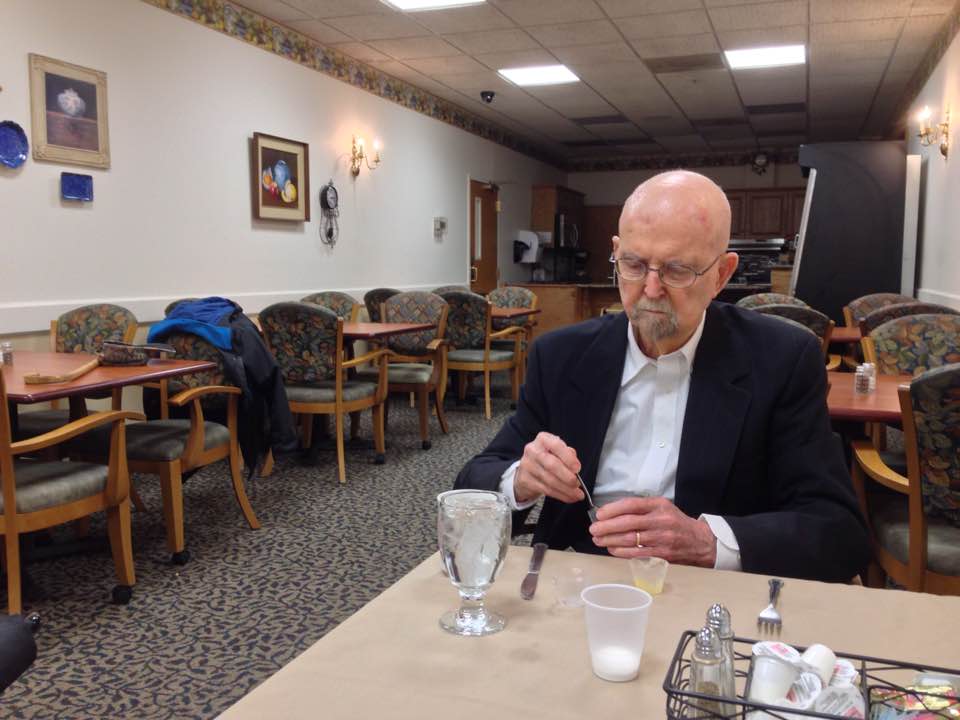
My dad died six hours ago. His name was Chester B. Fish, Jr. At age 93, dad outlived my mom by two years. And among his parents and two brothers, dad was the last man standing.
Had you asked me if I have any of my father’s mannerisms, I would have answered an honest “no.” Then in 2003, as part-time panelist on Maine Public Broadcasting’s “Public Opinion” tv show, I was shocked to see myself with my father’s facial expressions and body language.
Of his five children, I am the only one to follow in his journalism footsteps. Although that never crossed my mind until my mom mentioned it years ago when I was Modern Drummer magazine’s Managing Editor. My dad worked mostly as an Outdoor Life magazine editor, including as Editor-in-Chief.
He switched to book publishers the last stretch of his career, working as Acquisitions Editor for Scribner’s, David McKay, and Stackpole.
Dad never warmed to computers. I’m told that was his undoing in the publishing business. While co-workers were transitioning to word processing, dad stuck to his typewriter. Someone else had to retype my dad’s work into a computer. Not a winning economic model.
My attempts to assure dad he could get the hang of computers — and be glad — failed. He acted as if he was afraid if he pushed a wrong button the family computer would self-destruct in a shower of sparks and smoke.
But I certainly do remember many weekends of dad on the living room couch editing magazine manuscripts, or banging away on his green-and-tan Royal typewriter, which I still have.
I credit my father with instilling in me love of the outdoors. Most of our family vacations were tent camping. I don’t think mom was thrilled vacationing in tents with four young kids; two girls and two boys born within seven years. But those were good times for me.
Along with years in outdoor journalism, dad grew up on a tree nursery, and was an Eagle Scout. He taught us how to build a safe campfire — even with flint and steel; how to tie rope knots, how to police a campsite; how to catch a fish and prepare it for eating, how to cook over a campfire; how to shoot a rifle, gun safety; how to use axes, knives, and hatchets.
Among my favorite memories: My brother, Craig, and I are little kids, probably four and five years old. Dad is holding white birch bark and saying, “You can get this birch bark as wet as you want — I can still use it to start a campfire.”
What? Sure our dad has underestimated our abilities with garden hose and water bucket, Craig and I drowned the piece of bark. We hand the bark back to dad, and he sets it afire with one match. Wow!
Of all environmental histrionics over the last twenty years — there’s not one I didn’t learn about from dad. And he taught me without using fear and scare tactics, but with basic outdoor common sense.
I wish my dad had more interest in communicating with his kids as adults, especially after we kids scattered over many states. But the very few times my dad initiated phone calls, it was at my mom’s urging: “Why don’t you call Scott and see how he’s doing?”
In the last few years, one of my calls to dad was fairly long. We had a very good time chatting, maybe our best phone call ever. As our call was nearing its end, dad said, “Well, Scott. This has been a good phone call. But we probably shouldn’t count on doing this on a regular basis.”
I smiled.
In the grand scheme of fatherhood? Well done, dad. I wish we could have known each other better, but, thank you, dad, for my life.
SKF NOTE: Will Calhoun is among my favorite interviews. I am sorry it was never published. From reading my 1989 notes, this interview was meant to be published in Modern Percussionist magazine.
But before Will’s interview was published, Modern Percussionist ceased publication.
Will talks in this excerpt about two early influential teachers who encouraged him to add to his drumming a knowledge of keyboard and music theory.


 Scott K Fish
You must be logged in to post a comment.