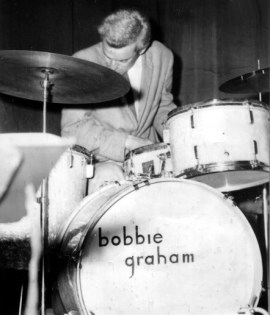
[SKF NOTE: File under, “Old Dog, New Tricks.” I just learned today that Bobby Graham is the drummer on this classic rock tune. Maybe there are others like me. My apologies to the already enlightened.]
Wall Street Journal
ANATOMY OF A SONG
How the Kinks Roughed Up Their Sound To come up with the fuzzy distortion on ‘You Really Got Me,’ members of the Kinks distressed their speakers with knitting needles and razor blades. A look at how the influential 1964 hit took shape
By MARC MYERS
Updated Oct. 29, 2014 11:33 a.m. ET
[Producer Shel] Talmy: The Kinks didn’t have a drummer yet, so I hired Bobby Graham, the best English session drummer at the time for rock. I played the tambourine.
[SKF NOTE: An excerpt from the full transcript of my Modern Drummer interview with Joe Morello. My questions here reflect an interest I had at the time in how the drummers who came in during or soon after BeBop interacted with the great drummers who preceded them. Were there friendships? Mentoring relationships? Or no contact at all?
Joe Morello’s story about playing Papa Jo Jones’s bass drum has always been a favorite. I didn’t expect to hear that Morello – who was 49 years old at the time of this interview – would have a challenge playing ANY drum!]
Joe Morello: One of my favorite drummers was Davey Tough. ‘Cause he could keep a nice rhythm with a band and he kept good time. He didn’t hardly do anything with his left hand. He was just straight ahead on the big cymbal, but he got it cookin’ real good.
Scott K Fish: Did you ever get to meet those guys?
JM: Sid Catlett I met once. One time in New York.
J.C. Heard was another fine drummer. I don’t know if you’ve ever heard of him.
And then Jo Jones, who is still a good friend of mine. He’s still here. Old man Jo Jones. Jonathan Jones to you. [Morello mimics Jo Jone’s raspy voice.] Boy, that guy taught me a lot, because I played opposite him for about six or seven weeks at the Embers. He was working with Tyree Glenn and Hank Jones. He use to play his bass drum open, see. He had a little 20-inch bass drum, and a snare drum, cymbal, and a hi-hat cymbal. That’s all he had. Oh, and he had one little floor tom. And he’d get up on the drums with brushes and he’d get that bass drum going. [JM taps drum stick on leather sofa cushion, imitating the sound Jo Jones’ would get from this bass drum at the Embers].
SKF: When you say “open,” you mean he had no felt strips at all?
JM: Not at all. [Keeps tapping stick on couch] and he’d get a sound just like that. A good sound.
I’d get up there and I’d play something and it would go BOOM BOOM BOOM BOOM. And I’d say to him, “Jo, how do you do…?” And he wouldn’t talk to me for the first two or three days. He just sort of flugged me off, you see.
But I sat down and I watched that f***in’ bass drum, and I said, “I’m doing something wrong.” ‘Cause he sounds tap tap tap tap, and when I hit it, it goes BOOM BOOM. I couldn’t play it.
The only way you could play it, I found out, was by pressing the beater into the head. He’d play up on his foot like that, but he’s been playing it like that for so long that he can control it, see. Jo was always playing….
SKF: Toes down.
JM: Yeah. With his heels up.
And I learned a lot about hi-hats from Jo, because Jo would really get a breathing sound from hi-hats. Just a nice full…. Then we became good friends.
–end–
LikeLoading...
Posted inSKF Blog|Comments Off on Joe Morello: I Couldn’t Play Papa Jo’s Bass Drum
Day of the Drum by John Densmore / Founding member of The Doors
– We drummers all know that our mother’s heartbeat was the first instrument we heard. As a race, we’ve all been trying to get back to that womb. That’s why rhythm makes us move… dance.
– Sound is everything to a musician.
– As we were leaving the festival, my mind flashed back to the first time I was here, when I got to see a very old Jo Jones, the drummer who invented playing brushes on the snare drum — the drummer who freed up the bass drum and relied on the hi-hat for time. Revolutionary rhythmic thinking. Papa Jo was definitely in his 80s, but was swirling his brushes around on his snare, the way he first taught all of us percussionists back in the ’30s. I’m proud to be in the tradition of the drum….
Legendary drummer Ginger Baker pays tribute to ‘one-off’ Jack Bruce
By Western Morning News | Posted: October 26, 2014 By Alex Diaz
Jack Bruce (left), Ginger Baker, Eric Clapton during a Cream reunion concert in 2005.
Speaking from a hotel in the Republic of Ireland, Baker, 75, said: “We go back a long way, I called him Wee Jack. It’s a big loss to the world and I’m very sad.
“I found out yesterday when my daughter phoned me and my first reaction was that it was a hoax because I have been reported dead so many times myself, but then it became reality.
“It was quite a while since I last spoke to him but he was a one-off, his approach to music made him special.
“My feeling is with his wife Margrit and his kids.”
SKF NOTE: This is from an interview with Mel Lewis in his New York City apartment on September 8, 1977. An edited version appeared as Mel’s first Modern Drummer feature interview.
Mel, a Modern Drummer Advisory Member, was telling me at this point in the interview, how MD founder Ron Spagnardi “just called me about calf heads. Where you can find them and how you can choose them. Because I’m one of the few guys who knows how to do that. You can get ’em, but they’re hard to get. Calf skin has to come from a rawhide manufacturer.”
I mentioned the American Rawhide Company, Mel mentioned the National Rawhide Company. “They make a limited amount [of calf heads], a very small amount. And sell them to a few drum companies and a few stores. That’s all.” It’s unclear from the interview transcript if Mel was talking about both companies or only the National Rawhide Company.
Mel must have been endorsing Remo drum heads in 1977. Finding out he actually used a mix of calf and plastic heads was one of those neat factoids that popped up quite often during the early MD interviews. Drum advertisers had almost a complete lock on what drummers on the outside knew about professional drummers’ equipment.
Mel was either my first or second interview for MD. And what a great guy to interview!
Scott K Fish: Do you use calf skin heads on all your drums?
Mel Lewis: No. Just the top of the snare drum and the bass drum batter head. That’s all. All my snare drums. I use calf skin on the top, on the batter head. And plastic on the bottom. I’ve been doing that for years. Remo knows that. Remo understands why I do it, and he’s always been kind enough. Naturally, his aim in life is to perfect a synthetic head that will be just like calf skin, you know. So he’s trying and trying. Nobody has done it.
SKF: Have you tried the Canasonic heads?
ML: I’ve tried that, but I still think that’s junk, you know. That’s still plastic. Um, they’re not bad.
SKF: They tend to deaden a sound.
ML: Yeah. You don’t have that liveliness. With brushes, none of them make it. Only calf.
SKF: I think you’re the only drummer I know of still using calf, except maybe Jake Hanna.
ML: I don’t know if I’m the only one. There’s got to be others. But I’m the only one that’s pretty outspoken about it. And maybe Jake does. I don’t know. I don’t think so. I think it’s a little hard to use them out in California. There’s something about the weather out there. It’s a little rough. But, they say it’s bad – the weather – back here. But, see, I like it damp. I prefer a little moisture in the head. I don’t like it bone dry. Then they’re too tight.
SKF: You have to tune calf heads about five times a night, don’t you?
ML: Naw, maybe twice, really. Sometimes I don’t have to tune them all. Sometimes it’s perfectly okay when I sit down, and that’s the way they stay all night.
SKF: Do you start out tuning the heads tight?
ML: No. I don’t like them tight. I don’t like real tight drumheads.
SKF: What if a drummer wanted to use calf skin heads and also wanted a tight, crisp sounding snare drum?
ML: He can get. He can certainly get it. But he’s got to remember that he’d better not leave it that way or he’s a goner. A calf head, the tighter you make it, naturally, it stretches. That head will probably go dead on him a lot sooner than sort of keeping it medium.
SKF: Tune the head down?
ML: Yeah. You’ve got to remember to change the tension at the end of the night. Frankly, I don’t do anything, and everything works out pretty good. But there’s something about the feeling and the sound. That’s all. The feeling and the sound of a plastic head just doesn’t feel right to me. I don’t know.
SKF: Plastic heads don’t bother you on your tom-toms?
ML: No. Tom-toms are alright. I’m not thrilled about the sound on the tom-toms, but it’s alright. And I don’t have time to mess with them. I tune the tom-toms and… you know. Tom-tom heads, you it it so damn hard and you get all those dents in them. That gives you an idea of why it’s basically dangerous to have calf. You just don’t hit a snare drum as hard as you hit tom-toms for some reason or other. At least I don’t.
When I want a lot of noise out of a snare drum it’s usually with a rim shot. But tom-toms, you want some… when you give ’em that power thing.
Of course, most of the dents in my tom-tom heads were created by other people sitting in on them. And that’s the truth! I don’t put dents in my drums either! But anytime a drummer has to use my drums, or sits in, they manage to dent up my heads – which really bugs me.







You must be logged in to post a comment.