Sherlock Holmes on the Power of Music

conan_doyle

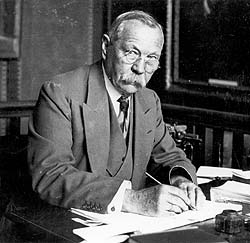
Sherlock Holmes’s creator and author Sir Arthur Conan Doyle.

SKF NOTE: In Arthur Conan Doyle’s story The Cardboard Box, it transpires that Sherlock Holmes owns and plays a violin made by Antonio Stradivarius himself.

Sherlock Holmes: “Do you remember what Darwin says about music? He claims that the power of producing and appreciating it existed among the human race long before the power of speech was arrived at. Perhaps that is why we are so subtly influenced by it. There are vague memories in our souls of those misty centuries when the world was in its childhood.”

Source: Doyle, Arthur Conan; Books, Maplewood (2014-05-15). Sherlock Holmes: The Ultimate Collection.

Posted in SKF Blog | Tagged , , | Leave a comment

Discovering Buford Oliver

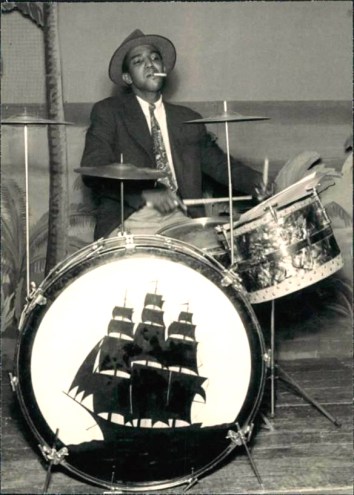
bern_buford3SKF NOTE: Listening this morning to tenor saxophonist Don Byas‘s CD Riffin’ and Jivin’. Mr. Byas is one of those great musicians I haven’t listened to much. Last night, combing through a large box of my CD’s, I came across Riffin’ and Jivin’, and decided I would dig deeper into Don Byas’s jazz contributions.

With the CD playing softly in the background, and me at work on my computer, a cool drum solo on the song, Rosetta, grabs my total attention. The drummer is Buford Oliver – a name brand new to me. Great! I love discovering drummers. Looking forward to learning about, and hearing more, from Buford Oliver.

-end-

Posted in Uncategorized | Tagged , , , | 1 Comment

Herbie Hancock: How I Became Friends with Tony Williams

SKF NOTE: I received a copy of Herbie Hancock’s autobiography, “Possibilities,” for Christmas. It is a great read. Here’s a segment, in Herbie’s own words, on how he first met Tony Williams.
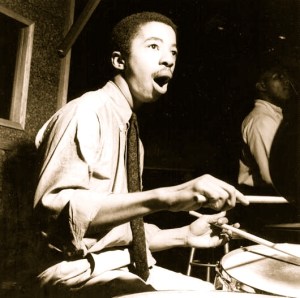
tonywilliams009Herbie Hancock: Tony had just turned seventeen, but…he was the hottest jazz drummer around. I had met him in late 1962, when he was living in Boston and I was gigging there with Eric Dolphy, but I didn’t get to hear him play…. [H]e moved…to New York in early 1963, [and] called me…. Well, what was I supposed to do with a teenage drummer? Hang out? …I just kind of put him off. About a week later I got a call from…Jackie McLean. Jackie was putting together a group for a gig.., and he asked me to play. “Who’s on the gig?” I asked. [H]e said, “Eddie Khan on bass, Woody Shaw on trumpet, and Tony Williams on drums.”

“Look, Jackie, I asked, “can Tony really play? Or does he just sound good for a seventeen-year-old kid?”

Jackie answered. “Just make the gig, and find out for yourself.”

So I did. We didn’t have any kind of rehearsal, but we were doing…stuff we all knew. When Jackie counted off the first tune, I play the opening chord – and then Tony started playing some amazing rhythm I’d never heard before. I took my hands off the piano and turned around to look at him, my mouth just hanging open. I couldn’t believe what I was hearing…! I had no idea how he was conceiving such rhythms, and it took me a couple of choruses before I could actually collect myself and play anything.

Tony had absolutely mind-blowing talent. He could play drums like no one else I’d ever seen, and even at that young age he had complete confidence in his abilities. Some musicians seem as if they were born playing their instrument, and Tony was one of those guys. He was magical to watch and listen to, because energy and creativity just flowed out of him. [T]he day after the gig I called him and said, “Hey, man, what’s happening? You doing anything? Can I come over?” And that’s how I became friends with Tony Williams.

Source: Possibilities, by Herbie Hancock with Lisa Dickey, Penguin Group (USA) LLC, 2014

Posted in SKF Blog | Tagged , , , , | Comments Off on Herbie Hancock: How I Became Friends with Tony Williams

Ringo Starr’s New Album, Tour

musictimes.com/
Ringo Starr’s New Album is Finished, Beatles Drummer Hints at Spring Tour

The drummer was elated when news broke that he would be inducted into the Rock and Roll Hall of Fame.

“It means recognition. And it means, finally, the four of us are in the Rock and Roll Hall of Fame even though we were the biggest pop group in the land. You know that won’t look funny in black and white,” he told Rolling Stone.

“I can only look to Tony Bennett and B.B. King. We can go as long as we can go. That’s always been the way. If I can hold the sticks and I can stand up, I can do what I love to do. If people are still coming, that’s the deal. I don’t want to play with myself.”

Full Story

Posted in Drum/Music News | Tagged , , , | Leave a comment

Composer Alec Wilder on Pianist Ellis Larkins

larkins_ellis

Ellis Larkins (Photo from the Digital Collections in the Arthur Friedheim Library of the Peabody Institute.)

SKF NOTE: I am familiar with composer Alec Wilder and pianist Ellis Larkins. Through the writings of pianist Marian McPartland, and, I think, other sources, I’m also somewhat aware of Mr. Wilder’s command of the English language, and of his wit. This is from a short essay Mr. Wilder wrote about Mr. Larkins. The way Wilder describes Larkins’s musicianship is, in my opinion, first-class writing.

Alec Wilder: He achieves his musical points always by means of understatement. His economy is as brilliant as a Simenon sentence. He is strong and direct without ever spilling over into aggressiveness. His left-hand harmonic inventions and sinus bass lines are marvels of ingenuity and unexpectedness. His rhythmic sense is absolute, and his choices of tempi are as right as Basie’s or Norvo’s. His wit, manifested in interpolated phrases, is irresistible and his blues walk you right on down the aisle. His ballads are rich without being cloying and his up tunes are danced in felt slippers with an almost audible smile.

Source: “Ellis Larkins: An Appreciation,” by Alec Wilder, Down Beat October 26, 1972.

Posted in SKF Blog | Tagged , , , , , | Comments Off on Composer Alec Wilder on Pianist Ellis Larkins