Dream Stealers and Drummers

Something inside us, often when we’re very young kids, tells us, “Play drums!” We know at that moment what we’re supposed to do in life. We may not know if we’ll be performers, teachers, inventors, manufacturers. But we know, beyond a doubt, one reason we’re on Earth is to play drums.

And then — WHAM! The whole world, it seems, conspires against us. In a world where so many people go through life without any direction, it would make sense for our families and friends to celebrate our finding a goal. A positive goal about which we’re passionate. Committed!

But, no. The Dream Stealer’s negatives start early: “Drums are too loud.” “You can’t make a living playing drums.” “Drums are okay as a hobby, but you need to think about what you’re going to do for a living.” Blah, blah, blah.

Some drummers are blessed with the opposite life experience. They really do have the support and encouragement of family and friends.

For drummers who didn’t or who don’t have that life experience, I have two books which should be of immeasurable help. The books are not written specifically about drumming and drummers. But author Steven Pressfield, drawing from his own life struggles as a writer, offers words of wisdom that can help any drummer feeling as if they are about to drown while swimming against the tide.

For what it’s worth, Mr. Pressfield’s books, not long ago, helped pull me through tough times. I still enjoy revisiting them. In fact, I was listening to “Do The Work” on the way to the post office this morning. That’s when I realized it made sense to share these books with Life Beyond the Cymbals readers.

Again, Mr. Pressfield’s books are written primarily to an audience of writers. But as a writer and a drummer, I promise these books are helpful to just drummers.

The book descriptions are Mr. Pressfield’s descriptions. I agree with them.

The Art of War

pressfield_war_of_art

What keeps so many of us from doing what we long to do? Why is there a naysayer within? How can we avoid the roadblocks of any creative endeavor—be it starting up a dream business venture, writing a novel, or painting a masterpiece?

The War of Art identifies the enemy that every one of us must face, outlines a battle plan to conquer this internal foe, then pinpoints just how to achieve the greatest success.

The War of Art emphasizes the resolve needed to recognize and overcome the obstacles of ambition and then effectively shows how to reach the highest level of creative discipline. Think of it as tough love . . . for yourself.
Do The Work

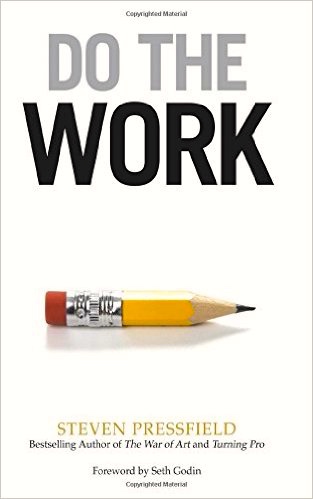
pressfield_do_the_workDo The Work isn’t so much a follow-up to The War of Art as it is an action guide that gets down and dirty in the trenches. Say you’ve got a book, a screenplay or a startup in your head but you’re stuck or scared or just don’t know how to begin, how to break through or how to finish. Do The Work takes you step-by-step from the project’s inception to its ship date, hitting each predictable ‘Resistance point’ along the way and giving techniques and drills for overcoming each obstacle.

There’s even a section called ‘Belly of the Beast’ that goes into detail about dealing with the inevitable moment in any artistic or entrepreneurial venture when you hit the wall and just want to cry ‘HELP!’

end

Posted in SKF Blog | Tagged , , , , | Leave a comment

One Door Closes, Another Opens

SKF NOTE: In April 2014, when the time was right for me to start writing again about drummers and drumming, I expected to find changed, but vibrant, freelance writing opportunities.

To be clear: when I stopped looking for those writing opportunities years ago, I wasn’t walking away from my passion for music in general and drumming in particular. To the contrary, I devoted those years to study in two areas.

First, I re-learned how to use my hands. I was holding drumsticks, and using my hands, in ways making it impossible to execute rhythms and melodies I was hearing. I wanted to break my lifelong bad habit, replacing it with good hand technique I had learned while interviewing Freddie Gruber.

Along with Freddie, my inspirations were Big Sid Catlett and Arthur Rubinstein. Big Sid said, “I can swing seventeen men with one wire brush and a phone book.” And I know he could. So I set up in my home office a snare drum. That’s it. No hi-hat. No cymbals. No bass drum. No toms. And I kept a pair of sticks and brushes nearby.

In 1934, [Arthur Rubinstein], who stated he neglected his technique in his early years, relying instead on natural talent, withdrew from concert life for several months of intensive study and practice.”

I’m not putting myself in the same league as Catlett and Rubinstein. They simply inspired me.

In brief, I spent years relearning drum rudiments and how to use my hands correctly using sticks and brushes.

I also spent my years away from freelance writing in study. For example, I had a good working knowledge of Tony Williams and Elvin Jones. But now I dug deep. I listened to Tony with Miles Davis, Wayne Shorter, Eric Dolphy, Herbie Hancock, VSOP, Ray Manzarek, Andrew Hill, Jackie McLean, and on Tony’s albums as a leader. The same with Elvin. If I was studying a drummer, I would listen to everything of theirs I could find.

Also, I was studying other musicians of many genres who I hadn’t had time to dig deep into, or I never knew about them. Segovia, Bobby Hutcherson, Joe Henderson, Kenny Dorham, Yo Yo Ma, Bill Laswell, among many others.

The freelance music writing opportunities I knew are gone. The days of earning a few hundred bucks from a magazine for a feature drummer interview disappeared. The internet and blogs changed all that.

Last year I had a great time playing drums in public for the first time in 30 years. Me and my snare drum, a pair of sticks and brushes, among a dozen or more Celtic musicians: violinists, guitarists, cellists, mandolin players, and a bodhran player.

My blog, Life Beyond the Cymbals, is my first writing step through the new open door, eyes and ears wide open for new opportunities.

One door closes, another opens.

Posted in SKF Blog | Tagged , , , , | Leave a comment

‘The World’s Greatest Drummer is Louis Bellson’

My Uncle Bob on the far left. Scott K Fish on far right.

My Uncle Bob on the far left. Scott K Fish on far right.

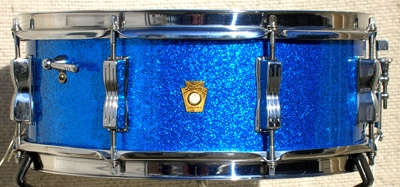
SKF NOTE: My Uncle Bob, older brother Craig, and I are standing in the dirt driveway at Charles R. Fish Nurseries, 39 School Street, Auburn, Massachusetts. I’m maybe 10 years old. Craig is one-and-a-half years older. The sun is shining on everything, including the chrome and blue sparkle Ludwig snare drum Uncle Bob is holding in his hands. Bob tells us he paid $75.00 for the drum.

He then asks Craig and I, “Do you know who’s the world’s greatest drummer?”

I say nothing. I have no idea.

Craig offers, “Gene Krupa?”

“No,” says Uncle Bob, “The world’s greatest drummer is Louis Bellson.”

ludwig_snareIt’s curious how Louis Bellson appears at key places throughout my life. In the early 1970’s, while living in Davenport, Iowa, I found out Louis grew up right across the Mississippi River in Moline, Illinois. Local musicians and jazz lovers talked of hearing Louis in clubs when Moline was a happening place.

Louis’s name would also often prompt the same people to rave about another Illinois drummer, Gaetan Caviola. Some said Gaetan was a better drummer than Louis. I never saw Mr. Caviola play. I only heard him on two albums: “The Sotos Brothers Quartet – On Stage“, and also, “Introducing Sue Childs.”

I saw Louis play once in Illinois. I stood to his right so I could watch his feet and hands. He was, of course, great.

In another blog post I write about an embarrasing teachable moment of sitting in at a Davenport jam session and stepping all over the group leader — on a drumset custom made by Bob Grauso for Louis Bellson.

Then there was my correspondence with Louis, and his consenting to be a part of the “Who Reads Modern Drummer?” ad series.

The first time I remember hearing Louis was on his “Concerto for Drums” album. This was before hearing his more famous “Skin Deep” with Duke Ellington. Louis introduces his “jingle sticks” – a set of tambourine cymbals attached to drumsticks – on “Concerto.” And his calfskin head drums sound wonderful. It’s a great solo. Especially impressive to an up-and-coming drummer.

Once in conversation with Joe Morello, Joe was wishing Louis’s playing was more spontaneous, less pre-planned. Joe and Louis were friends and, in my conversation with Joe, Joe was not being unkind about Louis. We were simply having a candid talk about drummers. My impression was Joe couldn’t understand why Louis, with his drumming ability, wasn’t playing more spontaneous. As if Joe was looking at the math equation 2 + 2 = 5, knowing it should be 2 + 2 = 4.

As I listened, and still listen, to Bellson, I understand Morello’s point. And I have seen times when Louis seems to let loose. His performance here on The Tonight Show with Buddy Rich is one example. I can’t help laughing whenever I watch it.

Sometimes Louis’s playing is exactly what I need to hear. His measured, clean, supportive and swinging accompaniment; his solos in which, as with all great players, I hear familiar phrases. And everytime I hear Louis I recall my first, and perhaps greatest drumming influence, my Uncle Bob, standing on a sunny day holding his blue sparkle Ludwig snare drum telling me, “The world’s greatest drummer is Louis Bellson.”

end

Posted in SKF Blog | Tagged , , , , , | 3 Comments

Billy Cobham: My Concept is My Own

SKF NOTE: A glimpse at Billy Cobham’s drumming concepts 41 years ago in Different Drummer magazine.

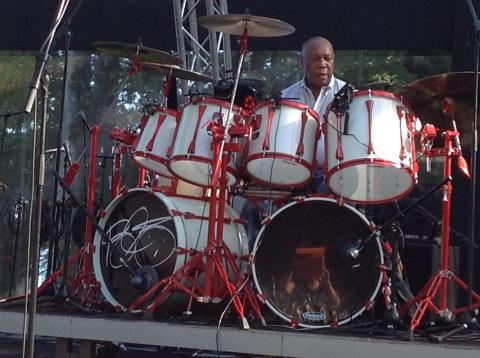
cobham_billyBilly Cobham: My concept is my own, my personality is my own. Dynamics enhance my playing and gives a lot of contrast to the amount of intensity and volume that I project off the drums naturally. When the band is really in a level of intensity, I like to let it all hang out and then drop back and let it build again.

The more drums you have the wider your scope in what you can think to do. Drums aren’t just drums to me, they don’t all work in every situation. I don’t record with the drums you see. I record with other drums that have a mellower sound, and, to me, they record better.

Depending on who I play with is what I’m gonna use. If I’m gonna work with people that don’t play hard, I’m gonna use smaller drums to cut down on my projection. I want to play with people, not against them.

I’ve always considered myself a better rhythm player than a soloist, so I learn toward team playing. I have nothing to prove. First I want to be an artist. I want to share my emotional thoughts with the people through the musical medium. I’m going for something where I can say here it is right here all the time, but there it is up there too. You can’t grasp that, but you can grasp this. So grasp it, and we’ll take you.

Source: “Billy Cobham,” by John Stix, Different Drummer, November 1974

Posted in SKF Blog | Tagged , , , , , | 2 Comments

Willis Conover: The Voice of American Music Behind the Iron Curtain

SKF NOTE: Thank you, Doug Ramsey, for this wonderful piece on a true missionary of American music.

wsj.com
The Radio Broadcaster Who Fought the Cold War Abroad but Remained Unheard at Home
Willis Conover spread American culture and values across Europe and the U.S.S.R. with his radio program, but almost no one in the U.S. knew about his show.
By DOUG RAMSEY — July 21, 2015 5:09 p.m. ET

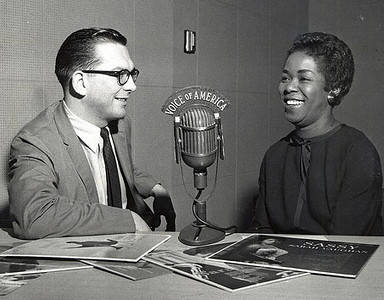
Willis Conover and Sarah Vaughan

Willis Conover and Sarah Vaughan

During the Cold War, listeners in captive nations behind the Iron Curtain huddled around radios in basements and attics listening to the imposing bass-baritone voice of the man who sent them American music.

For 40 years, until shortly before his death in 1996, Conover’s shortwave broadcasts on the Voice of America constituted one of his country’s most effective instruments of cultural diplomacy. With knowledge, taste, dignity and no tinge of politics, he introduced his listeners to jazz and American popular music.

Countless musicians from former Iron Curtain countries have credited Conover with attracting them to jazz….

In its Dec. 9, 1966, issue, Time magazine quoted Conover on the importance of the music he championed. “Jazz tells more about America than any American can realize. It bespeaks vitality, strength, social mobility; it’s a free music with its own discipline, but not an imposed, inhibiting discipline.”

Full Story

Posted in Drum/Music News | Tagged , , , , | Comments Off on Willis Conover: The Voice of American Music Behind the Iron Curtain