
SKF NOTE: From the December 21, 1972 Down Beat.

SKF NOTE: From the December 21, 1972 Down Beat.
SKF NOTE: A bittersweet story. At what point do people involved in The Star Making Machinery voluntarily do what’s right and see that artists are paid monies they’re owed?
November 11, 2015
Happy Ending
Man who wrote ‘the most famous drum sample of all time’ finally gets paid for it
[A] drum solo from a little-known track called “Amen, Brother” could very well be one of the most famous beats in the world. However, the beat’s creators — a funk group known as The Winstons, fronted by Richard Spencer — never saw “a single penny for its use in the countless music that contains it,” according to a GoFundMe campaign…set up to right that wrong.
Believed to have been used in around 1,862 tracks, “Amen, Brother” itself might not ring any bells. But Amy Winehouse, Oasis, N.W.A., and hundreds of others have used “the most famous breakbeat and sample of all time” in some of their best known music:
Now, 46 years after “Amen, Brother” was written, around $36,400 has finally been raised for Spencer….
…Spencer thanked contributors for the money on Facebook. “Thank you so much for this great contribution to my life,” he said…. “Thank you very, very much. A-men!” Gregory Coleman, the drummer who…played the Amen Break, “died a broke and homeless man” in 2006.., according to the GoFundMe campaign.
You can learn more about the history of the Amen Break in this BBC documentary below.
SKF NOTE: I bought this L.C. Silent typewriter circa 1971, used, for $35 at a Goodwill in Huntington, NY.
I began my professional writing career with it.
Factoring for inflation, magazines — including Modern Drummer — paid me $2,500 for stories written on my L.C. Silent.
I haven’t used my typewriter in a long, long time.
But now I am bringing it back to life.
Stay tuned!

SKF NOTE: My pattern of studying music history: When I hear for the first time a musician I like, I then listen to their every album and read everything I can about them. That’s true of all music genres.
In the last two decades digital technology made available, more than ever, music and reading material. I used the opportunity to revisit music and stories of musicians I knew, but had not studied, including Kenny Dorham.
I probably first heard Kenny Dorham with Max Roach. Either the Max Roach Plus Four or The Max Roach 4 Plays Charlie Parker albums. But at the time, Kenny Dorham had impossible shoes to fill.
Max Roach was a major influence on my drumming. And I first heard Max on the Clifford Brown and Max Roach album – an exceptional jazz album by an exceptional jazz group. To my ears, Max’s bands with trumpeters other than Clifford Brown never sounded as good.
My first objective listen to Kenny Dorham was on the Art Blakey & The Jazz Messengers at the Cafe Bohemia albums.
His partnerships on record with Joe Henderson — Page One, Mode for Joe, Our Thing, In ‘N Out — are all great. And among his albums as a leader I like Afro-Cuban, Quiet Kenny, and The Complete ‘Round About Midnight At the Cafe Bohemia. Art Blakey, Elvin Jones, Pete LaRoca, and Tony Williams are among the drummers on Kenny Dorham’s’ albums.
Kenny Dorham left a strong musical legacy, but as noted in his Down Beat obituary, he died much too young.

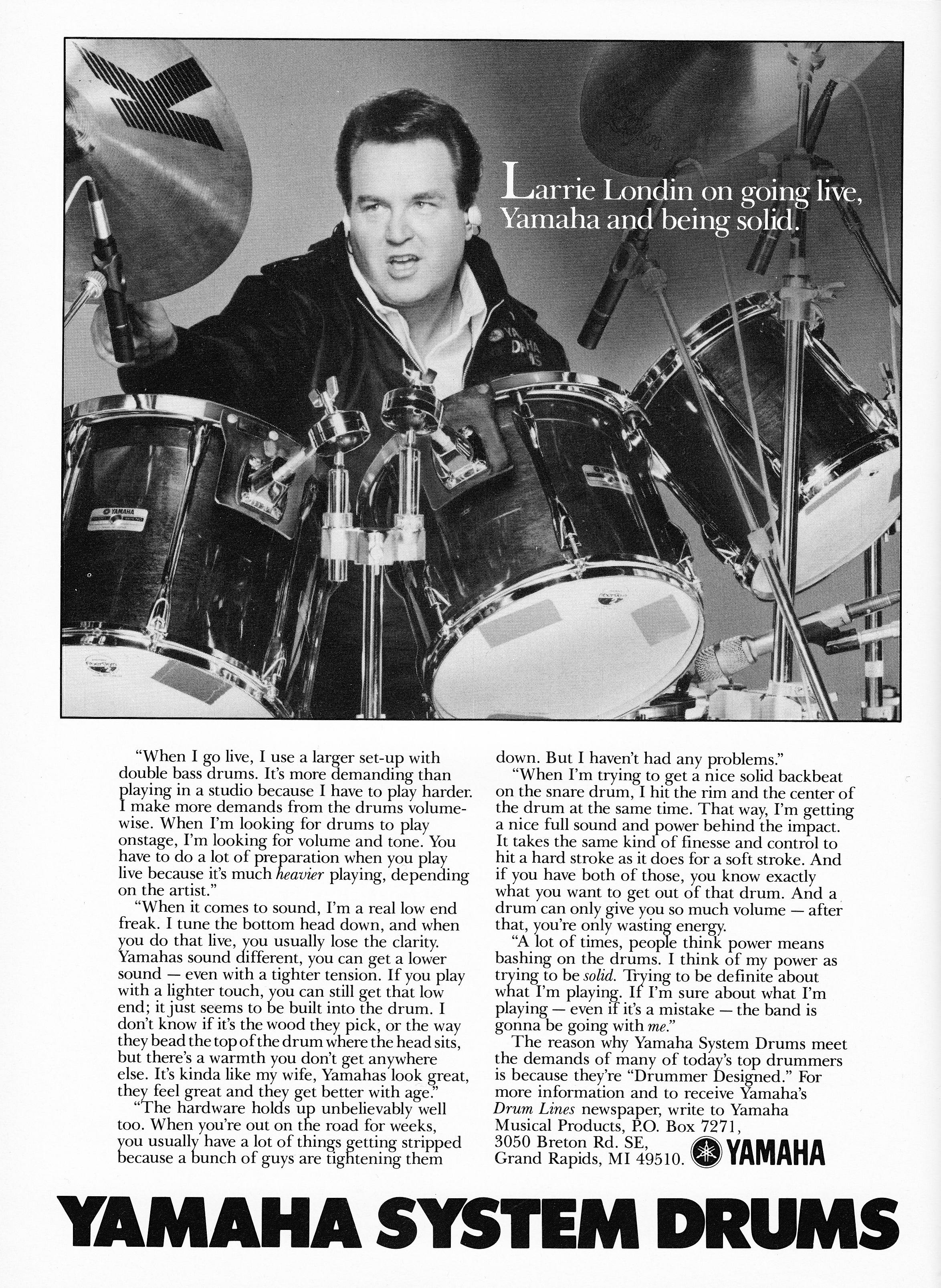
SKF NOTE: Larrie Londin gives good advice in this Yamaha ad from the August 1984 Canadian Musician magazine. For example:
 “A lot of times, people think power means bashing on the drums. I think of my power as trying to be solid. Trying to be definite about what I’m playing. If I’m sure about what I’m playing — even if it’s a mistake — the band is gonna be going with me.”
I remember a phone call with Larrie in the early 1980s. I was in my Modern Drummer office. Larrie was, I think, in Nashville. What a nice guy. We were talking about what it takes to become a studio drummer. I don’t remember if our conversation was an interview for an article, or for backgrounder information, or just shooting the breeze. It might have been an introductory phone call.
At any rate, my take away from that phone call, was Larrie’s story about one piece of simple advice a fellow musician gave him about reading charts. It was advice, said Larrie, that enabled him to evolve from being a poor sight reader to a very good sight reader in a relatively short time period. Improving as quickly as possible was important, Larrie said, because it was the difference in earning a living or not.
Larrie said the gist of the advice given was:
Most of the notes you see on drum charts will be quarter notes and eighth notes. Take Ted Reed’s Progressive Steps to Syncopation for the Modern Drummer. Practice reading Reed’s quarter/eighth note exercises playing the quarter notes on your bass drum and the eighth notes on your snare drum.
Larrie said practicing that way with Syncopation helped him relax and gain confidence reading charts. And developing the quarter note/bass drum, eighth note/snare drum habit, he said, gave him a strong foundation to build on.

Sample of Quarter/Eighth Note Exercise from Ted Reed’s “Syncopation”
Final Note: Yamaha Drum Company gets points from me with this ad. I can’t think of another drum company approving a photo of one of their artists playing their drums with taped drum heads!
— end —
Life Beyond the Cymbals
A Blog about Music and Popular Culture
Online Drum Tracks | Drum Recording | Remote Session Drumming | Pro Session Drummer
Life Beyond the Cymbals
Writing About and Reviewing Classical Music and Jazz
Life Beyond the Cymbals
A Drummer's Look at Drums and Drumming
 Scott K Fish
You must be logged in to post a comment.