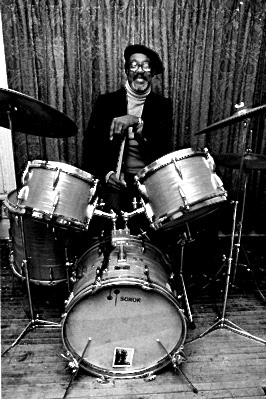
Keith Copeland: You Can’t Teach Feeling

SKF NOTE: This interview was done over dinner at a Centre Island, New York restaurant in early 1980s. I have forgotten the restaurant name. Neither do I remember how this interview happened, nor if it was ever published in Modern Drummer. But re-reading it for the first time in 30 years — I am impressed! Keith Copeland and I had a good rapport, asking very good questions and giving very good answers.

We were talking about teaching and drum student aptitude. Keith said, “You can’t teach feeling. You can teach anybody technique. If you don’t have heart it’s going to be very hard for me to teach it to you.”

That’s when I asked my opening question in this exchange.

copeland_keith

Keith and Ute Copeland

Scott K Fish: What about that famous story of Papa Jo Jones throwing a cymbal at Charlie Parker because he felt he was playing so bad? Doesn’t that contradict the theory of either you have got it or you don’t?

Keith Copeland: I can’t say what was going through Papa Jo’s mind. But, I think he did that because he recognized some talent in Charlie Parker and, that would scare him enough to really make him get it together.

That’s what happened to me when I was coming up.

The worst, most traumatic experiences I had was when I was trying to play with people I love and revere today. They literally scared me to death to make me practice.

When I was 17 I sat in with a group that pianist Barry Harris was leading at Minton’s Playhouse. It was George Coleman on tenor, Charles McPherson on alto, Peck Morrison on bass, and Barry. Lenny McBrowne was the regular drummer.

BarryHarris2_depth1

Barry Harris

I thought I was playing pretty good. But I wasn’t playing any bass drum or bottom. I wasn’t playing four-to-the-bar lightly like Lenny. I was just using my bass drum to drop bombs and answer what my left hand was doing — in the style of Philly Joe Jones with Miles [Davis].

But Barry wanted to hear some bottom! We were playing all the Charlie Parker tunes. When those tunes were recorded, Max Roach was playing some bottom too. When I was playing behind the horn soloists, Barry kept looking at me real strange and I was feeling real bad.

When Barry started soloing he started having a conversation with me about my inadequacies in using my bass drum. He was soloing and talking to me at the same time! I’d never seen anybody do that before.

So, I went home and worked on it. The next time, I had it more together. At least Barry didn’t talk to me during his solo. The way he looked at me and the way he was talking is still alive in my mind.

end

Posted in SKF Blog | Tagged , , , | 1 Comment

Internet Helps 95-Year Old Jazz Pianist Host Jam Session

SKF NOTE: Heartwarming story and a great example of networking possibilities thanks to the internet.

Lonely Elderly Pianist Places Ad, Drums Up 80 Musicians to Jam
by Terry Turner – Dec 30, 2015

This 95-year-old jazz piano player is booked solid since placing an online advertisement asking musicians to join him for a jam session.

Edward Hardy tickled the ivories in a jazz quartet for 40 years…. When he had to go into a care home for dementia, he needed to strike up a new band.

The World War II vet placed an ad on the website Gumtree and musicians have been beating a path to his door….

At least 80 musicians jumped at the chance to sit in for a set. [T]he other three members of his former quartet — who he hadn’t seen in 30 years — all showed up because of the ad.

Hardy is putting the band back together — and they’re already rehearsing a reunion show next year.

Full Story

Posted in Drum/Music News | Tagged , , , , | Comments Off on Internet Helps 95-Year Old Jazz Pianist Host Jam Session

Tears for Natalie Cole

SKF NOTE: Tears for Natalie Cole. Very sad. A unique singer of some memorable songs, and by all appearances, a genuine, nice person. RIP, Natalie.

Singer Natalie Cole Dead at 65


Posted in Drum/Music News, SKF Blog | Tagged , , , | 1 Comment

Fred Below: The Drum is a Beautiful Instrument if Played Correctly

SKF NOTE: This is an excerpt from my interview with drummer Fred Below, arguably the father of Chicago electric blues drumming. Mr. Below recorded with Muddy Waters, Sonny Boy Williamson, The Aces, Little Walter, Chuck Berry, and other pivotal blues musicians.  The interview was published in Modern Drummer‘s September 9, 1983 issue as, Fred Below: Magic Maker.

Mr. Below is shown in this blog post behind Ludwig and Sonor drumsets. He was playing the Sonor kit when we had this interview. In fact, the Sonor photo here is one of several MD used for this interview. 

Fred_Below

Fred Below

Scott K Fish: Do you have a preference between matched grip and traditional grip?

Fred Below: I use traditional myself because it works good. But, I’ve seen guys use drumsticks like mallets. To me, that gives off a different sound and a different beat. It’s harder. It’s not soft enough.

I like my way best, the traditional, because of the technique and the pressure. You’re no so much slamming/bang, slamming/bang.

The drum is a beautiful instrument if you play it correctly. You can get beautiful sounds. And your drums should be tuned so that you can hear different tones coming out of all the different sizes.

You can be playing in a band, and all of a sudden you hear that their tones are going up. You can’t reach it up if your drums are flat. You just have a plop sound that don’t have no tone. But if you’ve got tone, if the band goes up, you can go right up with it.

SKF: Was there any one person that taught you how to tune drums?

FB: That was back when I was going to DuSable [High School]. Way back in the early ‘40s.

SKF: How do you like to tune your drums?

FB: I tune my drums left to right, so that the two tom-toms have different tones. My floor tom has the lowest tone. My hardest, flat tone would be my bass drum.

Fred BelowMy snare drum has an intermediate tone. That is, it’s between the two tom-toms on the top so that, when you flick the snares off, you’ve got three tones. The two tom-tom tones and the snare drum in the middle of both of them.

I never put anything inside the drums. I never understood why drummers want to stack all that stuff in there. It’s okay for recording purposes — putting padding in the drums. But not for when you’re playing! God! That just kills all the tone. You don’t know what you’re playing. I don’t put no foreign matter whatsoever in there.

SKF: Are you using a wood beater on your bass drum?

FB: No. Felt. Hard felt.

SKF: Obviously you were using calfskin heads when you first started playing and recording. Did you mind switching to plastic heads?

FB: No. I think I liked it better. It’s a different tone. The calfskin gave a little sharper tone. The plastic heads are better for different weather conditions. That’s the main thing. When it got damp and muggy and bad weather them calfskin heads would go up and down. They’d be flabby and all other kind of stuff.

With the plastic heads you don’t have that problem.

Then it was the way you had them tuned. The part that you beat on is the only part of the drum that you tune. The part that you do not beat on — you do not tune it. Like, on the bass drum, you loosen the part that you’re playing on and that’s all.

But when you’re playing on the top head, you keep the top head for tuning. Tighten the bottom head of all the drums. You just tune from the top. You never tune from the bottom. The bottom stays like it is. Once you tighten it up, then it stays. The top head is what you tune. You can loosen it or tighten it.

end

Posted in SKF Blog | Tagged , , , , , , | 7 Comments

Ed Soph: The Tale of the ‘One-Arm’ Drummer

SKF NOTE: Ed Soph and I have reconnected by email — about which I am very happy. Ed is a great guy, marvelous drum teacher, a student of drum history, and a thinker. Plus, he was fun to interview the several times he and I chatted in the 1980’s over a tape recorder. The back story to all that is in this earlier Ed Soph Life Beyond the Cymbals post.

This exchange about essential and non-essential drum studies, and drummer pitfalls, took place at Ed’s home in North Haven, CT. 

soph_ed

Ed Soph

Scott K Fish: You’ve had a lot of legitimate drum studies. Your five-year old son is starting to play drums. Now that you’re 40, is there any part of your studies that you would tell Steven is a waste of time? And are there any parts of your studies that you would tell him are absolutely essential to learn?

Ed Soph: No. The only thing I could tell him about would be his attitude, and about how to approach the instrument or whatever he’s doing. That none of it is drudgery. That any event with the instrument can be positive — and should be positive — even if it’s an event that, once you’ve gone through it you know you never want to do it again.

As soon as that instrument becomes something that you’re going to say right, wrong, good or bad with — then, to me, it’s lost its validity. Because that instrument is neutral.

As a musician, if you take a gig, your job is to play it well. There’s nothing worse than going on a gig where you’ve got a one-arm bass player. If you get angry and say, “Oh, shit,” — first of all, that’s the most egotistical thing in the world. If you look hard enough and approach it the right way, you can make music at some level, in some form, with that person. If you give and if you take. Mostly give.

It’s like Baby Dodds said. Your job is to make everyone in that band feel like playing. It’s a very idealistic way of looking at it, but you have got to. Because that’s your outlet.

SKF: Were you ever in a situation where you were the one-arm drummer?

ES: Oh, definitely. When I was 14 I was playing with great players like Jimmy Ford and Don Wilkerson. I’d be rushing, dragging, playing too loud or too soft. And instead of going, “What the fuck are you doing?” they would take me aside on the break and say, “Listen, do you know what you were doing on that last tune? I’d say, “No.” They’d say, “Boy, you’ve got to listen. Listen to your time. You were up and down.”

It wasn’t negative. They weren’t saying, “You can’t play.”

SKF: Has anybody ever jumped on you like that?

edsophaa

Ed Soph

ES: Woody Herman. We came into a gig in Kansas City in a country club. The bus got in about 20-minutes before we were supposed to hit. It was one of those smash-o insta-setups.

Woody was ready to give the down beat and I was going through my stick bag getting sticks out. You reach a point where you feel real good about yourself with the band. You know the book. You can look around and scope out the ladies while you’re playing. Mr. Cool. I’d reached a point like that.

Whenever your mind’s off the music, no matter how many times you’ve played the chart, the music suffers.

So, I said, “Hey, Woody. Just a minute. I’m getting some sticks.” He says, “Oh! While you’re down there, try to find some with time on them.”

Boy! The clouds parted. The lightning bolt hit. Back to earth, folks.

It’s so easy to let yourself get into that frame of thinking, “I’m in control. I’M THE DRUMMER!”

So, attitude is the whole thing.

end

Posted in SKF Blog | Tagged , , , | Leave a comment