Meet Big Sid Catlett’s Son

SKF NOTE: Last night I found out Big Sid Catlett has a son, a retired professional basketball player for the Cincinnati Royals also named Sid Catlett.

Big Sid died when his son was age two. I came across this YouTube clip of basketball legend Kareem Abdul Jabbar on tv, telling the story of how he came across a DVD with Big Sid Catlett playing and talking. “Out of the blue,” he called “Little” Sid and told him about the DVD.

“I had never heard my father speak,” Little Sid says. “I didn’t have a clue he was in the movies. So here I was, a guy in his fifties, hearing his dad talk for the first time. It was an incredibly private, emotional moment.”

Swing Men
How a basketball game brought Big Sid and Little Sid Catlett together
By Dave McKenna • February 18, 2011
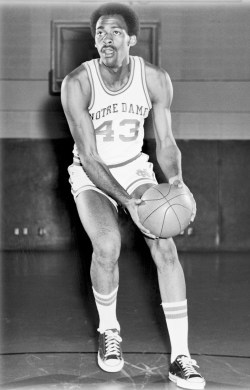
catlett_sid_little

Sidney Catlett

…Catlett’s dad…was Big Sid Catlett, literally and figuratively among the biggest drummers of the 1930s and 1940s. Big Sid pounded out the beat for, among others, Dizzy Gillespie, Charlie Parker, Benny Goodman, and Louis Armstrong.

“Sid was a powerhouse,” says Rob Bamberger, host of “Hot Jazz Saturday Night” on WAMU-FM. “Benny Goodman thought him too loud when Sid was with [Goodman’s big band].”

Big Sid is also regarded as a trail-blazing entertainer. His assortment of crowd-pleasing tricks included throwing a stick in the air and lighting a cigarette before it came down, all without missing a beat.

Little Sid’s parents—Big Sid and the former Florence Jackson—met when the drummer played a gig in D.C., her hometown.

After getting married, the couple made a home in Big Sid’s hometown of Chicago. Little Sid was born there in 1948. But on Easter Sunday of 1951, Big Sid had a heart attack backstage at the Chicago Opera House. He died at 41 years old.

Little Sid was only two.

“I have almost no recollection of my father,” he says.

Little Sid remembers playing the drums a lot in his early years, trying to imitate what he’d heard on the Big Sid 78s he says his mother played “all the time.”

“But then I’m 12 years old and I’m 6-foot-2,” he says, “and there was no way I’d survive in the community without playing basketball. I couldn’t serve two masters.”

So Catlett put down the sticks….
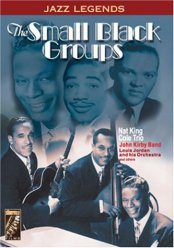
small_black_groupsFast forward to 2003. [Kareem[ Abdul-Jabbar was in D.C. on a book tour and…called Catlett at home. He mentioned a French DVD he’d found.., The Small Black Groups. The compilation of vintage movie clips, he said, included footage of Big Sid’s appearances in a pair of 1940s feature films.

“Kareem told me my dad talked,” Catlett says.

Catlett jumped in his car and drove to the old Tower Records in Rockville. There was a copy of the DVD in stock. Catlett brought the disc home. Sitting alone in his living room, he put it on.

Sure enough, there was his dad pounding out the big beat. And, as billed, Big Sid had small speaking parts, too.

“I had never heard my father speak,” Little Sid says. “I didn’t have a clue he was in the movies. So here I was, a guy in his fifties, hearing his dad talk for the first time. It was an incredibly private, emotional moment.”

…Catlett isn’t convinced he ever would have come across those special clips if he hadn’t gotten a call “out of the blue” from his old rival.

Full Story

Posted in Drum/Music News | Tagged , , , , | Comments Off on Meet Big Sid Catlett’s Son

Paul Motian: Time is There All the Time

SKF NOTE: My first awareness of Paul Motian — which might be different from when I first heard Paul Motian — was the opening song, Victoria, on his 1974 album Tribute. This haunting, beautiful song written by Paul Motian, is played by guitarists Sam Brown and Paul Metzke, bassist Charlie Haden, and Carlos Ward on alto sax.

This was a period in my life when I was first thinking a jazz drummer’s ding-dinga-ding ride cymbal and two-and-four hi-hats were outdated and unnecessarily constricting. I thought it would be great to play drumset with the fluidity of a tenor sax player.

One Amazon.com reviewer of Tribute writes, “Mr. Motian plays the most stretching, elastic, breathing drumming I have ever heard in my life…” That was my reaction on first hearing this album. Motian was one drummer who found a way out of the shackles of ding-dinga-ding and the two-and-four hi-hat.

Then I listened to Keith Jarrett‘s Byablue album with Paul Motian on drums. The one song I liked — and I loved the melody – was the title track, composed by Mr. Motian. Today I think the definitive version of Byablue is from the Paul Motian Quintet’s Misterioso album with guitarist Bill Frisell.

So when I interviewed Paul Motian for Modern Drummer I was a freelance writer, devouring every jazz book and magazine article I could find. Certainly I was aware of the innovative role of the Bill Evans Trio with Evans on piano, Scott LaFaro on bass, and on drums, Paul Motian. But I’m not sure — at that time I interviewed Mr. Motian — I had heard much of that trio’s records. My stronger point of reference was Motian’s own albums and his work with Keith Jarrett and Carla Bley’s Liberation Music Orchestra.

This exchange took place at Paul Motian’s New York City apartment circa 1979 or 1980. If you have the original Modern Drummer with this interview, I think it includes one photo I took of Motian on his drumset which, along with his acoustic piano, took up 75-percent of the room we were in.

This is where I ask Paul Motian about what seemed to be the point at which he figured out how to keep time while breaking free from ding-dinga-ding and the two-and-four hi-hat.

Scott K Fish: How did you get that gig [with the Bill Evans Trio]?

Paul Motian: That was kind of accidental too. Well, I had played with Bill alot. We played with Tony Scott together and a couple of other people. A clarinet player named Jerry Wald — years ago.

And so then, Bill — we played alot. We use to play gigs together and I use to live in the same building as Bill. And we played together a lot.

And then one day he had his trio. It was after he had been with Miles Davis, and I think he had a drummer who was Kenny Dennis. And he had a bass player too at the time.

He was playing in Midtown at a place called, I think, Basin Street [East]. Kenny Dennis couldn’t do it one night, so Bill called me.

Scott LaFaro was playng around the corner with somebody else, and he use to come by. He liked Bill a lot and he came by and sat in. It seemed like that was it, y’know? Bill liked it alot, and from there we just kept it together. We played together about two years.

MUSIC_020_Paul-Motian_JohnAbbottSKF: Somebody said that you and Scott LaFaro were responsible for freeing up Bill Evans.
PM: Yeah, I think it might have been mutual. I think it was just a thing. I mean, nobody was playing bass like that [Scott LaFaro] before. It was a freeing up too. I guess bass player played roots of chords all time, and this was the first time the bass player was playing with the pianist, and wasn’t playing that kind of bass, and I guess that freed him.

[With] myself sort of playing what I hear and fitting in with that.

SKF: It was keeping time but not in a strict sense.

PM: Yeah. I’ve really gotten away from that now. (laughs) I think that the time thing is there all the time. I don’t mean a particular pulse, but the time itself. Maybe if you took eight measures of music, and each measure was in a different pulse. Like one fast, another one is slow, and another one a ballad in each measure — but it’s all there somehow. I think that can be played without being played. All different ways.

It’s like a huge thing that says TIME, and it’s up there [gestures as if pointing to an eye chart on the wall before him] and it’s printed TIME. I mean, that’s there and you can play all around that.

SKF: Was the Bill Evans Trio the first time you played like that?

PM: I guess it was a sort of freeing up for me too.

SKF: Was it a conscious thing?

PM: No, I don’t think so. I think it was something that just happened. I’ve never thought of playing that way. I’ve never pre-thought something. It seems like it’s always been something that’s happened through the involvement in the music and the musicians.

Photo of Paul Motian by John Abbott

end

Posted in SKF Blog | Tagged , , , , , , , | 4 Comments

Vinnie Ruggiero’s Drum Method Book Available

SKF NOTE: Jon McCaslin posted some wonderful news recently on his Four On The Floor blog. Vinnie Ruggiero’s handwritten jazz drumming method book is now available thanks to Vinnie’s son.

Since the early 1980’s I have personally heard stories about Vinnie Ruggiero from Joe English and, most recently, Roy McCurdy. And now, thanks to YouTube, those of us who missed seeing Vinnie when he was alive, can at least see him on video.

Good for Vinnie’s son for keeping his father’s work alive.

end

Posted in Drum/Music News, SKF Blog | Tagged , , , , | 1 Comment

American Revolution: Wet Drumheads Saved Lives

SKF NOTE: An interesting news report. I learned new information and concepts on the use of drums during the American Revolution. The idea of “hearing” history, of drums as communications technology, and of wet calfskin drumheads saving lives.

Drums of history sound off at Fort Meigs presentation
By EMILY GORDON, Sentinel Staff Writer | Posted: Tuesday, March 1, 2016 9:32 am

56d5b1f887bd0.image

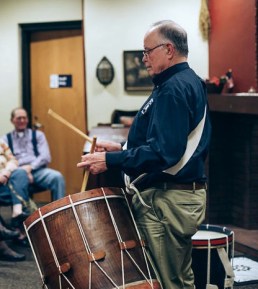
Mark Logsdon and 1824 Drum

PERRYSBURG — History buffs read extensively about their favorite aspects of the past, but…don’t often get to actually hear them.

…Mark Logsdon…talked to local history fans about the importance of music in battle….

During his presentation, entitled “Music in the Military: The Story of Fifes and Drums,” Logsdon, director of the 1st Michigan Colonial Fife and Drum Corps, explained how musical instruments were used as disciplinary tools as well as ways to relay commands on and off the battlefield.

With a reproduction rope tension drum hooked onto the drumstick carrier slung over his shoulder, Logsdon described the thrill of hearing what soldiers and citizens would have heard in the late 18th century.

“Musically, sonically, what you’re about to hear are the kinds of things you would have heard over two centuries ago on the technology of the time period,” he said.

The loud, rapid sounds signalling soldiers around the time of the American Revolution were so loud, they could be heard…five miles away.

“Fifes and drums became so important as communication devices that some towns levied taxes on the colonists so they could be purchased,” he said.

Logsdon played songs and signals soldiers would have heard throughout the day from fifes…and drums, such as a call to wake, dress and stand at attention, a call to go to church and a call to dinner.

“Paul Revere never said ‘the British were coming.’ It wouldn’t have made any sense. We were British. What he did say was, ‘The regulation is coming.’ It was a scary time,” he said, referring not only to the looming presence of soldiers marching through a village on their way to war, but also the intimidating sounds of their drums.

Although historians have questioned whether drums were used during the battles themselves, Logsdon is confident they were, citing numerous anecdotes in diaries, letters, memoirs and pension applications.

He also relayed a story about how General Mad Anthony Wayne wanted to move out earlier than planned before the Battle of Fallen Timbers…but…the drummers’ calfskin drum heads were wet from the night before.

“He had to wait for them to dry out. There were campaigns that didn’t happen because drums were wet,” Logsdon said. “The drums were the voice of the battle.”

Drum and fife signals told soldiers which way to turn and how to get in formation.

…Logsdon played a restored Brown Family drum circa 1824, an almost entirely original solid shell drum made of tiger stripe maple and ash that was found in a garbage pile in Baltimore, Maryland, held together by its tack pattern.

Logsdon sent it to the Smithsonian, where it was “saved from having its voice silenced,” he said.

“You can be old and still have something to say. It’s a privilege to be able to hear history,” he said,

“Because of the Grand Army of the Republic, thanks to old veterans, drummer boys from both the Union and Confederate sides getting together to play, the tradition has carried on,” he said. “We speak for the dead. We honor the veterans we cannot thank in person. In playing these drums, we hope we make those ghosts happy,” Logsdon said.

Full Story and Photos

end

Posted in Drum/Music News, SKF Blog | Tagged , , , , | Leave a comment

Max Roach: A Favorite Photo of a Favorite Drummer

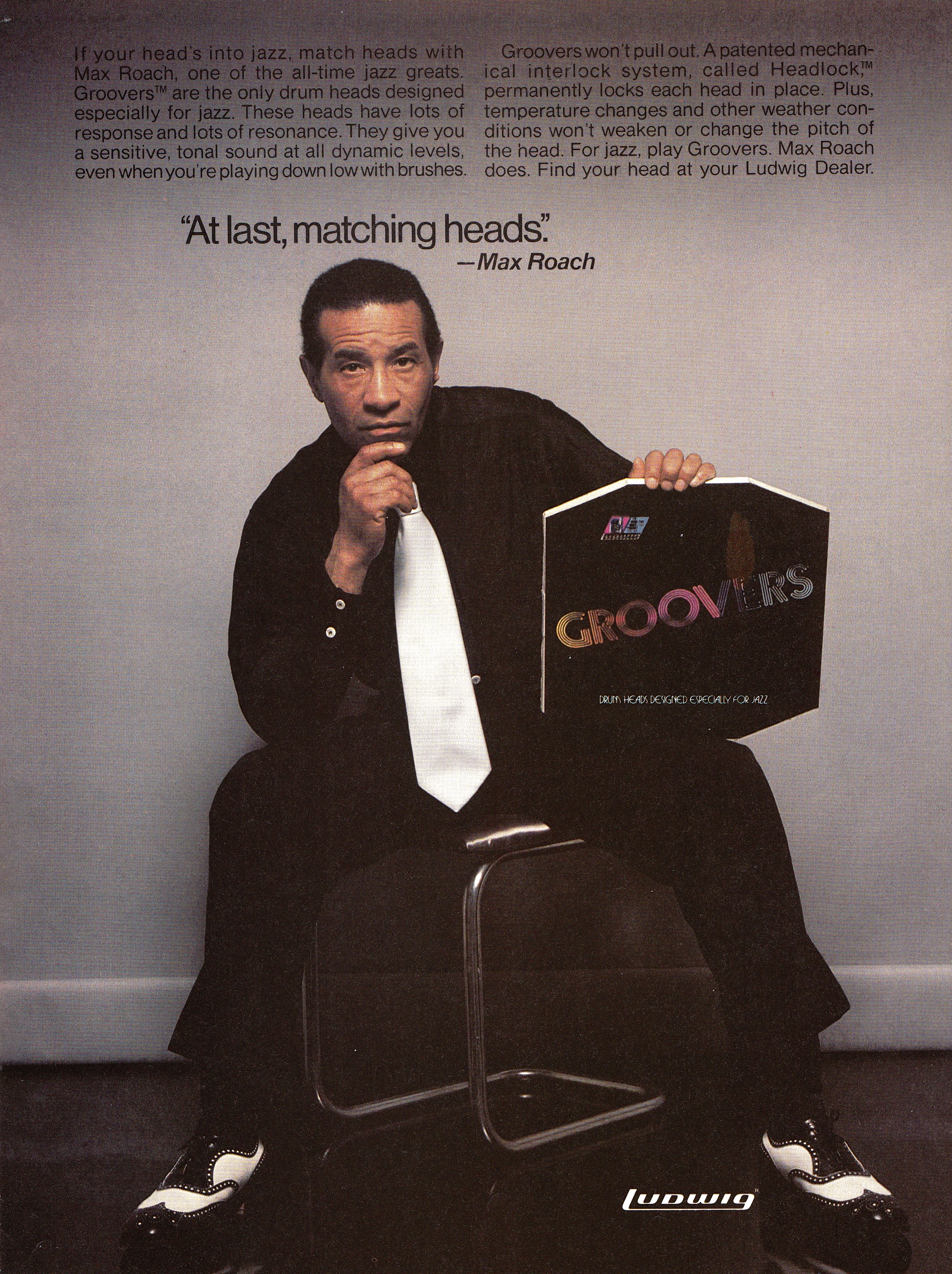
SKF NOTE: A favorite photo of a favorite drummer, Max Roach, from the March 22, 1979 Down Beat. Max looks so c-o-o-l in this shot. That said, I never quite understood Ludwig‘s “At last! Matching heads” campaign.

792203_roach_max_groovers_db

end

Posted in Drum/Music News, SKF Blog | Tagged , , , | 2 Comments