
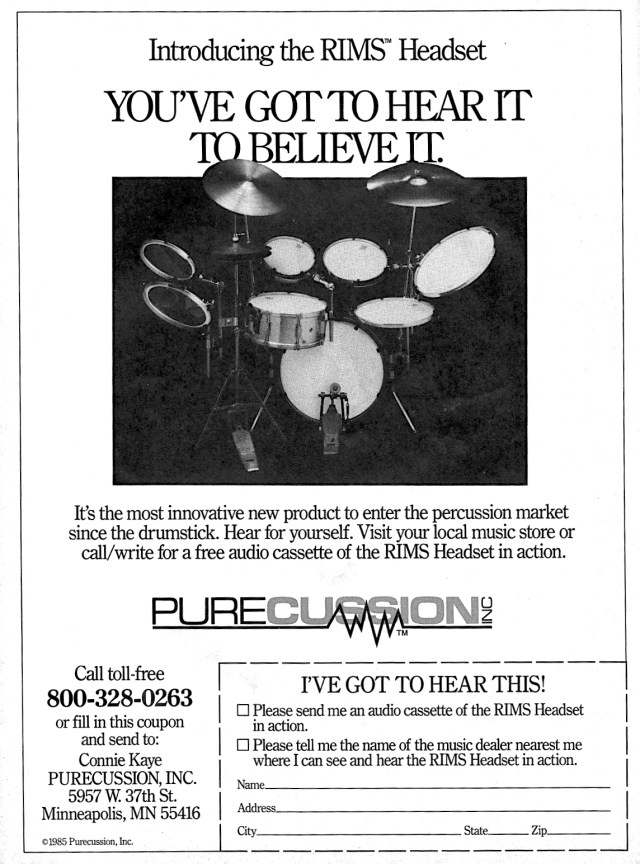
SKF NOTE: A blast from the past. October 1985, to be exact.
SKF NOTE: A blast from the past. October 1985, to be exact.
SKF NOTE: The three voices on this excerpt are Artimus Pyle, Paul T. Riddle, and Scott K Fish. We three were conducting an interview with Artimus which was published in Modern Drummer. As mentioned in my first post about this interview, Paul and Art were old friends and Paul was invaluable on this interview. Plus, Paul and I were friends, so what you have here are three people relaxed in each other’s company.
You’ll hear Art talk about his time (“meter”) playing consistency, and advice he received from Ronnie Van Zandt and producer Tom Dowd about leaving space in his drumming. And Paul says, for the record, that Artimus “taught me more about playing rock n roll than anybody.”
Final point: Art makes reference to “thrashing with the Throbbers.” The Throbbers were Paul’s band at the time.

SKF NOTE: Fleetwood Mac was among my favorites back in the 1960s when that version of Fleetwood Mac was considered a British blues band with Peter Green, Jeremy Spencer, Danny Kirwan, John McVie, and Mick Fleetwood.
Fleetwood Mac’s original version of Black Magic Woman (written and sung by Peter Green) preceded Santana’s version by two years. When I first heard Santana’s Black Magic Woman I remember saying out loud, “Hey! That’s Fleetwood Mac’s song.”
Of course, Albatross, remains a cool song, and one that, for some of my circle of musician friends at the time, helped open our ears to instrumental jazz. Listening to Albatross this morning for the first time in decades, I hear the Mick Fleetwood and John McVie drums/bass rhythm team perfected on 1975’s self-titled album, Fleetwood Mac.
My theory was always that Mick Fleetwood built his drum parts around John McVie’s bass lines. But, no. According to the recent interview which follows, McVie created his bass parts around Fleetwood’s drumming.
They remain one of the best drum/bass rhythm teams ever.
=====
Entertainment & Arts
Mick Fleetwood on the early days of Fleetwood Mac and why he’s a terrible drummer
By Mark Savage – BBC Music reporter
It was a beginning of a beautiful friendship. Fleetwood and [bassist John] McVie not only gave their names to Fleetwood Mac, but they are the only constants in the band’s ever-changing line-up.
In the book, Fleetwood says of McVie: “Musically, he helped me survive whenever I was drowning.” And it’s this comment that prompts the revelation about the drummer’s supposed lack of skill.
“For a while, he thought he could train me into doing the same bass drum pattern every night but I couldn’t… because of the way my mind works,” he explains, “so John learned to push all his notes around what I do.”
“It’s become this weird thing. It’s not really how a rhythm section should work. They’re supposed to be doing exactly the same thing at the same time. I’m doing different stuff and he’s falling in between the gaps.”
=====

SKF NOTE: Count me among the listeners blown away by Grady Tate’s drumming with Stan Getz on the Sweet Rain album (1967). Chick Corea (piano), and Ron Carter (bass) make up the rest of that Getz quartet. Clean, musical, swinging on great sounding drums and cymbals — Grady Tate’s Sweet Rain drumming alone set the bar high for other drummers. I was an instant Grady Tate fan.
Here’s a rite of passage story about Papa Jo Jones and a young Grady Tate from Mr. Tate’s New York Times obituary.
=====
OBITUARIES
Grady Tate, Jazz Drummer Turned Vocalist, Dies at 85
By RICHARD SANDOMIROCT. 12, 2017
Grady Bernard Tate was born on Jan. 14, 1932, in Durham, N.C.
At 13, he had an odd if inspiring experience watching the jazz drummer Jo Jones perform at the Durham Armory….
He recalled being mesmerized as Mr. Jones, “the craziest man I’ve ever seen in my life,” played with unalloyed joy. Afterward, Mr. Jones invited him onto the stage and asked if he had brought his drumsticks with him.
“No, sir,” Mr. Tate said, and Mr. Jones offered his own pair but whacked one of [Grady Tate’s] hands with them. “That’s just a tiny bit of the pain that you’re going to get,” Mr. Jones said, “if you’re gonna pick these damn things up and use ’em.”
SKF NOTE: My opening question to James Black was, “Early on, was there a person, or something that influenced your decision to play drums instead of another instrument, or something else altogether?” Mr. Black’s answer is part mystery. His main influence, he says, was “an almost midget sized drummer” in New Orleans who “played Dixieland.” Black could not remember that drummer’s name.
Ed Blackwell is cited here too as a James Black influence. As of 1982, the two drummers had only a passing acquaintance with each other. What a duo those two would have been.

Life Beyond the Cymbals
A Blog about Music and Popular Culture
Online Drum Tracks | Drum Recording | Remote Session Drumming | Pro Session Drummer
Life Beyond the Cymbals
Writing About and Reviewing Classical Music and Jazz
Life Beyond the Cymbals
A Drummer's Look at Drums and Drumming
 Scott K Fish
You must be logged in to post a comment.