Freddie Gruber: In the Final Analysis, You Are the Instrument

SKF NOTE: I post this, with hesitation, because it is a glimpse at Freddie Gruber as drum teacher. As such, it probably belongs in the public square. But it doesn’t show my drumming skill in the best light. Oh well.

I spent part of several days with Freddie Gruber in New York City. A fascinating, non-stop talker, I enjoyed our time together. But our prime goal was to have me interview Freddie for Modern Drummer. Much easier said than done. The back story is here

In brief, on our last day together I was able to persuade Freddie to let me tape our conversation, which became the basis for his MD article. At one point I asked Freddie, “Let’s say I come to you for a drum lesson. I walk in your door and introduce myself. Where does it go from there?”

After talking for a few minutes about how he’d approach our first drum lesson, I asked Freddie to show me. And he did.

We were sitting across from each other at a formica top kitchen table in Buddy Rich’s New York City apartment. Was I nervous? You bet. I played a double-stroke roll on a magazine placed on the kitchen table. Then, at Freddie’s request, I played a double-stroke roll on the formica table top.

I wish I could say Freddie’s reaction was, “Wow!” It wasn’t. Here is exactly what Freddie Gruber said during my “first drum lesson.” He instructed me to relax and not think about what I was doing.

glry28-093Freddie Gruber: Okay. You responded differently to this harder surface with another sound than you were playing on the magazine.

You’re the instrument. In the final analysis you are the instrument. The instrument you are sitting behind is just an extension of you and what you hear and feel.

Something changed when you played on another surface.

Let’s do it again.

[SKF NOTE: I again play a double-stroke roll on the table top.]

Freddie Gruber: Okay. You can hear that the strokes are not as even as they were on the magazine. You’ve backed off a little because the sound of the table is harder. In other words, it discloses more of what you’re doing. It hides less.

So you’ve backed off a little, which only means that you got mildly apprehensive. So we dismiss that. It doesn’t really count. We’ll try to get relaxed and we’ll do it again.

[SKF NOTE: Again I play a double-stroke roll on the table top.]

Freddie Gruber: Okay. On the left hand, the first stroke of the double-stroke was much louder, and the second one came down as a rebound.

The right hand was following the left hand. It was just hanging there limp and just playing a little rebound. Whereas, the left hand was actually playing the more aggressive lead.

So in technical terms it means, simply, that it’s uneven. One hand is different than the other. And if we’re talking technically, one hand should be able to do what the other can do.

Freddie-Gruber3We’re not talking about sitting down and playing music now. We’re not talking about swinging. We’re not talking about phrasing.

Technically speaking, that means that one of your hands is not matched to the other. And there’s a slim possibility that, sometime in your playing life, you might want to express something you’re hearing that might not come out because of the technical deficiency. And you find yourself saying, “I can’t get it out!”

Now this may or may not be relevant, because we’re sitting together for the first time, and you might not be doing what you can actually do. But I’m getting an opportunity to view what you’re doing at that moment, which gives me the opportunity to estimate where you’re at.

[SKF NOTE: I didn’t play again. Freddie finished up by explaining what his next step would be if I were actually a student sitting with him for the first time.]

Freddie Gruber: Then I’d try to instill some confidence and have him [play] again. I’d try to point out some bad habits, if they were in existence, where I could show you, very quickly, that you are not utilizing some fundamentally correct natural principles.

I’d make you aware that you could do what you’re doing, possibly better, and certainly alot easier. So when people ask you, “How’d you do that?” the best answer is “Easily.”

end

Posted in SKF Blog | Tagged , , , | Comments Off on Freddie Gruber: In the Final Analysis, You Are the Instrument

Tony Williams’s Drumset and the Nub of Great Drummers

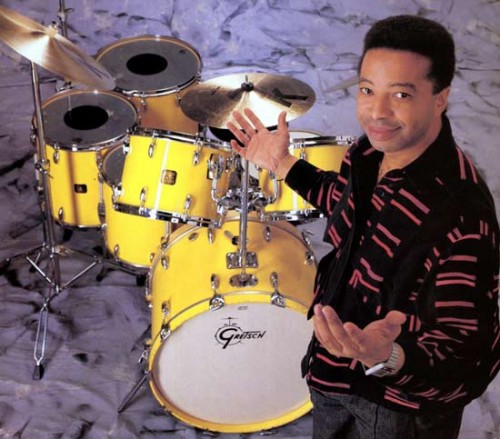
Driving Maine roads, listening for the first time to Tony Williams’s “Civilization” album. I think of a recent email concerning Tony’s yellow Gretsch drumset. The email includes a photo of Tony’s drumset assembled in a home basement.

Tony Williams

Tony Williams

The photo haunts me as if I’m seeing a close friend, an inspiration, dead in an open coffin. I think of my lifelong conflict with drummers putting so much emphasis on drum equipment. As if the nub of great drumming and drummers is made of wood, brass, or chrome.

I like drum equipment. Especially well-made, beautifully designed, great sounding drum equipment. And I confess to buying my Gretsch drumset because I liked how Gretsch drums sounded when my drum heroes played them.

But back when I was interviewing drummers for a living, I stopped asking equipment questions unless a drummer’s set included something unique. Bill Bruford‘s Simmons drums, for example. I was, and am, more interested in what makes drummers tick.

As Pamodhi Kuruppu said: “[O]ne drummer‘s style cannot be followed by another. It’s always different. Above everything when the drummer dies, the drum dies too.”

Red Smith

Red Smith

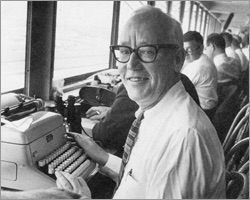
That is true of every tool used by great communicators of all types. No one will ever sit at Red Smith’s typewriter and write sports columns as Red Smith.

Tony Williams’s yellow Gretsch drumset is a tool through which Tony communicated to world. What’s gone is the spark, that life force that went from Tony, through his drumset and cymbals, to the world.

No one will ever again play this drumset and be Tony Williams.

end

Posted in SKF Blog | Tagged , , , , | Leave a comment

Drumming with Words: A Time to Pound, a Time to Pause

Drumming With Words
by Greg J. Stone — 06/11/2015

Greg J. Stone

Greg J. Stone

I have what…Ginger Baker calls the “gift of time.” …I have always had an instinctive ability to keep a beat — at least at the level of an amateur drummer. That skill crosses over to my business in that I have found that rhythm is an integral part of any speech, story or presentation.

Though I have been a percussionist ever since I was…young.., I never learned to read drum music until recently…when I started performing with a parent-student-teacher band in [my] town…. I was hoping…to follow along with the melody, but was horrified to see…the sheet music…showed the percussion parts with no other references. [T]here are gaps, sometimes large ones, where I had to stand by and wait – counting each measure in my head. Coming in at the wrong time…could be very embarrassing.

Then I thought about the significance of this. There is a time to speak, and a time to remain silent. A time to pound and a time to pause. This has vast implications for communication.

Full Story

Posted in Drum/Music News | Tagged , , , | Leave a comment

Elvin Jones: The Subtleties of Timekeeping

SKF NOTE: Herb Nolan’s 1977 Elvin Jones interview is loaded with wisdom and insight. Thank you, Down Beat, for making the entire interview available online. What Elvin says here about keeping time is among my favorites from Mr. Nolan’s piece.

ElvinJones_10-08-12_CI1064Elvin Jones: “Time doesn’t change. I mean, there is nothing new about timekeeping…., some people can keep better time than others. Some people are more sensitive to rhythmic pulses, and the more sensitive you are, the more you can utilize the subtleties of timekeeping.

“For instance, when I am playing I can use the bass drum beater at a minimum because [the bass drum’s] not necessary for me to sustain the pulse. I can get just as much of a dynamic thrust with the hi-hat or a light touch on the ride cymbal and balancing the natural pulsation of, say, 4/4 or 3/4 time throughout the different components of the drum set.

“It’s just as effective for keeping the same pulse going as…using one component—but it’s not conventional. The conventional thing is to use the hi-hat for the after beat and use the bass drum for the underlying 4/4 or 3/4 rhythm to keep the steady pulsation … I just think you have to use all of the drum set all of the time. Of course, …the character of the composition…dictates how you are going to use the set’s components.

“[W]e have become more aware of the possibilities of the drum set. When I’m playing, I feel that whatever I’m doing has a certain rightness about it, but you have to keep your mind free enough to use everything…there.”

Full Interview

Posted in SKF Blog | Tagged , , , , | 1 Comment

3D Printer Drumset? Cool! But, How Does It Sound?

SKF NOTE: The technology here is fascinating. I emailed 3DPrint.com, however, asking if online readers can have a chance to hear Mr. Szydlowski’s drums. Not sure why the film editor ends this video at the exact moment the listener expects to find out how this 3D printer drumset sounds.

3DPrint.com
Maker Creates an Awesome 3D Printed Drum Set on a ZMorph 2.0 S Personal Fabricator
BY TE EDWARDS · JUNE 10, 2015

Michal Szydlowski is a graduate student at the Wroclaw University of Technology acoustics program, and he’s also a Research and Development Engineer for Toolheads at ZMorph.

Szydlowski also has lots of experience 3D modeling and prototyping, and when he faced having to come up with a thesis project, his passion for music, 3D printing, and a tight deadline came together to inspire him to create something impressive. So Szydlowski decided he’d…build a…homemade digital drum set.

Full Story

Posted in Drum/Music News | Tagged , , , | Leave a comment