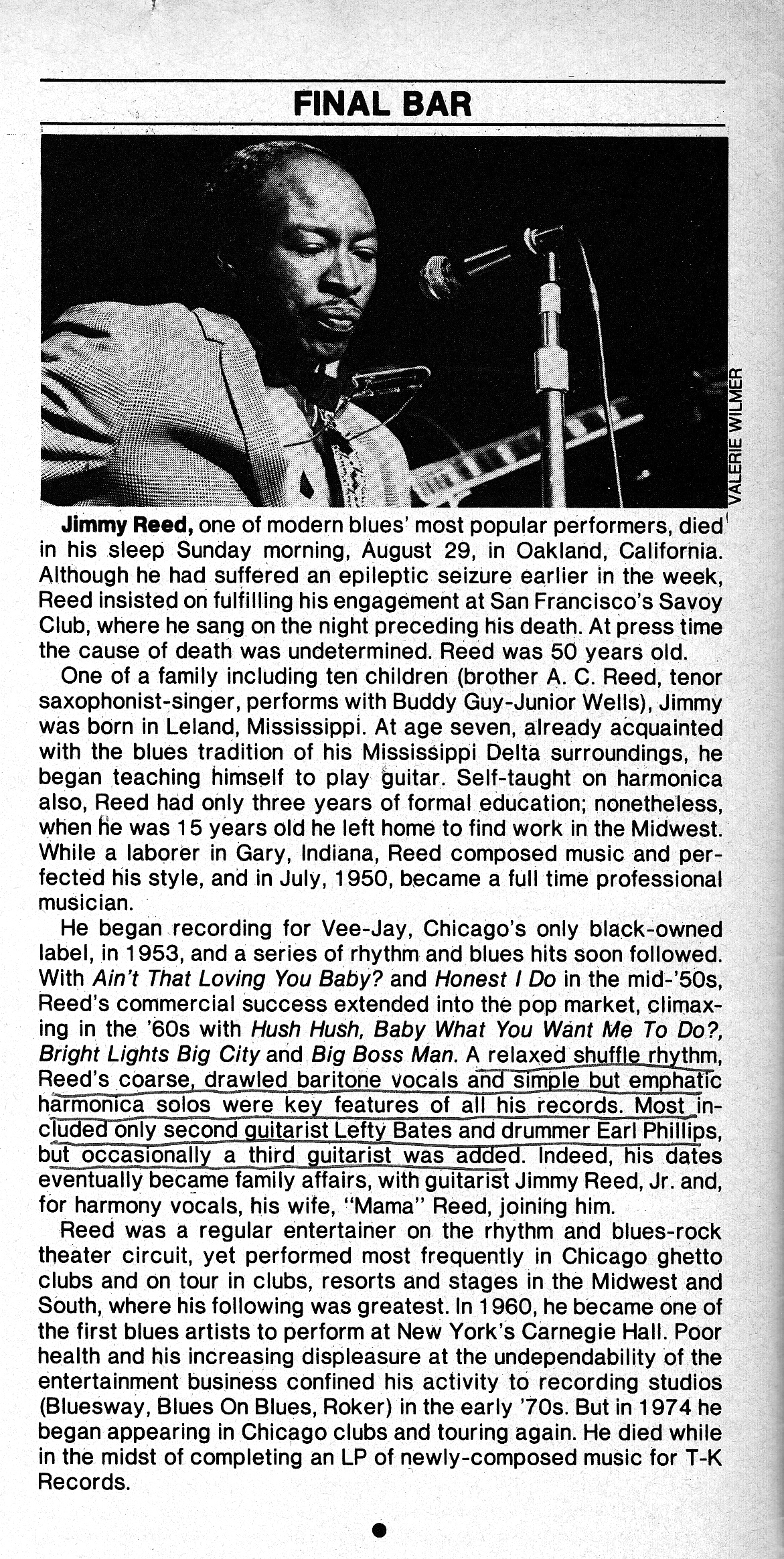
SKF NOTE: From Down Beat November 4, 1976. One of the greats. Dying far too young at age 50. When I was playing drums in Honest Tom Pomposello‘s band, we played Bright Lights, Big City and Big Boss Man. Honest Tom sang lead on the former. I sang lead on the latter. Great songs. Fun to play.
SKF NOTE: From Down Beat‘s March 20, 1958 issue comes this brief history of jazz drummers; an excerpt from Leonard Feather‘s The Book of Jazz. Feather was a prolific jazz writer, perhaps best known for his Encyclopedia of Jazz. Through his writings — his books, his liner notes, his album reviews, and his classic Down Beat musician Blindfold Tests — Mr. Feather was a key part of my knowledge of jazz.
I’ve had this 1958 issue in my possession since the early 1970’s. The underlined sections are mine. I’m sure I used them as a source in one or more of my published writings. It’s interesting to read Feather’s take on where jazz drummer’s and drumming were as of 1958 — 57 years ago! But I’m willing to bet not many drummers today will agree with Feather’s conclusion: Admittedly the drummer today is over-publicized, over-featured, and over-praised in proportion to the role he should play as a member of an ensemble….
SKF NOTE: This was an instructive lesson. Leafing through the July 7, 1962 Down Beat I came across this Camco drum ad. The only name I recognized was Norm Jeffries. And, I admit, I couldn’t tell you off the top of my head anything about Norm Jeffries or his drumming.
The other five Camco endorsers in the ad? Forget it. Never heard of ’em! Camco drums have a good reputation. My first reaction to this ad, placed during Camco‘s second year in business, was, “I guess Camco couldn’t find any name endorsers. Oh well! Camco had to start somewhere.”
The instant I finished my snotty thought I had another thought. “Who are these drummers? Instead of dismissing them out of hand because you’ve never heard of them — look them up! Find out who they are! Google them!”
So I did. Camco‘s 1962 endorsers, it turns out, were an impressive group of drummers, cited in varying degrees on the Internet. I’ve compiled a brief paragraph on each man with a link to the online source of the info.
As for me and my knee-jerk reaction to Camco‘s ad? I have filed it under: Old Dog, New Tricks.
Alexander Lepak, Hartford, CT: He was the author of the Friese-Lepak Timpani Method and many other books that have become standard texts worldwide. His “Concerto for Mallet Instruments” has been performed in the United States, Canada and throughout Europe. He was also solo timpanist and principal percussionist with the Hartford Symphony Orchestra for 56 years and was a longtime member of the Connecticut Opera Association.
Tommy Perkins, Tulsa, OK : Tommy Perkins, former drummer for Bob Wills. His performances included the 1950 recording of “Faded Love,” when the drummer was just 15.
Norm Jeffries, Hollywood, CA: Recorded on percussion and/or drums with The Beach Boys, Neal Hefti, The Everly Brothers, Rick Nelson, and the Monkees, among others.
Marty Clausen, Chicago, IL (Page 13: In October 1953 he began working at the Preview Lounge with Jimmy Ille. The Ille band alternated with “name” groups and one of those was Buddy Rich. One night as the exchange proceeded, Rich yelled for Marty to play fours with him. Clausen said Rich was gracious with his solos and didn’t try to cut him.
Eddie Knight, South Bend, IN: Eddie used to be a dealer for Camco – started way back when Geo. Way were still built in Elkhart (next town over).
“Hap” Gormley, New York, NY: He is a wonderful drummer to watch and listen to because he not only has good time, but he knows what to do and when. He is also always thinking of ways to improve drums and drum equipment.
SKF NOTE: Whitney Balliett‘s interesting book can be read at any time, starting on any page. There’s almost always at least one tidbit of historical significance on every page. Of course, drummers can learn a great deal about drumming from other instrumentalists – such as this observation from pianist Mel Powell.
In his New Yorker magazine obituary, it says, “Balliett played drums, and that great drummer [Sid Catlett] may have been his God.”
Mel Powell: Imagine working at age eighteen with the likes of Sidney Catlett and Cootie Williams and Billy Butterfield and Benny [Goodman], and imagine what it felt like to be on that stage at the Paramount when it rose into view at the start of each show! Catlett was a particular delight. He had delicacy as powerful as a bomb. The comfort his support gave you!
SKF NOTE: Drummer Phil Gould offers lots of common sense advise in this interview. I’m going to file this piece away for future reference. The YouTube insertions are mine, not part of the original interview.
Drummer Phil Gould explains the secrets of groove By Rhythm magazine The former Level 42 sticksman tells us what it is to be in the pocket
Phil Gould was the man who laid down the tight grooves in support of Mark King’s slap-bass led jazz-funk popsters Level 42 in their ’80s heyday. We asked Phil just what groove means to him, how to have good time in your playing, and to list his favourite groove drummers.
Q. How do you define groove?
Phil Gould: “For me, groove is that place in the music where all the musicians are in sync with one another, and the music has a constancy, often called the ‘pocket’ (ie, the beat placement remains constant either ahead, on top of or behind the beat).
“Sometimes, a tension between two different feels can create amazing feel, and a very deep groove, such as in early rock’n’roll, where the drummers were still swinging while the guitarists were trying to straighten things out (eg, Chuck Berry’s Roll Over Beethoven).
“But how musicians groove…and…arrive at a certain place in time is as a result (as Steve Gadd once put it) of a ‘negotiation’ between the musicians, which reflects many things other than just the music, including the culture, the climate, the instruments played, technical proficiency, etc.
“I learned a lot about note values from studying classical percussion. [B]y and large, you can hold a note for its full duration on a guitar, saxophone or a violin, but you can’t do that on a snare drum.., but you still have to give each note its full value.
“[Y]ou must be able to grasp the concept of musical time to make it work, and that comes down to basic musical talent. If you play a drum pattern and are constantly coming in early on the downbeat or varying where you place the backbeat you’re not going to make the musicians around you feel good, and you’re likely to get kicked out of the band at some point….”
Q. Who is your favourite groove drummer of all time?
Phil Gould: “Depends on the music but I’m a massive Harvey Mason fan. When I heard how Harvey played behind George Benson’s solo on Masquerade, from the album Breezin’, my head nearly exploded! I knew then that I wanted to play with that kind of minimalism!”




 Scott K Fish
You must be logged in to post a comment.