
Driving Maine roads, listening for the first time to Tony Williams’s “Civilization” album. I think of a recent email concerning Tony’s yellow Gretsch drumset. The email includes a photo of Tony’s drumset assembled in a home basement.
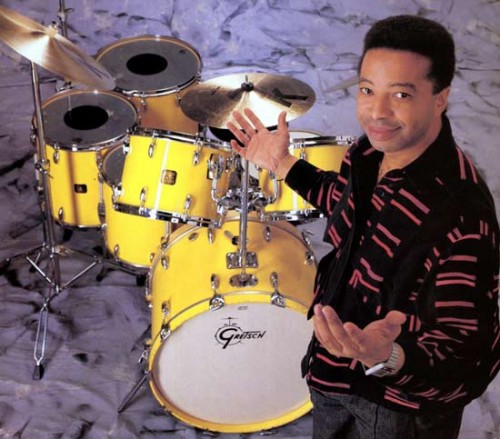
Tony Williams
The photo haunts me as if I’m seeing a close friend, an inspiration, dead in an open coffin. I think of my lifelong conflict with drummers putting so much emphasis on drum equipment. As if the nub of great drumming and drummers is made of wood, brass, or chrome.
I like drum equipment. Especially well-made, beautifully designed, great sounding drum equipment. And I confess to buying my Gretsch drumset because I liked how Gretsch drums sounded when my drum heroes played them.
But back when I was interviewing drummers for a living, I stopped asking equipment questions unless a drummer’s set included something unique. Bill Bruford‘s Simmons drums, for example. I was, and am, more interested in what makes drummers tick.
As Pamodhi Kuruppu said: “[O]ne drummer‘s style cannot be followed by another. It’s always different. Above everything when the drummer dies, the drum dies too.”
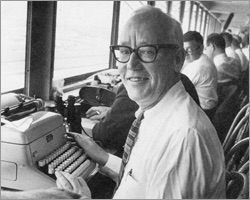
Red Smith
That is true of every tool used by great communicators of all types. No one will ever sit at Red Smith’s typewriter and write sports columns as Red Smith.
Tony Williams’s yellow Gretsch drumset is a tool through which Tony communicated to world. What’s gone is the spark, that life force that went from Tony, through his drumset and cymbals, to the world.
No one will ever again play this drumset and be Tony Williams.
– end –


 Scott K Fish
You must be logged in to post a comment.